South Korea sees modest rise in births amid long-running population decline
South Korea has posted a modest rise in births after years of record-low fertility, though experts remain divided over the reasons. Officials and researchers say marriages, delayed pandemic births and policy support may all have contributed.

SEOUL: South Korea has recorded a modest increase in births after years of extremely low fertility, offering limited relief to a country grappling with a prolonged population decline.
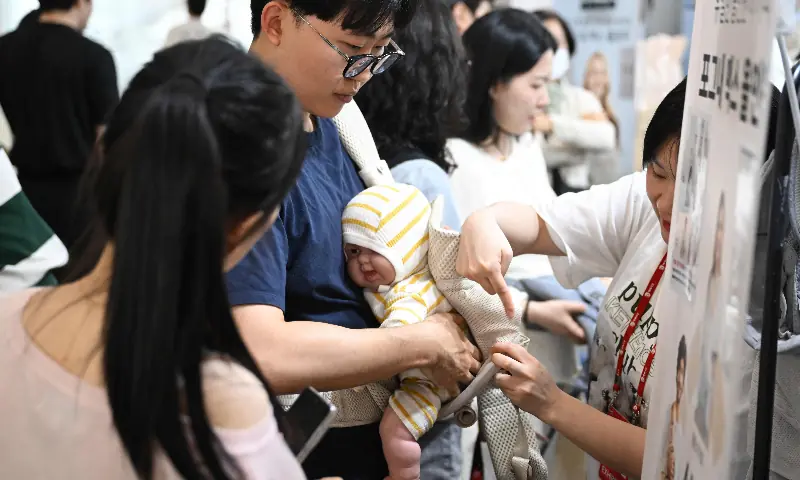
The shift comes as some couples choose to have children despite persistent concerns over living costs, housing, education and job security. Kim Su-jin, a 32-year-old freelance worker in the music industry, gave birth to her daughter in January last year after previously worrying about finances during her four-year marriage. She said she and her husband moved past concerns over housing, schooling and work “because we believed that having (a baby) would bring us happiness”.
South Korea has one of the lowest birth rates in the world, and authorities have spent billions of dollars on measures aimed at encouraging childbirth and reducing the effects of a shrinking population. While the country remains far from reversing the broader trend, official data shows a recent rise in monthly births compared with the same period a year earlier.
Nearly 23,000 babies were born in February, the highest figure for that month in seven years. The year-on-year increase of 13.6 per cent was the largest for any February since records began in 1981.
Marriages and policy support
Official figures also show that the increase in births has followed a rise in marriages since mid-2022, although that trend has been less steady. Experts said younger South Koreans may be showing more positive attitudes toward family life, but they differed over what is driving the change and how much credit should go to government support programmes.
Hong Sok-chul, an economics professor at Seoul National University, said the policies had been “quite effective”. He said, “Rather than trying to force marriage or childbirth … the government focused on lowering the direct and indirect costs to make these choices more rational,”
Kim Woo-jin, a 33-year-old office worker, said state assistance had eased the cost of pregnancy, childbirth and raising a child. She said vouchers had “played a significant role in alleviating the financial burden” and pointed to a payment of two million won ($1,400) when her daughter was born last year, a one-million-won voucher for maternity expenses, and subsidies for transport and post-natal care. “I believe that the significant improvements (in state support) … played a role in the recent rebound” in births, the office worker said.
South Korea also provides parents with a one-million-won monthly allowance during a baby’s first year. Other measures include low-interest home loans for young families, broader parental leave and subsidised fertility treatment. Some companies also offer large bonuses to employees who have children.
Experts differ on causes
Not all parents believe the incentives are enough. Kim Su-jin said government support “in reality … provides little substantial assistance”. She added, “The issue is not merely a matter of a few million won,” while pointing to high private tutoring costs, school bullying and the risk of job losses linked to artificial intelligence.
Lee Sang-lim, a demographer at Seoul National University, said it was “very difficult” to conclude that the latest government measures had caused the rise in births, noting that several initiatives only started in early 2024, less than nine months before the increase became visible. He said more than a decade of fertility-related policies may, however, have helped improve conditions for childbirth and child-rearing.
South Korea’s total fertility rate, which measures the average number of children a woman is expected to have in her lifetime, rose from 0.75 to 0.8 last year. That remains far below the 2.1 level generally needed to maintain a stable population.
Park Hyun-jung, a data ministry official, said in February that part of the increase reflected a demographic “echo” from a relatively large group born in the early 1990s who are now in their main childbearing years. Official figures also show that younger generations appear to attach less traditional stigma to having children outside marriage, with the number of such births nearly doubling between 2002 and 2024. Even so, births outside marriage made up only 5.8pc of all births in 2024.
Lee said the recent increase was driven mainly by marriages and births postponed during the pandemic, although he added that people born in the 1990s appeared “more family-oriented”. He said it was “difficult to define this as a demographic turning point” and warned that births could fall “rapidly” again once that age group moves beyond its peak childbearing years.
Hong also said “continued aggressive policy support will be necessary”, adding that “the current rebound, while positive, is still insufficient for long-term population replacement”.
Comments
No comments yet. Be the first to join the discussion!