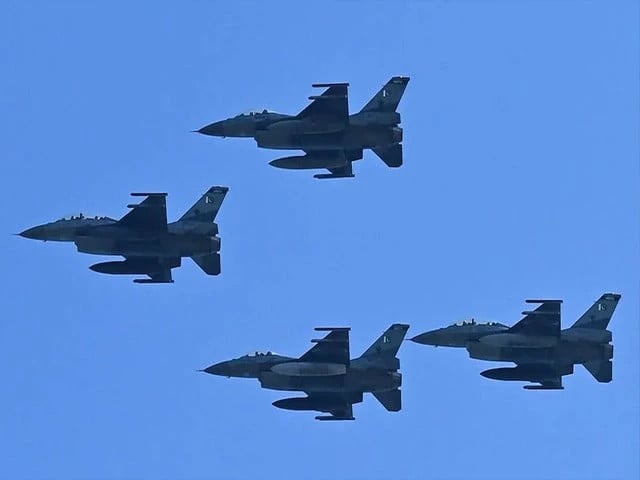
Pakistan highlights weapons and warfare systems used during Marka-i-Haq
A report has outlined the weapons and military technologies Pakistan used during last year’s conflict with India, including network-centric warfare, drones, J-10C jets and missile systems.

ISLAMABAD: Pakistan employed a range of weapons and military technologies during last year’s conflict with India, including network-linked warfare systems, drones, fighter aircraft and missile platforms, according to a report published by Dawn.
The two nuclear-armed neighbours fought a short but intense war a year ago, described as the most serious military confrontation between them in decades. During what Pakistan terms Marka-i-Haq, Indian fighter jets were shot down and Pakistan launched Operation Bunyanum Marsoos in response to missile strikes by New Delhi. The fighting ended with a ceasefire brokered by the United States.
Network-centric warfare
One of the key capabilities used by Pakistan in the early hours of May 7 was network-centric warfare, a doctrine based on sharing real-time information across multiple platforms, including fighter aircraft, airborne early warning systems and ground command centres.
Pakistan integrated Chinese and Western hardware into a unified structure using indigenously developed software. Intelligence was shared in real time among ground assets, fighter jets and support aircraft, enabling the detection of incoming Indian aircraft on the first night of the conflict and helping establish a kill chain.
The same system also enabled beyond visual range engagements, allowing aircraft to be targeted from more than 100 kilometres away. This contributed to the downing of at least six Indian fighter jets, including French-made Dassault Rafales.
Brigadier (retd) Masood Ahmed told Dawn that the use of real-time data sharing enabled Pakistan Air Force pilots to “see” Indian aircraft from beyond visual range, and they “laid an ambush” for incoming Indian Air Force jets.
Drones and unmanned systems
Unmanned aerial systems were used extensively by both sides during the conflict. Citing a report issued by the Institute of Strategic Studies Islamabad last August, drones were used for surveillance, cross-border strikes and infrastructure targeting.
“Drones played a major role in surveillance, cross-border strikes, and even targeting infrastructure,” it says.
Pakistan used aerial platforms for both strikes and surveillance, as well as loitering munitions during Operation Bunyanum Marsoos. In response to Indian drone and missile strikes on the night of May 9, Pakistan targeted 36 military sites inside India in the early hours of May 10, including Udhampur, Jammu and Pathankot.
The report identified the systems used as the YIHA III loitering munition, Asisguard Songar quadcopter, and China’s CH-4 and Wing Loong II medium-range long-endurance platforms.
It also cited the Irregular Warfare Initiative as saying Pakistan’s drone architecture is “based on a mix of homegrown development, partnerships with Turkey and China, and adaptability”.
“Operationally, drones were employed to test radar coverage, identify gaps in low-altitude air-defence networks, and conduct stand-off targeting of logistics nodes and forward facilities,” the Initiative outlines.
“Unlike earlier crises, drones were not confined to surveillance or cross-border nuisance activity; they were integrated into signalling strategies intended to demonstrate resolve while avoiding immediate escalation to manned airpower.”
J-10C and PL-15 missile
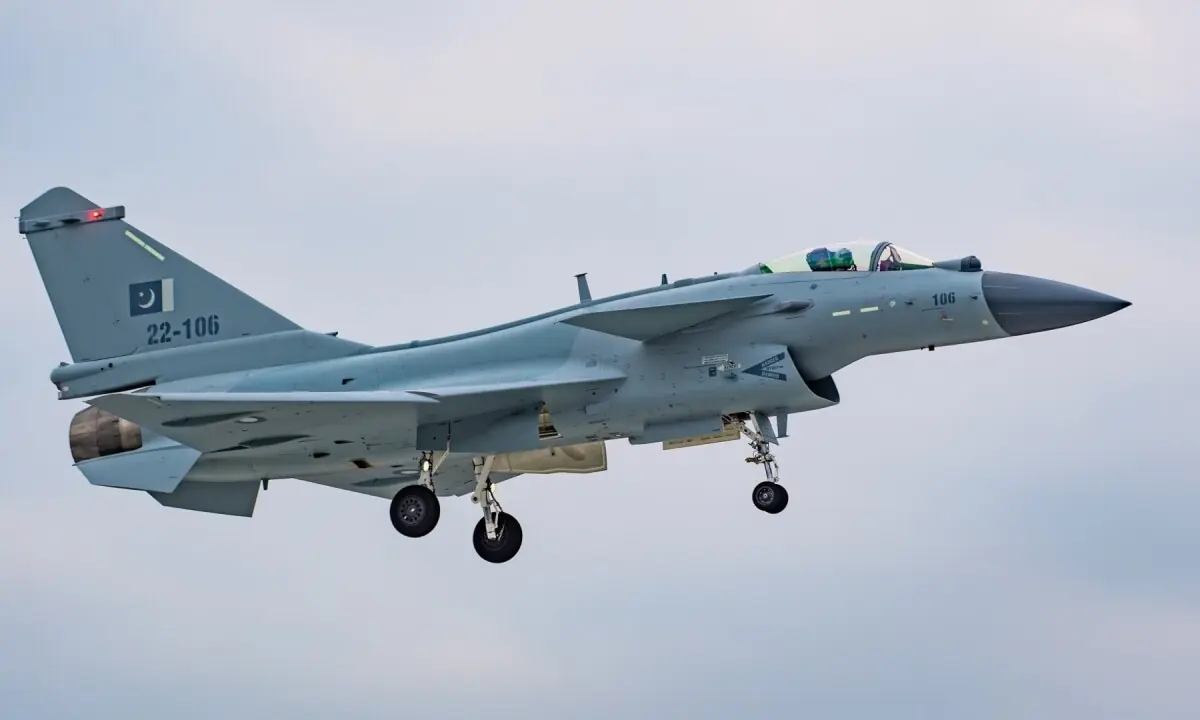
The Chinese-made Chengdu J-10C, a single-engine fourth-generation multirole combat aircraft with a top speed of Mach 1.8, played a central role on the first night of hostilities. The aircraft shot down six Indian Air Force Rafale jets.
Speaking at the procurement ceremony in 2022, PAF Air Chief Marshal Zaheer Ahmed Babar said of the jet: “The J-10C has a fully integrated weapons, avionics and electronic warfare suite that makes it a potent combat system under the contemporary environment of non-contact warfare.”
The J-10C launched PL-15 air-to-air missiles during the opening air battle. It described the PL-15 as a Chinese beyond visual range missile with a speed of Mach 5 and a range of 200 to 300 kilometres. Experts believe this was the first combat use of the PL-15.
Brigadier (retd) Ahmed said that, through data sharing between the Pakistan Air Force and ground-based assets, the missiles were able to track and hit targets across the border.
Fatah and CM-400AKG missiles
The indigenous Fatah guided multiple launch rocket system was also used during Operation Bunyanum Marsoos against Indian military targets. The launcher can fire guided rockets and missiles of different calibres and ranges, while the Fatah-II missile has a range of 400 kilometres, according to defence outlet Jane’s.
“They were used because of their precision and, at the same time, because of their mobility. They were very quick to deploy, so that was one of the advantages,” Brig (retd) Ahmed explained, adding that the system was also integrated into the Pakistan Army’s networks as part of network-centric warfare.
Pakistan used the Chinese CM-400AKG, an air-launched supersonic anti-ship missile that can also be employed against ground targets. The missile has a speed of Mach 4.5-5 and a range of 400 kilometres.
The missile was used during Operation Bunyanum Marsoos to destroy Indian S-400 air defence systems. It added, citing the South China Morning Post, that this was the first combat use of the system.
Comments
No comments yet. Be the first to join the discussion!