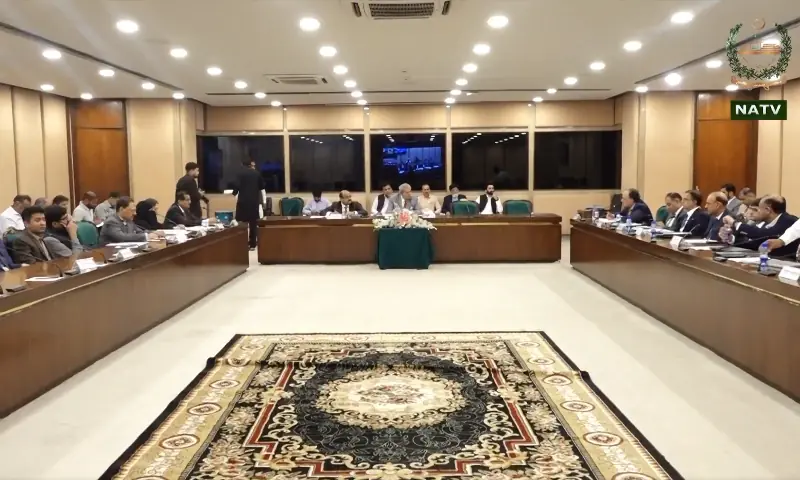
NA panel defers bill on banks’ powers to take over mortgaged properties
The National Assembly finance panel has deferred a bill that would expand banks’ powers over mortgaged properties after borrower default. Lawmakers also raised concerns over fiscal space for the government’s 500,000-home financing plan.

ISLAMABAD: The National Assembly Standing Committee on Finance on Thursday postponed approval of the Financial Institutions Recovery of Finances Amendment Bill 2026, a proposed law that would allow banks to move against mortgaged property after a series of default notices and limit borrowers’ ability to obtain relief from banking courts before satisfying the financial institution.
The bill was brought forward to address concerns raised by banks and was linked to the government’s plan to expand housing finance under Prime Minister Shehbaz Sharif’s scheme for 500,000 homes over four years. However, committee members did not approve it immediately, even after a proposed change that would extend the period before a bank could take over a property from 42 days to 90 days.
MNA Jawed Hanif objected to the proposed legislation, saying it would take away property rights, fundamental rights and due process from borrowers. The committee was also told that there was confusion over the draft because some changes had been made after the bill was introduced in the National Assembly in January this year.
According to the law ministry’s briefing, a bank’s right to take possession of a property would not be restricted even if the borrower approached a banking court. Under the bill, a financial institution may issue a first notice after a mortgage default, requiring payment within not less than 14 days. If payment is not made, a second notice may be served for another period of not less than 14 days. If the borrower still fails to pay, a final notice of 14 days may be issued, bringing the total period to 42 days.
The proposed law says that after the third default notice, the financial institution may proceed to sell the property. Committee members were told that the bank could sell the property even before getting it vacated. After the sale, the institution would be able to seek eviction through the district administration.
Clause 13 of the bill states that a banking court shall not grant an injection to restrain any sale or proposed sale of mortgaged property, until and unless the financial institution is put on notice and is heard, and the banking court is satisfied that no mortgage in respect of the immovable property has been created. The proposal also gives protection to banks by stating that no suit, prosecution or other legal proceedings shall lie against any financial institution or any of its officers or managers exercising any of the rights of the financial institution for anything done or to be done in good faith under the ordinance.
Standing Committee Chairman Syed Naveed Qamar said the government had proposed a couple of amendments, including increasing the period to 90 days and allowing borrowers to reschedule and restructure debt during the notice period. "We have to balance the interest of financial institutions and clients to promote housing finance and for that we have to address some of the concerns of banks," said Qamar.
The committee was informed that the bill was intended to provide a legal framework for recovery of funds by financial institutions, including enforcement of mortgage rights.
Housing finance targets and fiscal concerns
Housing Secretary Captain (Retd) Mohammad Mehmood told the committee that the government’s plan to provide 500,000 housing loans over four years was overambitious. He said 100,000 loans were planned for the next fiscal year and would require a subsidy of Rs72 billion.
He further said that financing 500,000 housing units would involve an estimated Rs3.2 trillion in interest subsidy and risk-sharing cost, which would pose a major challenge for the financial sector given its current scale and capacity.
Naveed Qamar questioned why a target of 500,000 units had been set when there was no fiscal space for subsidies.
Finance Secretary Imdadullah Bosal, however, said fiscal space was limited and that other subsidy schemes, including the Public Sector Development Programme, might have to be reviewed to make room for the housing initiative. "There will be trade-offs and we will give funds for the PM’s housing scheme," he said.
The committee was told that 25,304 applications had so far been received for housing loans, of which about 9,000 had been approved. Banks approved Rs37.1 billion in financing, but only Rs5.1 billion had been disbursed in 1,845 cases. MNA Sharmila Faruqi said banks had rejected 2,613 cases, indicating a high rejection rate.
The housing secretary said applicants were being asked to submit 27 documents, which was slowing approvals. He added that the government was planning a pilot project in Punjab under which borrowers would need to provide only one document.
Captain Mehmood said that since Pakistan’s creation, only Rs246 billion in housing loans had been extended to 64,836 clients, and added that the main reason was the lack of protection available to commercial banks.
Comments
No comments yet. Be the first to join the discussion!