Senate panel reviews conviction rates, justice gaps, gender inequality
A Senate panel reviewed conviction rates in human rights-related cases and raised concerns over delays in justice, security failures and gender inequality. Lawmakers also discussed the Jaranwala attacks and Pakistan’s low ranking on the Global Gender Gap Index.

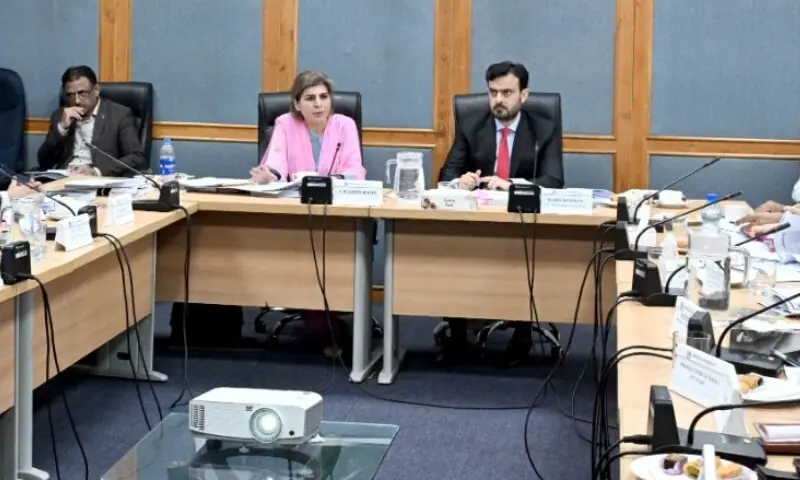
ISLAMABAD: The Senate Standing Committee on Human Rights on Thursday examined conviction trends in human rights-related cases across provinces, alongside wider concerns over justice delivery, security lapses and gender disparity in Pakistan.
The meeting, chaired by Senator Samina Zehri, was briefed by the human rights secretary, who stated that the overall conviction rate stood at 4 per cent in 2020, with officials claiming some improvement from 2021 onwards.
Provincial breakdowns of rape conviction rates were also presented before the committee. Sindh recorded a 22 per cent conviction rate, followed by Balochistan at 12 per cent, Islamabad at 6.9 per cent, and Khyber-Pakhtunkhwa at 6 per cent. Punjab reported the lowest rate at 4 per cent.
Lawmakers raised concerns over persistent delays in the justice system and institutional inefficiencies. Senator Khalil Tahir questioned the logic of lengthy trials, asking why justice could not be delivered within 24 hours when crimes can occur in seconds.
The committee chairperson remarked on societal desensitisation to violence, stating that “humanity has died” and criticising the tendency to discuss such incidents informally without meaningful follow-up. She also referred to a case involving a bus conductor allegedly linked to the rape of a woman in Punjab.
Senator Abid Sher Ali questioned inconsistencies in the application of legal provisions, stating that in some instances the Anti-Terrorism Act is invoked against civilians for minor offences involving security personnel, while in other severe incidents involving large-scale firing on individuals, similar provisions are not applied.
He added that even courts sometimes contribute to perceived injustice by granting bail in such cases, arguing that influential groups often receive preferential treatment.
Responding to queries, the Punjab prosecutor general stated that anti-terror provisions are applied in cases involving attacks on uniformed personnel.
The committee also discussed the Jaranwala attacks on Christian community, strongly condemning the violence against churches and the minority community, and calling for stronger action against religious extremism.
Senator Abid Sher Ali urged efforts to curb extremism, while Senator Aimal Wali Khan criticised the policing system, describing law enforcement institutions as deeply compromised. He also said accountability should apply across institutions without exception.
“If a judge is corrupt or takes bribes, we will speak against it,” he said, adding that no one should be above scrutiny.
The human rights secretary also briefed the committee on gender disparity indicators, noting that Pakistan ranked last among 148 countries in the Global Gender Gap Index. He said approximately 26 million children remain out of school, with higher dropout rates among girls after primary education.
He further informed the committee that women’s representation in the civil service had improved to around 44–47 per cent in recent years, while representation in the federal cabinet remains limited. He also highlighted regulatory requirements mandating at least one female member on corporate boards.
Comments
No comments yet. Be the first to join the discussion!