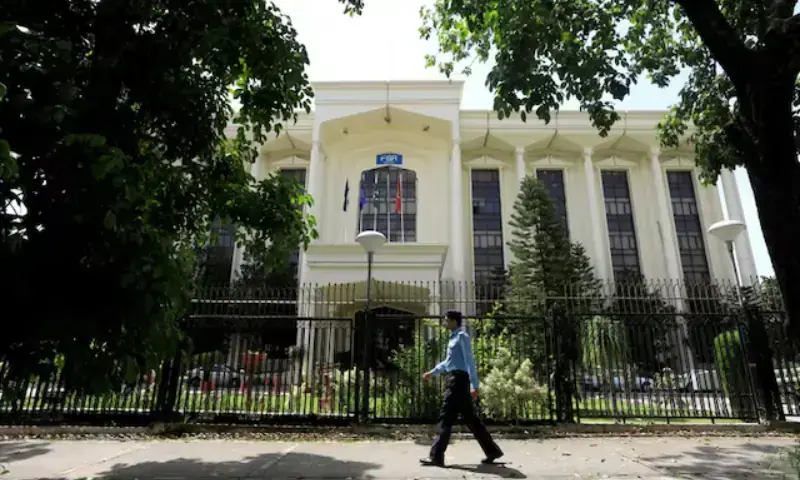
FBR shortfall raises questions over budget revenue targets
Business representatives have questioned the government’s next revenue target after the FBR posted a shortfall of over Rs600 billion. They urged the upcoming budget to reflect economic realities and focus on structural reforms.

ISLAMABAD: A widening tax collection gap at the Federal Board of Revenue (FBR) has prompted concern from members of the business community, who say the upcoming Finance Bill should be based on economic conditions on the ground rather than optimistic assumptions.
Speaking on Monday, Mudassir Masood Chaudhry, a former executive committee member of the Lahore Chamber of Commerce and Industry, said the budget should be framed around practical realities. He said, Budget document should not be given a cosmetic makeover, it must reflect ground realities so that tangible results can be achieved.
Chaudhry said economic policymaking should rest on realistic and sustainable footing. He linked his concerns to current revenue figures, noting that the FBR’s tax collection in fiscal year 2025-26 has already posted a shortfall of more than Rs600 billion. He also pointed to revenue growth of 6% in March, saying the pace remained weak as the fiscal year moved into its final quarter.
According to Chaudhry, if the current trend continues, the shortfall could widen to Rs900 billion by the close of the fiscal year, leaving actual FBR revenues at around Rs13,080 billion, below the original goal.
The government has fixed the FBR revenue target for fiscal year 2026-27 at Rs15,564 billion. That would require 19% growth over a base that is itself expected to miss target. If achieved, the tax-to-GDP ratio would rise by about 1.1 percentage points. Chaudhry said the key issue for budget planners was whether such a target could be met.
Business community calls for structural reforms
Alongside revenue concerns, Chaudhry outlined a broader reform agenda that he said was necessary for durable economic growth. He called for incentives and facilitation for industry to help increase exports, arguing that Pakistani manufacturers could not compete in international markets without competitive energy pricing.
He also urged reforms in the power and gas sectors to lower the cost of doing business, an issue he said had remained central in chamber discussions for years. On taxation, he said expanding the tax base and bringing undocumented economic activity into the formal system should be among the government’s main priorities. He also called for modernisation of agriculture through access to new technology and targeted subsidies.
Other business figures also argued that revenue and growth targets should be set in line with domestic economic realities rather than framed to satisfy international lenders.
Ahmad Raza, a textile exporter, said, "When you set a revenue target that requires 19% growth while the economy is growing at a fraction of that pace, you are not planning a budget; you are writing fiction."
Members of the business community said they recognised the need for fiscal consolidation, particularly in view of Pakistan’s commitments under its ongoing IMF programme. However, they argued that consolidation based on overstated revenue expectations eventually creates further problems, including mid-year disruptions, mini-budgets and a loss of policy credibility.
Raza added, Numbers that look good on paper but ignore the economy on the ground carry a cost and that cost, as Pakistan has learnt repeatedly, is paid long after the budget speech ends.
Comments
No comments yet. Be the first to join the discussion!