

Cow dung biogas gains attention in India amid LPG supply delays
Biogas made from cow dung is drawing renewed interest in parts of India as LPG supply delays trigger long queues for cylinders. Farmers say the systems provide cooking fuel and fertiliser, though cost and space remain hurdles.

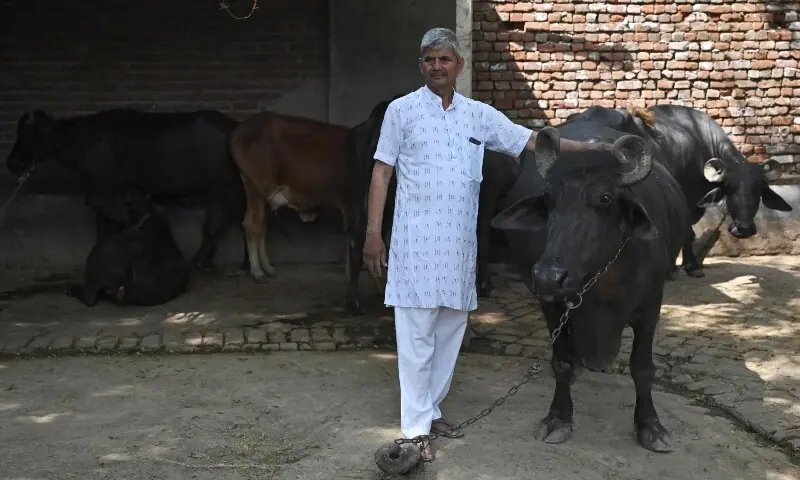
NEW DELHI: An energy squeeze in India linked to the Iran war has led to long lines for cooking gas cylinders in many areas, while some rural households using biogas made from cow dung have been less affected.
In Nekpur, a village in Uttar Pradesh about 90 kilometres from New Delhi, 25-year-old Gauri Devi cooks on a stove fuelled by methane generated from cow dung.
"It cooks everything", she said.
If the pressure goes down, we let it rest for half an hour and it works again.
India uses more than 30 million tonnes of liquefied petroleum gas each year and imports over half of its requirement. The government has said there is no shortage of cooking gas, but delays in supply, panic buying and black market activity have resulted in long queues for cylinders.
India has promoted biogas in rural areas since the 1980s as a relatively inexpensive energy source. More than five million digester units have been subsidised by the government to turn farm waste into methane for cooking and slurry rich in nitrogen for use as fertiliser.
For households such as Gauri Devi’s, the process involves mixing a few buckets of dung with water and feeding the mixture into an underground tank roughly the size of a car, fitted with a storage balloon. The system provides a regular piped gas supply, meaning she turns to LPG only in emergencies or when hosting larger gatherings. She said the biogas is used for "vegetables, tea, lentils".
Fertiliser benefit adds to appeal
The leftover slurry from the plant is later applied to fields. Farmers say it offers better nitrogen availability for crops than untreated dung.
Farmer Pramod Singh, who installed a larger unit in 2025 for a six-member household, said it is fed by 30-45 kilogrammes of dung each day from four cows. He said the slurry has become especially useful as global supplies of artificial fertilisers have been affected by trade disruptions caused by the war.
Local farmer leader Pritam Singh said the biggest advantage goes beyond fuel.
"The real benefit is not just the gas — that is like a bonus", he said.
More than 45 per cent of India’s 1.4 billion people depend on farming, and the country has one of the world’s largest cattle populations. India, which is the world’s most populous country and the third-largest fossil fuel polluter, has also been pushing larger-scale biogas production as part of its target to reach carbon neutrality by 2070.
Last year, the government made it mandatory for biogas to make up at least one per cent of liquid gas used for vehicles and domestic consumption, with that share set to rise to five per cent by 2028. Dozens of production plants worth millions of dollars are in the pipeline. At the same time, smaller rural units costing about INR25,000-30,000 ($265-$318) are also being introduced, often with substantial state support.
In India, where cows are revered by many in the Hindu-majority country and dung and urine are used for purposes ranging from floor plastering and fuel to ritual practices, Pritam Singh said it has not been difficult to persuade people. He installed his first plant in 2007 and said he had helped install 15 more in his village in the past year.
According to him, demand rose sharply after LPG shortages.
Cost and space remain obstacles
Even so, biogas still accounts for only a small share of household cooking fuel, with LPG seen as easier to use because companies handle the supply chain.
A.R. Shukla, president of the Indian Biogas Association, said household systems require more than simple installation.
"Biogas plants are not just equipment; they are mini factories", he said.
"They need organised installation, regular operation and maintenance", he added:
There are also practical barriers despite government backing, including the cost of setting up a unit and the need for space. Ramesh Kumar Singh, a labourer waiting in a queue of around 100 people for LPG cylinders in the nearby village of Madalpur, said many workers could not install such systems.
"We work on other people’s farms the whole day. We don’t have land for it", he said.
Mahendri, 77, who had been unable to obtain a cylinder for three consecutive days, described the hardship of waiting in the heat.
"I am standing in scorching heat, hungry and thirsty", she said.
Comments
No comments yet. Be the first to join the discussion!


