

April 30, 2026
Media freedoms in Pakistan declined sharply over the past year, says Freedom Network report
A Freedom Network report says media freedom in Pakistan deteriorated over the past year amid legal, regulatory and economic pressures. It documented 129 verified violations against journalists and described PECA as a key tool used to curb free expression.

April 30, 2026
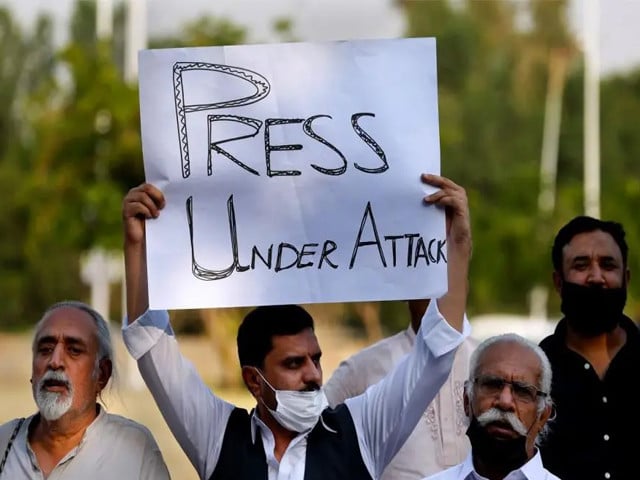
ISLAMABAD: Pakistan’s media environment saw a marked reduction in space for free expression over the past year due to mounting legal, regulatory and economic pressures, according to Freedom Network’s latest annual assessment of media freedom and journalists’ safety.
The report, titled Regulatory Repression of Freedom of Expression – Legal Controls and PECA Undermine Media and Journalism in Pakistan, was released to coincide with World Press Freedom Day, observed in Pakistan and globally on May 3 each year.
The amended Prevention of Electronic Crimes Act (PECA) has become the most consequential tool being used to curb journalists and others engaged in free expression. Freedom Network said the law, first introduced in 2016 to address cybercrime, was amended in 2025 and that those changes were increasingly used in 2025-26 to criminalise lawful expression, suppress dissent and intimidate journalists, lawyers and political commentators.
Freedom Network Executive Director Iqbal Khattak said the law’s use had deepened fear in the media sector. "The weaponization of PECA has created a climate of fear where journalists are compelled to self-censor to avoid legal repercussions. This represents one of the most serious threats to media freedom in Pakistan today," he added.
A press release issued by the organisation said the report cited the convictions of human rights lawyers Imaan Mazari and Hadi Ali Chattha as prominent examples of custodial sentences being used to discourage dissent. Dozens of journalists were booked under broadened PECA provisions, while defamation cases, regulatory suspensions and internet shutdowns also restricted independent reporting.
Legal framework and disinformation concerns
One of the report’s findings said that although right to information laws are in place, their enforcement remains uneven, with federal institutions described as especially reluctant to share information.
"Pakistan's broader legal and regulatory framework reinforced these challenges. Although Right to Information laws exist, their implementation remains inconsistent, with federal institutions particularly resistant to disclosure. The persistence of secrecy through outdated laws continues to weaken transparency and accountability," the report states.
Official efforts to tackle disinformation and hate speech have often gone hand in hand with greater surveillance and selective enforcement. Regulators overseeing online content and unclear definitions of fabricated news have made it harder to distinguish between misinformation and legitimate dissent.
Freedom Network said the dangers linked to disinformation were especially visible during the May 2025 India-Pakistan brief war, when altered visuals and old footage were widely shared across media platforms, affecting public understanding of events.
Violations against journalists
The report documented at least 129 verified cases of violations against journalists during the review period from April 2025 to March 2026. Legal intimidation and physical attacks made up nearly two-thirds of the total.
These incidents included two murders, five threats to murder, 58 legal cases — most of them involving PECA — 16 assaults, 11 threats to harm, and two cases of kidnapping and enforced disappearance.
Punjab and Khyber Pakhtunkhwa were identified as the most dangerous provinces for journalists, while killings in Sindh and Balochistan highlighted continuing risks in those provinces as well. State authorities were suspected to be the main perpetrators in more than 60 per cent of the violations, largely through legal and custodial measures. Non-state actors, including militant organisations and criminal groups, were also involved in threats, assaults and killings.
The report also referred to the detention of three female journalists in Islamabad in March 2026 when they were attempting to cover the Aurat March, saying the episode underscored the gender-specific nature of the threats faced by women in the profession.
Economic and gender pressures
Beyond legal and physical threats, journalists across the country were also dealing with delayed wages, insecure employment and dependence on government advertising, factors it said weakened editorial autonomy.
Women journalists remained particularly disadvantaged in the media industry. Harassment, online abuse and discrimination at work continued to create a difficult environment, while cases involving deepfake abuse and detentions further illustrated those problems.
Despite the overall deterioration, some positive developments, including leadership initiatives and the appointment of Ambreen Jan as the first woman to head the Pakistan Electronic Media Regulatory Authority.
It also reviewed the growing role of technology in journalism in Pakistan. While the use of artificial intelligence remains limited because of infrastructure and language constraints, concerns persist over misinformation and insufficient oversight. At the same time, some initiatives suggest early movement toward more responsible use of technology in media work.
The report concluded that the combined effect of these developments has significantly reduced the space for free expression in Pakistan, leaving journalists, citizens and rights defenders working in an increasingly restrictive setting. It called for urgent reforms, including a review of restrictive PECA provisions, stronger implementation of journalist safety laws, and better enforcement of right to information frameworks. It also urged legal and institutional support for journalists and ethical use of emerging technologies.
0 Comments
No comments yet. Be the first to join the discussion!


