April 30, 2026
EIB signals interest in Reko Diq project
The European Investment Bank has shown interest in infrastructure investment for Reko Diq while seeking access to part of the project’s mineral output. Pakistani officials also said tax issues during development are being discussed, as Barrick Gold slows activity over security concerns.

April 30, 2026
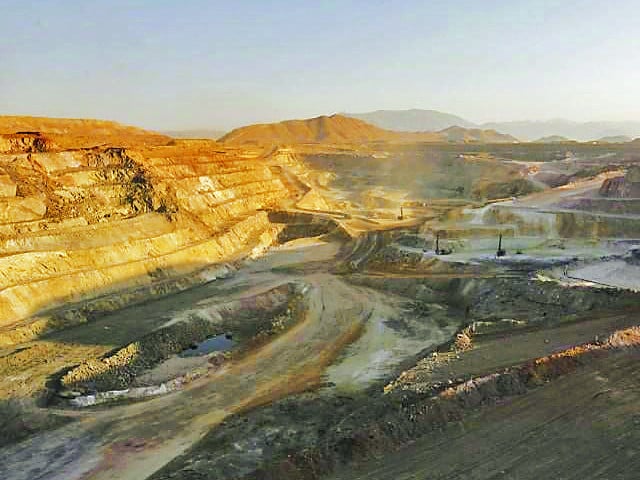
ISLAMABAD: The European Investment Bank (EIB) has expressed interest in supporting infrastructure linked to the multibillion-dollar Reko Diq mining project, while indicating that Europe would want access to part of the project’s critical mineral output.
The development came as Dr Nawaz Ahmed Virk, Director General of Minerals at the Ministry of Energy, said claims that Pakistan holds $6 trillion worth of mineral reserves were overstated. Speaking at a session on mining and responsible resource partnerships for Europe and Pakistan on the second day of the EU-Pakistan Business Forum, Virk said, ‘The $6 trillion is a highly exaggerated figure, which is not based on proper exploration studies but we have vast minerals.’
Pakistan’s leadership has presented the $6 trillion estimate as a possible long-term answer to the country’s debt and wider economic challenges.
Virk also said contractors involved in the Reko Diq project had raised concerns over the application of sales tax and withholding tax during the development stage. He said Pakistan had already exempted the project’s income from all taxes in an effort to make it more attractive to foreign investors.
He added that the Ministry of Energy was in discussions with the Finance Division on the issues of general sales tax and withholding tax, and said he was hopeful the Finance Division would agree to defer those taxes until production starts.
European interest in minerals and infrastructure
Marco Arena, an EIB official, said the bank was interested in investing in enabling infrastructure for the Reko Diq mines. At the same time, he said the European Union should receive a share of supplies from the project.
Arena said, ‘Of course, we don't expect that the entire off?take goes to Europe, that's unthinkable in an interconnected world. But having a strong connection to the European market is key, and the European Investment Bank supports critical minerals, which would enable Europe to secure critical mineral supplies for their green transition and digital transition, which are ultimately very important for European competitiveness.’
The EIB recently signed agreements worth €160 million with Pakistan for water and housing schemes, marking its first such arrangements in more than a decade. Arena said the bank had a longstanding relationship with Pakistan, although there had been a pause since 2015.
‘There is a real interest in this region, from the European Commission and the EIB, to engage with Pakistan, including in the mineral sector,’ he said.
He further said that while engineering challenges in mining were manageable, the larger risks often related to policy, regulation and stability. Arena said predictable regulation, contract enforceability and currency risk management were important for project success. He added that experience from mining and critical materials projects around the world showed that when such risks were addressed in practice rather than only on paper, projects were more likely to succeed.
Barrick slows project activity
Barrick Gold, despite the project’s importance for Pakistan, paused implementation of the Reko Diq project earlier this month.
In a statement issued earlier this month, Barrick Gold said that on February 5, 2026, it had announced a review of all aspects of the project because of worsening security risks and an increase in security incidents.
The company said, ‘Following the preliminary findings of the review and the further escalation of security issues in Pakistan and the region, the company considers it necessary to slow the development activity and continue the project review until mid 2027.’
Barrick said the ongoing review would allow it to comprehensively assess the changing security environment, capital requirements, project financing, project scope and the project timeline. While development work would continue at a slower pace, the project would remain under active management with reduced capital spending.
According to the company, development of Phase 1 had been approved on that basis. Barrick also said there could be substantial increases in the previously disclosed capital budget and timeline.
The previously disclosed estimated capital cost for Phase 1 was between $5.6 billion and $6 billion, excluding capitalised financing costs. The estimated cost of the second phase was between $3.3 billion and $3.6 billion, also excluding capitalised financing costs, with first production targeted by the end of 2028.
Reko Diq, described in the report as one of the world’s largest undeveloped copper-gold projects, is owned 50% by Barrick, 25% by three federal state-owned enterprises, and 25% by the government of Balochistan.
0 Comments
No comments yet. Be the first to join the discussion!