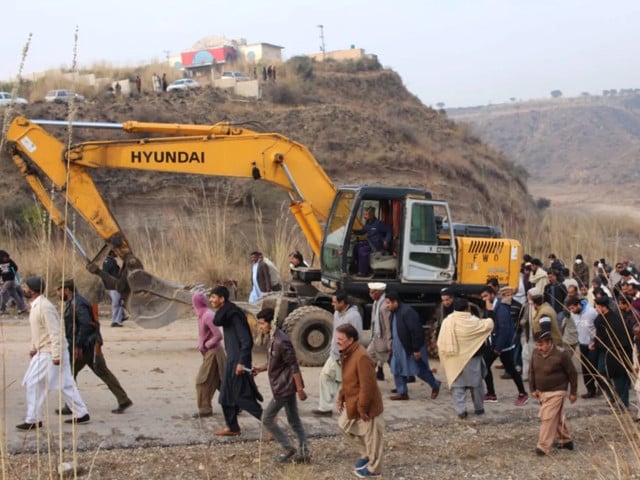
Taunsa Barrage settlement demolition sparks dispute over land rights, resettlement
A demolition drive at Taunsa Barrage has displaced residents of Basti Shaikhan, including Mohana boatpeople, prompting a legal challenge and renewed debate over land rights and resettlement.

MULTAN: A demolition operation at Taunsa Barrage near Kot Addu has triggered a dispute over land rights, resettlement and the treatment of a long-settled fishing community living along the Indus.
According to a report by Dawn, around 150 armed police personnel arrived in January with two bulldozers to clear a settlement spread over 47 kanal of government land. Many of the affected homes belonged to the Mohanas, the Indus boatpeople, whose locality is known as Basti Shaikhan. An official map marked the settlement for demolition and also identified the site as proposed for a Circuit House.
The operation was carried out by the Punjab Enforcement and Regulatory Authority (Pera) with the assistance of Deputy Commissioner Bilal Saleem. However, residents who say they have lived there for generations dispute the official position that they are encroachers. Pera Director-General for Monitoring and Implementation Ahmed Zaheer said the authority issues encroachers a digital Emergency Prohibition Order, but activist Fazl-e-Rab said residents of the basti were unaware that bulldozers were about to arrive.
Fazl-e-Rab also questioned how the settlement could be treated as an encroachment when the government had provided electricity, schools and drainage there, which he described as evidence that the state recognised it as a settlement. Deputy Commissioner Bilal Saleem said the government also plans to construct a cluster of buildings for an IRSA Flood Monitoring system at the site.
Khadim Khar Hussain of the Sindhu Bachao Tehreek, whose own home was also destroyed, said the boatpeople were now transporting construction material for projects being built on land from which they had been removed. He also said the displaced community supplies fish to the fisheries sector and generates an estimated Rs10 million in revenue.
History of the settlement and barrage works
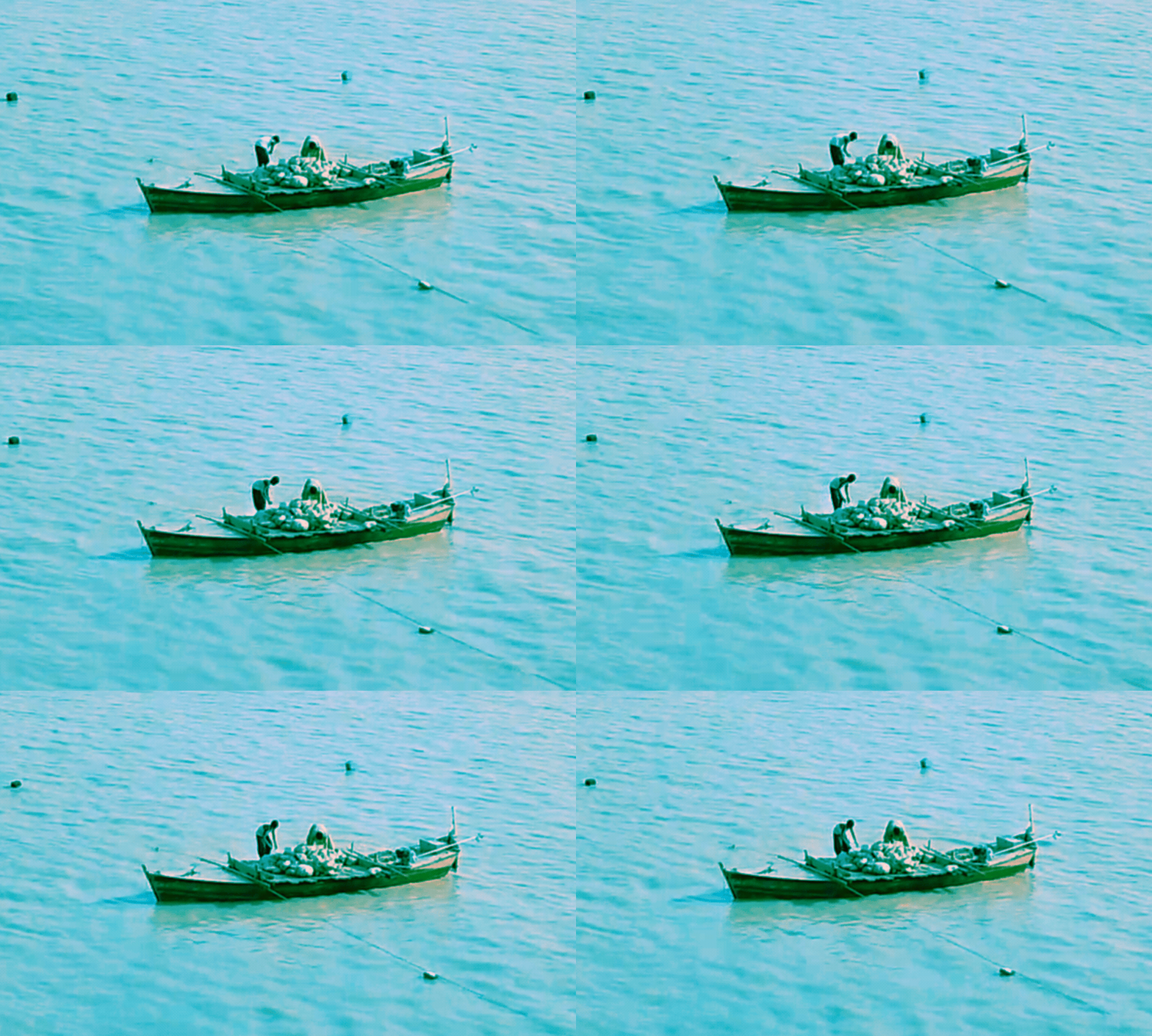
The Mohanas historically lived on boats and came ashore mainly to bury their dead. Over time, they shifted to land but retained a clustered style of settlement shaped by life on the river. Their homes were built on relatively safer and flatter ground near the Indus, with courtyards opening into one another and narrow lanes running through the locality.
Taunsa Barrage was built after Independence on the Indus to supply water to farmers in Punjab and Balochistan. The structure, unveiled in 1958, was expected to last 50 years, but the system began showing signs of deterioration early on. By 2003, the barrage faced the risk of immediate failure, raising fears that water supplies for millions could be disrupted. A weir was then built as an emergency measure to protect the main structure.
World Bank documents available on its website state that planners in 2005 did not initially account for the displacement of fisherfolk during rehabilitation work at the barrage. According to Asad Farooq of the Alternative Law Collective, the families were later moved 2,000 feet away in the first phase of evictions. He said they were allowed to remain near the river but were not given legal rights over the land.
Evicted resident Muhammad Shareef has filed a petition against Pera, and the matter is currently being heard. The government’s plans for a Circuit House have, for now, been put on hold.
Pera operations across Punjab
The demolition at Basti Shaikhan comes amid wider anti-encroachment operations led by Pera under Chief Minister Maryam Nawaz’s Saaf Suthra Punjab initiative. The campaign is aimed at improving urban cleanliness and appearance through coordinated municipal action targeting waste and informal structures.
Encroachment drives intensified after Pera was launched in July 2025. Maryam Nawaz had announced that complete operations across Punjab would be implemented by December to usher in a “new era” of implementation of the law through Pera. The authority was established under the Punjab Enforcement and Regulation Act, 2024, which was passed in October last year and gave the provincial government broad powers to remove encroachments from public property across Punjab.
Before that law, anti-encroachment work was handled by municipal committees and union councils, and most matters were resolved amicably. According to the figures cited in the report, Pera has so far carried out 232,194 raids across Punjab, including 55,562 in Lahore. The authority says it recovered 7,790.33 kanal of land worth Rs13,237,422,578 in 532 raids.
The report also referred to a March operation in Murree, where Pera demolished structures along Mall Road to clear 20 kanal for a theme park. One of the buildings razed was the colonial-era Habib Bank Limited building, which architect Fauzia Qureishi said had been conserved by the Urban Unit in 2016. In August last year, Pera also carried out an operation in Chelianwala, Mandi Bahauddin, after the village was selected as a model village under Saaf Suthra Punjab. Villagers who resisted were arrested.
Comments
No comments yet. Be the first to join the discussion!