Pakistan says India has yet to provide evidence on Pahalgam attack after one year
Pakistan said India has not provided credible evidence for its allegations over the Pahalgam attack one year after the incident. Information Minister Attaullah Tarar also said New Delhi had avoided an independent investigation.

ISLAMABAD: Pakistan on Wednesday said India had still not produced credible evidence for its allegations against Islamabad over the Pahalgam attack, as the first anniversary of the incident was marked.
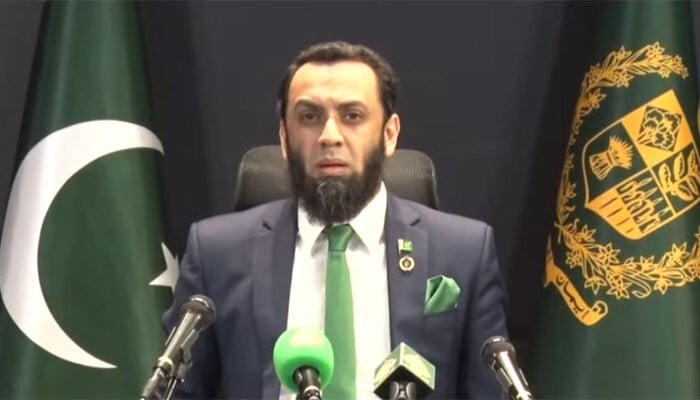
In a special televised statement, Information Minister Attaullah Tarar criticised New Delhi for not substantiating its claims and said India had also avoided calls for an independent investigation into what he described as a false flag operation.
The attack on tourists in Pahalgam, in Indian Illegally Occupied Jammu and Kashmir, killed 26 people. India accused Pakistan of being behind the attack without presenting evidence, an allegation Islamabad denied while also calling for a neutral inquiry.
The two countries later went to war in May last year after India launched an unprovoked attack on Pakistan following the Pahalgam incident. India then carried out missile strikes inside Pakistan, resulting in the martyrdom of several civilians and security personnel.
Pakistan responded by downing seven Indian fighter jets, including three Rafale aircraft, as well as dozens of drones, and destroying an S-400 defence system. The conflict between the two nuclear-armed neighbours ended on May 10 with a ceasefire brokered by the United States.
Tarar’s statement
Tarar said the Pahalgam incident reflected a mindset driven by "hollowness, illogical thinking, false pride, arrogance, and greed." He said India had consistently failed to address questions raised about the episode and had not provided satisfactory answers despite the passage of a year.
The minister said India continued to project its internal issues as external matters while portraying internationally recognised disputes as domestic issues. He said terrorism was an internal issue for India that it projected outwardly, while the dispute over IIOJK was an internationally recognised issue that India sought to present as internal.
He said India’s conduct over the Pahalgam incident had exposed its approach and described its handling of the matter as being in line with what he called historically known patterns of false flag operations. He added that India had used crude methods in dealing with the incident.
Tarar said Prime Minister Shehbaz Sharif had proposed an independent and impartial investigation into the Pahalgam incident, but India had sidestepped the offer and did not respond meaningfully. He said Pakistan’s position had remained clear, while India’s refusal to accept an inquiry raised further concerns about the nature of the incident.
He also pointed to the registration of an FIR within 10 minutes of the attack, calling it highly unusual given the distance between the site of the incident and the police station, and said this suggested prior preparation.
According to Tarar, international media, Indian civil society, politicians and think tanks had also raised serious questions about the incident. He said narratives built around false flag operations were difficult to sustain globally and added that India had not been able to present a convincing case or any credible evidence to support its claims.
The minister also criticised Indian media, saying it had created a war-like atmosphere and spread fabricated and baseless reports, and added that its credibility had been exposed internationally.
Broader allegations and security stance
Referring to wider issues, Tarar said minorities in India were being deprived of rights under the Hindutva ideology and that Muslims were facing violence. He further alleged that India used terrorism as a state policy and had been involved in such activities globally.
He cited incidents involving Sikh leaders abroad and the arrest of Kulbhushan Jadhav as examples that, he said, pointed to India’s involvement in such activities.
Tarar said Pakistan had concrete evidence of India’s involvement in terrorist activities inside the country and alleged that groups such as the BLA and TTP were being used to destabilise Pakistan. He said this evidence had been shared with the international community and global media on various occasions.
He also referred to attacks in Pakistan, including the Jaffar Express attack and the Khuzdar incident, saying they showed India’s involvement in destabilising activities in the country.
The minister said Pakistan remained fully committed to eliminating terrorism and that the nation stood united in that resolve. He said Pakistan would not compromise on its sovereignty, dignity and security and would continue taking all necessary steps to counter terrorism.
Tarar also said recent statements by Indian military leadership about a new operation reflected failure and defeat, adding that any misadventure would receive an immediate and decisive response.
Referring to Pakistan’s military campaign Marka-e-Haq, he said Pakistan had secured a decisive victory over India and continued to receive global recognition for its success, while India was facing growing isolation.
He added that under Prime Minister Shehbaz Sharif and Chief of Defence Forces and Chief of Army Staff Field Marshal Asim Munir, Pakistan was continuing its efforts for peace, with the civil and military leadership aligned on national defence. Tarar said Pakistan had emerged as a strong and united nation and prayed for continued peace, stability and prosperity.
Comments
No comments yet. Be the first to join the discussion!