Japan issues tsunami warning after 7.4-magnitude quake, records 80cm wave
Japan recorded an 80-centimetre tsunami wave at a port in Iwate after a 7.4-magnitude earthquake struck off northern Japan. Authorities issued warnings for waves of up to three metres and urged residents to evacuate to higher ground.

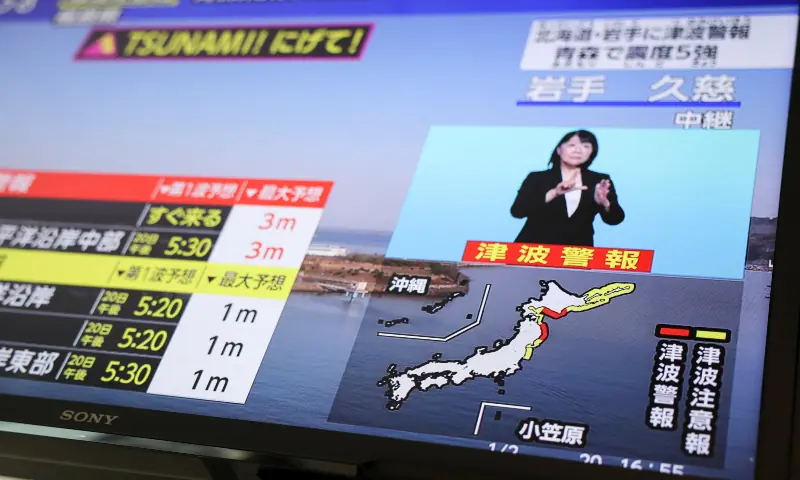
TOKYO: Japan recorded an 80-centimetre tsunami wave at a port in the country’s north on Monday after a powerful 7.4-magnitude earthquake struck off the region, according to the Japan Meteorological Agency (JMA).
The JMA said the wave was observed at 5:34pm local time at a port in Kuji, in Iwate prefecture. It had earlier reported that a 70-centimetre wave reached the same area at 5:32pm.
Earlier in the day, the agency said a magnitude-7.4 earthquake hit at 4:53pm in Pacific waters off northern Iwate prefecture. The tremor was strong enough to shake large buildings in Tokyo, which is located hundreds of kilometres from the epicentre.
Following the quake, the JMA issued a tsunami warning for waves of up to three metres and urged residents in affected areas to move to safety. In its warning, the agency said, “Evacuate immediately from coastal regions and riverside areas to a safer place such as high ground or an evacuation building,” adding that damage from tsunami waves was expected.
The agency also cautioned that, “Tsunami waves are expected to hit repeatedly. Do not leave safe ground until the warning is lifted.”
Footage aired by national broadcaster NHK did not show any immediate visible damage around several ports in Iwate.
Japan’s prime minister’s office said a crisis management team had been established in response to the earthquake and tsunami warning. Prime Minister Sanae Takaichi told reporters, “For those of you who live in areas for which the warnings have been issued, please evacuate to higher, safer places such as higher ground,” and said the government was working to determine whether there had been any casualties or damage to property.
Japan’s seismic risk
Japan is among the most earthquake-prone countries in the world. It lies atop four major tectonic plates on the western edge of the Pacific Ring of Fire. The country, which has a population of around 125 million, experiences about 1,500 earthquakes each year and accounts for roughly 18 per cent of earthquakes worldwide.
Most of these tremors are minor, though their impact depends on where they occur and how deep below the surface they originate.
The country continues to live with the legacy of the 2011 undersea earthquake, which measured magnitude 9.0 and triggered a tsunami that killed around 18,500 people. That disaster also led to a severe nuclear accident at the Fukushima plant.
In 2024, the JMA issued its first special advisory warning of a possible megaquake along the Nankai Trough, an 800-kilometre undersea trench where the Philippine Sea plate is gradually slipping beneath the continental plate under Japan. The government has said that a major earthquake in the Nankai Trough, followed by a tsunami, could result in as many as 298,000 deaths and cause damage of up to $2 trillion.
The JMA withdrew the 2024 advisory after one week, but it triggered panic-buying of basic goods such as rice and led some holidaymakers to cancel hotel bookings.
The agency issued a second week-long megaquake advisory in December 2025 after a magnitude-7.5 earthquake struck off the northern coast. The December 8 quake generated tsunami waves of up to 70 centimetres and injured more than 40 people, although no major damage was reported.
Comments
No comments yet. Be the first to join the discussion!