Raised Sargodha Road leaves nearby offices and homes facing drainage problems
Residents along Sargodha Road say the raised level of a new dual carriageway has left homes and public offices vulnerable to flooding. Officials gave differing accounts on whether NESPAK was involved in the project’s design.

FAISALABAD: A road expansion scheme on Sargodha Road has left dozens of public offices and private residential areas several feet below the new road level, creating drainage difficulties and adding to the financial burden on residents, according to local accounts.
Residents said the Communications and Works Department approved an Rs11 billion project in the 2023-24 fiscal year to turn Sargodha Road into a dual carriageway from Chak No. 3 JB bypass to District Chiniot. Of the total route, around 18 kilometres fall within Chiniot district, while about four and a half kilometres are in Faisalabad.
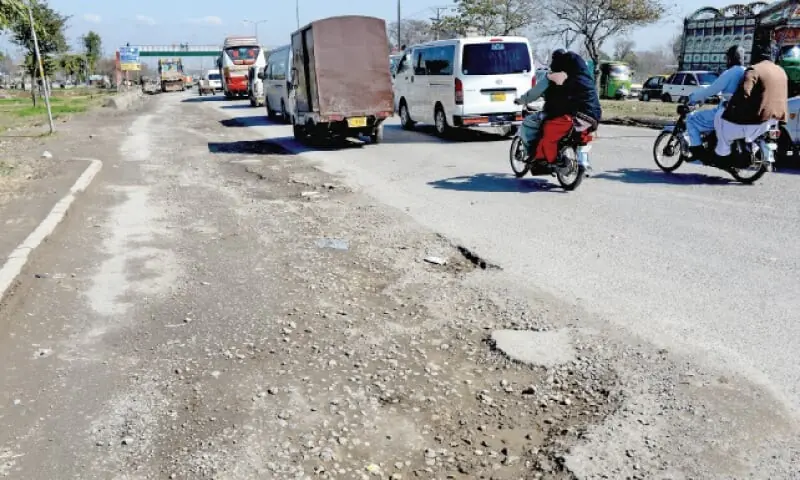
The road is described as one of Punjab’s busiest highways, with more than 16,500 vehicles using it every day, including heavy transport and dumper trucks carrying stone material from Sargodha to central Punjab. Earlier, the road was 24 feet wide, but it has now been widened into a dual carriageway with three lanes on each side.
The project was intended to lower the risk of accidents and improve travel conditions for commuters, transporters and pedestrians. It has also supported socio-economic activity in nearby areas, including Kamalpur, Chak 2, 3 and 4 JB, Ram Diwali, Arfa, Karim Nagar, FDA City, Lundianwala Adda, Jhok Mor and Bhutto Colony.
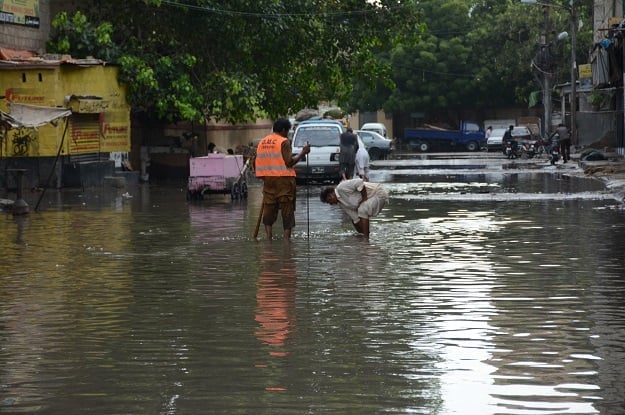
However, concerns have surfaced over the road’s elevation. Residents said engineers raised the road by four to seven feet in different sections, leaving adjoining settlements and government facilities at a much lower level. They said this has led to rainwater collecting in affected areas, causing repeated flooding and forcing both institutions and homeowners to spend more on drainage arrangements and reconstruction work.
The facilities said to be affected include government schools, offices of the Agriculture and Livestock Departments, Local Government offices, Land Record Centres and NADRA offices.
Mudassar Farooq, a resident of Chak 4-JB, said the planning flaws had forced people to tear down and rebuild their homes at higher levels, resulting in major expenses.
Syed Naveed Iqbal, Deputy Director of the District Government, said the issue falls under the Highway Department’s jurisdiction. He added that the project’s design and planning were prepared with the involvement of NESPAK.
NESPAK Resident Engineer Amjad Saeed, however, denied that the organisation had any role in the design and planning stage. He did say that a survey should have been carried out before the road level was raised so that such problems could be avoided.
According to an urban planner, an Environmental Impact Assessment (EIA) is required before project approval under the Pakistan Environmental Protection Act 1997 to assess possible effects on the environment and surrounding communities.
Attempts were made to contact Highway Department officials, but no response was received.
Comments
No comments yet. Be the first to join the discussion!