

Prospects rise for revival of Iran-Pakistan pipeline project after US-Iran peace talks
Prospects for reviving the Iran-Pakistan gas and oil pipeline projects have improved after US-Iran peace talks. The projects had remained stalled for years because of sanctions on Tehran and pressure on Islamabad.

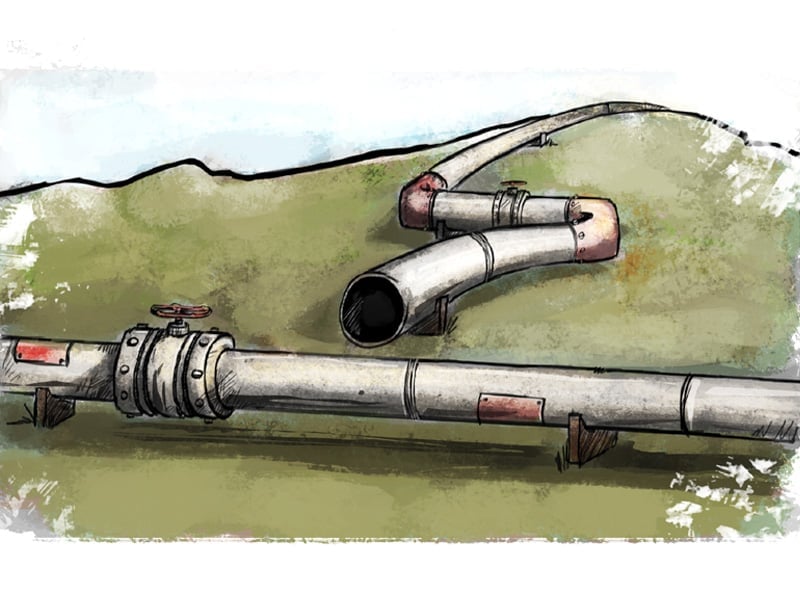
ISLAMABAD: Prospects for reviving long-delayed gas and oil pipeline projects between Pakistan and Iran have improved following peace talks between Tehran and Washington, according to officials and experts cited in recent discussions on the issue.
Pakistan and Iran signed a commercial agreement for the gas pipeline project in 2009 during the Pakistan Peoples Party government. The project was later formally inaugurated in 2013 by then Iranian president Mahmoud Ahmadinejad and former president Asif Ali Zardari. During the same period, the two countries also planned an oil pipeline, while Iran had also expressed interest in establishing what was described as the largest oil refinery in Gwadar with a production capacity of 400,000 barrels.
Those plans, however, were put on hold because of US sanctions on Iran and pressure on Islamabad not to move forward with the projects. In the same broader energy context, Saudi Arabia had announced plans to invest $10 billion in a refinery in Gwadar, but that proposal also did not materialise.
An expert said, Now, the US and Iran are negotiating a peace deal in Islamabad and hopes have arisen that Washington may lift sanctions on Tehran, with signals already coming from US President Donald Trump. The expert added that if restrictions are removed, it could create room to restart work on the Iran-Pakistan gas pipeline, which has remained stalled for years.
Energy security concerns
The recent war in the Middle East has renewed attention on Pakistan’s energy vulnerability. The conflict showed that Iran has the capacity to disrupt oil and gas supplies globally, while energy flows to Pakistan were also halted during the fighting.
In that setting, the gas and oil pipeline projects are being viewed as potentially important for Pakistan because they would bypass the Strait of Hormuz and could help maintain supplies even if major global chokepoints were blocked in a war-like situation.
Pakistan meets about 85% of its oil requirements through imports. Although the country has notable domestic gas production, it still depends on liquefied natural gas imports from Qatar to cover the shortfall. Supplies from Qatar were stopped after LNG facilities came under attack during the war. It also said oil installations in the UAE, Kuwait and Saudi Arabia were hit.
Pakistan had also considered an LNG pipeline to Gwadar as an alternative to the Iran-Pakistan pipeline after the possible easing of US restrictions, but that proposal was also shelved.
Talks, sanctions and alternatives
Pakistan had attempted to reach an out-of-court settlement with Iran to abandon the pipeline project. However, Iran agreed to extend the gas sale agreement by another 10 years in an effort to revive the scheme. The two sides have remained engaged in backdoor diplomacy over the matter, and the issue was also raised with visiting high-profile dignitaries in Islamabad, particularly by the former Iranian president.
Pakistan had earlier sought a waiver from the United States to proceed with the project, but Washington refused. Matthew Miller, who served as spokesperson for the US State Department during the previous administration, had said Washington would continue to enforce sanctions on Iran.
Iran has already completed its section of the pipeline, while Pakistan has not yet started construction on its side. Officials said Iran is ready to extend the gas sale agreement for another decade, but Pakistan wants to put the project aside because of sanctions and weak domestic demand.
Over time, Pakistan has examined other options as well. One proposal involved laying an LNG pipeline to Gwadar with an 80km extension to the Iranian border. A Chinese company had shown interest in building that line, but sanctions remained an obstacle.
“This gas is meant to meet the requirement of consumers in the power sector”, an official remarked.
At present, Pakistan relies on LNG imports from Qatar. However, power producers did not lift the full imported volume, resulting in a surplus in the market. To address that glut, the government has recently introduced two measures aimed at increasing LNG consumption.
Under one initiative, incentives have been offered through an incremental electricity supply programme to provide lower-cost electricity to agricultural and industrial consumers over a three-year period, allowing greater use of LNG in power plants. In addition, the government has ended a decade-long ban on new domestic and commercial gas connections. New consumers will be supplied gas at prices linked to LNG rates to enhance LNG utilisation and deal with the surplus gas.
Comments
No comments yet. Be the first to join the discussion!


