‘Too many moving pieces’: Pakistan envoy to US warns against rigid deadlines on Iran talks
Pakistan's Ambassador to the US, Rizwan Saeed Sheikh, warns that rigid deadlines complicate diplomatic efforts with Iran. He emphasizes the necessity for patience and a potential ceasefire as a starting point.

Ambassador Sheikh cites multiple communication channels, ongoing engagement at different levels
Stresses diplomacy involves ‘too many moving pieces,’ as rigid deadlines fail
Says ceasefire could be a good starting point, but diplomacy always takes time to deliver results
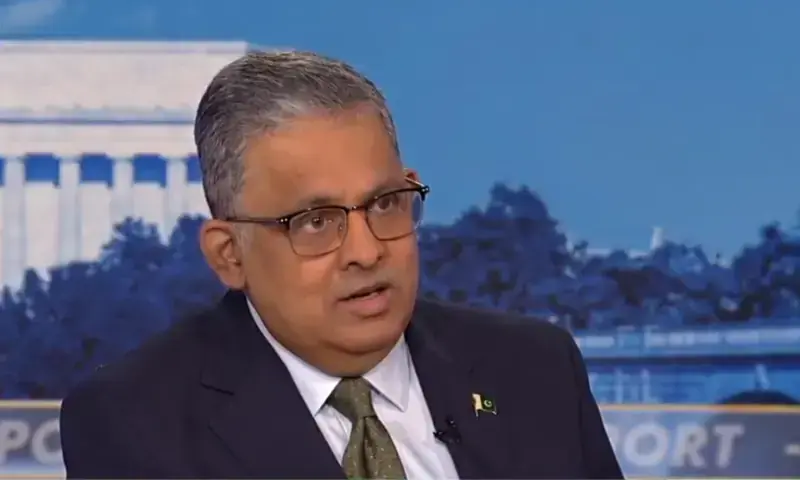
ISLAMABAD: Pakistan’s Ambassador to the United States, Rizwan Saeed Sheikh, on Tuesday said efforts to facilitate talks between Washington and Tehran are complicated by “too many moving pieces,” cautioning that diplomacy would take time and rigid timelines rarely yield results, even when attempts are made to accelerate progress.
“It’s a very complicated matter with too many moving pieces, economic, political,” Sheikh told Fox News during an interview, noting that “multiple channels of communication … at different levels of engagement” are currently active.
His remarks come as Pakistan intensifies diplomatic outreach amid media reports suggesting Islamabad could emerge as a possible venue for talks between the US and Iran.
Pakistan has positioned itself as a facilitator amid the ongoing Middle East conflict, hosting consultations over the weekend with Muslim countries including Saudi Arabia, Türkiye, and Egypt, while engaging multiple stakeholders as the war in Iran disrupts energy and trade routes and raises fears of wider escalation.
The country’s top officials have maintained close contacts with their US and Iranian counterparts in an effort to create conditions conducive to dialogue.
Sheikh cautioned that expectations for rapid progress may be unrealistic, particularly given the internal challenges within Iran. “Diplomacy is a gradual process. It takes a lot of patient politics that has to morph into deft diplomacy,” he said.
The envoy also warned against strict deadlines for negotiations, referencing public timelines set by US President Donald Trump pushing Iran to respond. “He kind of puts a deadline on it … but let’s look at the fact that Iran is a war-torn country with communication channels certainly disrupted,” Sheikh said, noting that responses from Tehran may not come quickly and that previous deadlines had already been extended.
While optimistic about Pakistan’s role in facilitating talks, Sheikh emphasized that progress ultimately depends on the parties involved. He noted that reducing hostilities would be a key first step. “In any negotiation process, that would be a good thing to start with,” he said, referring to the possibility of a ceasefire, which would help create the diplomatic space needed for substantive discussions.
Five-Point Initiative to Restore Peace and Stability Across Gulf
Ambassador Sheikh’s comments coincide with a five-point initiative jointly unveiled by Pakistan and China aimed at halting the ongoing US-Israel war on Iran and restoring peace and stability across the Gulf region.
The initiative was formalized during Deputy Prime Minister and Foreign Minister Ishaq Dar’s high-level visit to Beijing, where he held extensive talks with Chinese Foreign Minister Wang Yi. Discussions focused on the deteriorating regional security environment and the urgent need for coordinated international action to prevent further escalation.
According to a Foreign Office statement, both sides expressed deep alarm over the widening conflict, warning that continued hostilities could destabilize not only the Middle East but also global economic and energy systems.
At the core of the five-point plan is a call for an immediate cessation of hostilities. Pakistan and China urged all parties to exercise maximum restraint and avoid actions that could escalate the conflict into a broader regional war. They stressed that preventing spillover into neighboring countries is essential to maintaining international peace and security.
The two countries emphasized that military escalation would only deepen humanitarian suffering and complicate future peace efforts, urging global powers to act responsibly in accordance with international norms.
A central pillar of the initiative is the urgent commencement of peace talks. Islamabad and Beijing underscored that dialogue and diplomacy remain the only sustainable path forward, calling on all stakeholders to engage in “meaningful and sincere” negotiations.
They further reiterated that any resolution must respect the sovereignty, territorial integrity, and national independence of all states, including Iran and Gulf countries, and must be based on mutual consent rather than coercion.
Comments
No comments yet. Be the first to join the discussion!