

Scientists uncover cause behind super-bright supernova in distant galaxy
Astrophysicists have identified the cause behind a super-bright supernova in a galaxy a billion light-years away, linking its luminosity to a rapidly spinning magnetar and the twisting of space-time.

WASHINGTON: Astrophysicists have made significant progress in understanding the origins of superluminous supernovas—rare cosmic explosions that can shine up to 100 times brighter than typical supernovas. These extraordinary events have long puzzled scientists due to their exceptional brightness, far surpassing the luminosity of standard supernovas, which are already about a billion times brighter than the sun.
The breakthrough came after researchers studied a superluminous supernova that was first detected in December 2024. This particular event occurred in a galaxy located approximately a billion light-years from Earth. For context, a light-year is the distance light travels in one year, which is about 5.9 trillion miles (9.5 trillion kilometers).
The research team utilized data from the Las Cumbres Observatory, based in California, and the ATLAS survey telescope in Chile to closely examine the supernova. Their analysis focused on the aftermath of a massive star's death, which led to the formation of a magnetar—a type of neutron star with an extremely powerful magnetic field.
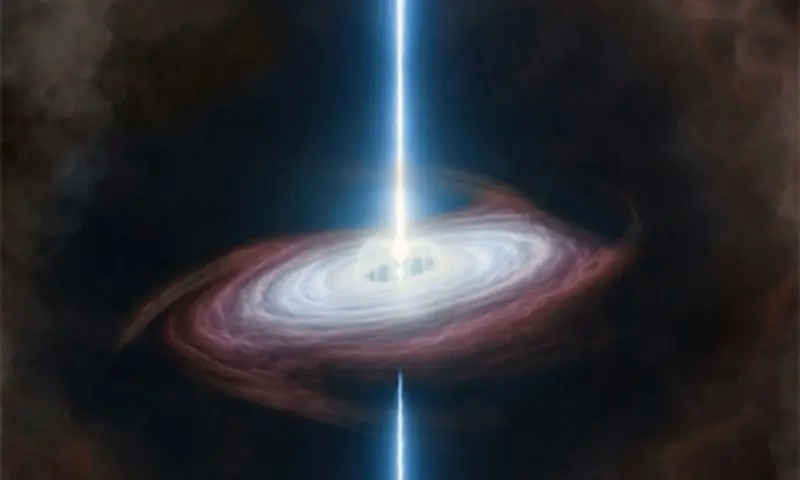
An artist's illustration accompanying the study depicts a magnetar surrounded by an accretion disk, exhibiting a phenomenon known as Lense-Thirring precession. This effect occurs when the spinning magnetar twists the fabric of space-time around it, a process that may be key to understanding the extraordinary brightness of superluminous supernovas.
According to the researchers, the findings from this observation are helping to clarify why certain supernovas become so luminous. The study suggests that the energy released by a rapidly spinning magnetar, combined with the effects of its intense magnetic field and the twisting of space-time, could explain the superluminous nature of these rare cosmic explosions.
This discovery marks an important step forward in astrophysics, shedding light on one of the universe's most spectacular and mysterious phenomena.
Comments
No comments yet. Be the first to join the discussion!


