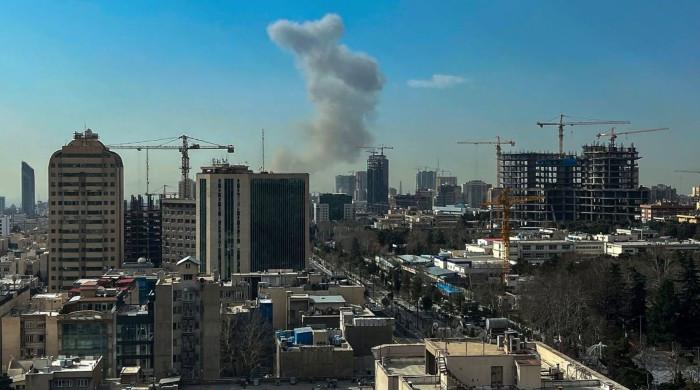
A deliberate and desperate war
The ongoing war with Iran poses significant risks for Israel and its allies. As tensions rise, the potential for regional destabilization increases, affecting Pakistan's security and alliances.

Longing for Greater Israel
The longer Iran resists the more dangerous and costly it becomes for Israel and its allies. If the war drags on for months and the Iranian government manages to survive, they will continue to fire back with their own missile attacks. If this happens, the plan to expand Israeli power and influence in the region with the dream of Greater Israel could fail completely and turn into a disaster for it.
The other day, Pakistan’s Defence Minister Khawaja Asif alleged that the war on Iran was "orchestrated by the Zionists" to bring Israeli influence directly to Pakistan's border. He warned of a "conspiracy" to create a hostile alignment of Afghanistan, Iran, and India against Pakistan, potentially reducing it to a "vassal state." Khawaja Asif asserted that Zionism has controlled the global economic system for over a century and that "major powers remain hostage to it," a sentiment echoed by journalist Tucker Carlson's criticism of the U.S. government's complicity in Israeli military actions.
In a segment on the Tucker Carlson Network titled "Breaking: Mossad Agents Arrested in Planned Bombing Operation," Tucker claimed that Saudi Arabia and Qatar arrested Israeli Mossad agents for allegedly planning bombings in those countries. Carlson's claims regarding arrested Mossad agents remain unverified and were explicitly denied by a Qatari spokesperson, who stated they had "no information" on such cells. Saudi Arabia didn’t confirm or deny it yet. Tucker argued these "false-flag" operations were designed to turn Gulf nations against Iran during the ongoing US-Israeli military campaign. Tucker can be too much a coward to directly blame Trump for getting America involved in the war in Iran.
Despite Iran's readiness for agreement, how this desperate war has been imposed upon them. By breaking past nuclear deals and attacking Iran twice while negotiations were still happening, Trump has shown his true goal. His real plan is regime change.
The assassination of Ayatollah Khamenei has plunged Iran into a volatile succession crisis, with profound security and economic risks for Pakistan. It is yet not clear who will control Iran, as the powerful Revolutionary Guard has vowed ferocious revenge. Destabilization in Iran would have implications for Pakistan. The loss of the world's primary spiritual Shia power centre has already sparked violent protests in Karachi, leading to clashes outside the U.S. Consulate and at least 23 deaths.
In a rare display of national unity, the death of Ayatollah Khamenei has bridged deep-seated divides within both Pakistan and Iran. In Pakistan, the shared sense of loss among both Sunnis and Shias has momentarily unified the country against what many perceive as a common external threat to the region. The mourning for Ayatollah Khamenei has gone far beyond digital hash tags; it is visible in the streets and shared conversations.
This response stems from a deep-rooted respect for him as a symbol of anti-imperialist resistance. Many Pakistanis, regardless of their specific sect, viewed him not just as an Iranian leader, but as one of the few global voices willing to directly challenge Western and Israeli power. In a country that often feels pressured by global powers, his "unyielding" stance earned him a place as a hero of the Muslim Ummah.
Strengthening ties with Kabul prevents the "India-Israel-Afghanistan" alignment that some analysts fear is being formed to pressure Pakistan. For this diplomatic reset to succeed, Pakistan must consider China to act as a primary guarantor of regional stability. Beijing has a vested interest in a peaceful border between Islamabad and Kabul to protect its multi-billion dollar investments. This coalition with Beijing would not only neutralize the threat of cross-border militancy but also create a formidable bloc capable of resisting the external pressures of 'regime change' and regional encirclement. A China-backed Pakistan-Afghanistan alliance makes it almost impossible for an India-Israel axis to isolate Pakistan diplomatically.
People felt a personal loss because he represented the idea that a regional nation could survive decades of sanctions and pressure without surrendering its core identity. The manner of his assassination triggered a protective instinct in Pakistan. There is a strong public feeling that "if they can do this to a leader of Iran’s stature, who is safe?" This has turned grief into a shared regional grievance. Similarly, within Iran, the assassination has triggered a "rally around the flag" effect, where even liberal and secular Iranians have joined in mourning, setting aside domestic grievances to condemn the violation of their national sovereignty. It looks as if Khamenei appears to have become more powerful in death than in life.
Nationalist pride can hold a country together during the initial shock of a war, but it cannot fix a broken economy for the long term. Often, regime change doesn't come from the streets, but from the inner circle. According to CNN, the USA is reportedly exploring a strategy to arm and support Iranian Kurdish opposition groups to create a "second front" against the Tehran regime. The CIA is working on plans to arm Kurdish forces to spark a popular uprising in Iran. Thousands of Kurdish militants are gathering in Iraqi Kurdistan. Reports suggest that they may launch ground operations into Western Iran in the coming days. This strategy may cause significant tension with Turkey and the new Syrian government, both of which oppose Kurdish militancy near their borders.
The future of the entire region depends on how this war ends. Specifically, whether the Iranian government falls or manages to stay in power. If a new government takes over Iran and its nuclear programme is wiped out, the focus of the USA and Israel will shift entirely toward Pakistan's nuclear arsenal. It would become very easy for the US government to gather support for action against Pakistan. Even if the USA thinks it is too hard to take away Pakistan’s nuclear weapons, Israel will not stop. Israel will use its political influence in Washington to demand that Pakistan’s nuclear programme be strictly controlled, monitored, or even completely dismantled. On the other hand, The USA currently views Pakistan through the lens of counterterrorism and critical minerals.
Prolonged instability in Iran could lead to refugee flows and increased militancy in Balochistan. Pakistan is actively engaging with regional stakeholders, including Saudi Arabia and the UN Security Council, to prevent the conflict from turning into a wider regional war.
With Iran in chaos, Pakistan cannot afford a "hot" border with Afghanistan. The ongoing fighting between Pakistan and Afghanistan is making an already unstable region even more dangerous, especially as it struggles with the regime change happening in Iran. In light of the destabilization in Iran and the shifting geopolitical map, it is imperative that Pakistan prioritises a diplomatic reset with Afghanistan. To secure its western frontier and avoid a catastrophic 'two-front' security dilemma, Islamabad must move beyond current tensions to establish a stable, normalized relationship with Kabul. In an era of 'regime change' and regional upheaval, a pacified Afghan border is no longer just a diplomatic goal— it is Pakistan’s most vital shield against further encirclement. A stable Afghanistan is the only way to connect Pakistan to Central Asian markets, which is critical if the Strait of Hormuz remains closed.
Strengthening ties with Kabul prevents the "India-Israel-Afghanistan" alignment that some analysts fear is being formed to pressure Pakistan. For this diplomatic reset to succeed, Pakistan must consider China to act as a primary guarantor of regional stability. Beijing has a vested interest in a peaceful border between Islamabad and Kabul to protect its multi-billion dollar investments. This coalition with Beijing would not only neutralize the threat of cross-border militancy but also create a formidable bloc capable of resisting the external pressures of 'regime change' and regional encirclement. A China-backed Pakistan-Afghanistan alliance makes it almost impossible for an India-Israel axis to isolate Pakistan diplomatically.

Aisha Noor is a freelance writer. She can be contacted at [email protected], Twitter: @aishaz99
View all articles →Comments
No comments yet. Be the first to join the discussion!