













DHAKA: The Bangladesh Nationalist Party secured a commanding two-thirds majority in Friday’s general election, a result widely seen as a turning point for a country emerging from months of political upheaval after the removal of former prime minister Sheikh Hasina in a youth-driven uprising last year.
Early tallies from television networks and provisional data from election authorities indicated that the BNP and its partners crossed the threshold needed to dominate the 299 contested seats in the Jatiya Sangsad, Bangladesh’s national parliament.
Figures released by the Election Commission showed the BNP leading with 181 seats, Jamaat-i-Islami with 61, and other candidates sharing the remaining handful, while allied counts projected the broader BNP bloc beyond 200 seats.
The scale of the result marked one of the most emphatic performances in the party’s history and returned it to government after a gap of two decades. Analysts had argued before polling day that only a decisive mandate could prevent further political drift in a country where protests, shutdowns and violence had unsettled economic activity and strained public life for months.
The BNP issued immediate guidance to its workers and supporters, urging restraint rather than celebration. “Despite winning … by a large margin of votes, no celebratory procession or rally shall be organised,” the party said in a statement.
The directive reflected concerns that public gatherings could trigger tensions in a charged environment still recovering from unrest. In several parts of Dhaka, small groups gathered outside party offices overnight, but there were no reports of large-scale rallies.
The National Citizen Party, formed by young activists who had taken part in the anti-Hasina protests and later aligned with the Jamaat-led alliance, managed to win five of the 30 constituencies it contested. Its modest showing contrasted with the national swing towards the BNP-led platform.
Observers described the vote as the country’s most competitive in years, with more than 2,000 candidates from at least 50 parties entering the race. Participation appeared markedly higher than the turnout recorded in the previous election. Media estimates suggested that close to 60 per cent of registered voters cast ballots, compared with 42 per cent previously.
Selim Raihan, an economics professor at the University of Dhaka, pointed to the importance of parliamentary arithmetic in the days ahead. “A strong majority gives BNP the parliamentary strength to pass reforms efficiently and avoid legislative paralysis. That alone can create short-term political stability,” he told Reuters.
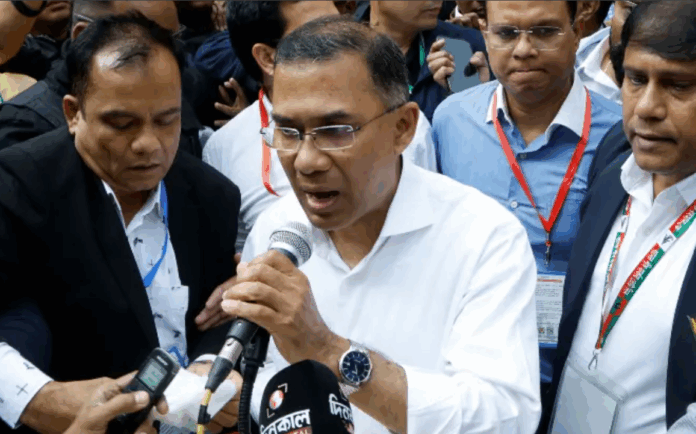
BNP leader Tarique Rahman is widely expected to assume the office of prime minister. The son of party founder and former president Ziaur Rahman, he returned to the capital in December after spending nearly 18 years abroad. His return had already energised party ranks before the campaign formally began.
The party’s manifesto placed emphasis on employment generation, support for lower-income families and fair market returns for farmers, themes that featured prominently in campaign messaging across urban and rural constituencies.
“If the factories run regularly and we get our wages on time, thats what matters to us. I just want the BNP government to bring back stability so more orders come to Bangladesh and we can survive,” Josna Begum, 28, a garment worker and mother of two, told Reuters after the results.
Bangladesh’s garment sector, one of the largest in the world, had been disrupted by repeated closures during months of unrest. Business groups had urged political actors to ensure a peaceful transition regardless of the outcome.
The Jamaat-i-Islami acknowledged late on Thursday that the trend of results was not in its favour but said it remained dissatisfied with aspects of the electoral process, calling on supporters to remain patient and peaceful.
Sheikh Hasina, now in exile in New Delhi, had dominated the political landscape for years, alternating in prominence with Khaleda Zia, Tarique Rahman’s mother. Ziaur Rahman, Tarique’s father, ruled Bangladesh from 1977 until his assassination in 1981. The rivalry between the two families shaped national politics for decades.
The BNP’s performance surpassed its 2001 election result, when it secured 193 seats. By comparison, Hasina’s Awami League had won 230 seats in 2008. Several intervening elections were marred by boycotts or disputes between major parties, raising questions at the time about competitiveness.
Voting in one constituency was postponed after the death of a candidate. Elsewhere, polling proceeded under heavy security with limited reports of disturbances.
Alongside the parliamentary vote, citizens also took part in a referendum on proposed constitutional changes. Broadcaster Jamuna TV reported that more than two million voters supported the proposals while over 850,000 opposed them, though official confirmation was pending. The measures under consideration include limits on the number of terms a prime minister can serve, stronger judicial independence, increased representation for women, provisions for neutral interim administrations during elections, and the creation of a second legislative chamber.
Leaders from neighbouring countries and the region issued messages following the result.
President Asif Ali Zardari and Prime Minister Shehbaz Sharif congratulated the BNP leadership and the people of Bangladesh.
“Pakistan looks forward to working with the new government to strengthen cooperation in trade, defence, cultural exchanges, and regional forums,” President Zardari said.
Whereas, taking to social media platform X, Prime Minister Shehbaz Sharif wrote: “I extend my warmest felicitations to Mr. Tarique Rahman on leading the BNP to a resounding victory in the Parliamentary elections in Bangladesh. I also congratulate the people of Bangladesh on the successful conduct of the elections.”
Deputy Prime Minister and Foreign Minister Ishaq Dar also congratulated Rahman, saying: “I am confident that, under your able stewardship, Bangladesh will continue its journey towards peace, progress, and prosperity.”
India’s Prime Minister Narendra Modi issued his own message. “This victory shows the trust of the people of Bangladesh in your leadership,” Modi said in a statement posted on social media, further adding that, “India will continue to stand in support of a democratic, progressive and inclusive Bangladesh.”
Political analysts noted that the BNP’s immediate challenge would be converting its electoral dominance into administrative stability and economic recovery. With expectations high among supporters and businesses alike, attention will turn quickly to cabinet formation, legislative priorities and steps to restore investor confidence.
For many citizens, however, the central hope remains a return to routine. After months when protests and uncertainty overshadowed daily life, the result has raised expectations that a clear parliamentary majority can help steady the country’s political direction and allow institutions and industries to function without interruption.