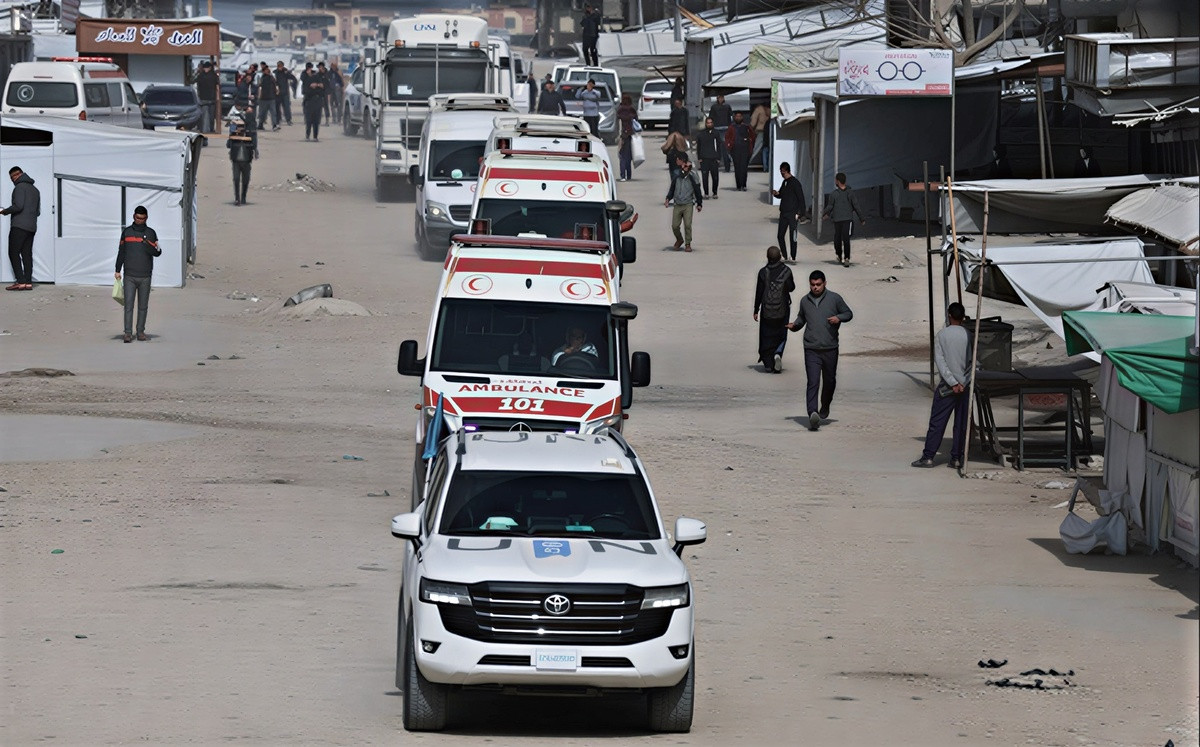
Israel allows limited movement through Rafah crossing after months of closure
Israel has reopened the Rafah border crossing, allowing limited movement for Palestinians after months of closure. This marks a significant step in the ceasefire agreement.


Israel reopened the Rafah border crossing between the Gaza Strip and Egypt on Monday, permitting a tightly restricted number of Palestinians to enter and leave the enclave on foot for the first time in months, according to Reuters.
The crossing, which lies in Israeli-controlled territory in an area that was once a densely populated city, remains the only exit and entry point for almost all of Gaza’s more than two million residents. It has been closed for most of the conflict, and its partial reopening marks one of the final steps required under the first phase of a United States-brokered ceasefire agreed in October.
A Palestinian source said that on the first day around 50 Palestinians were expected to enter Gaza, facing strict Israeli security screening, while a similar number would be allowed to leave. Those permitted to return are among the more than 100,000 Palestinians who managed to escape the enclave during the early months of the war. By mid-morning, it was still unclear how many people had crossed, though an Israeli security official confirmed the crossing was open for both entry and exit.
Israel seized control of the Rafah crossing in May 2024, roughly nine months into the war in Gaza, which was later brought to a fragile halt under the ceasefire brokered by US President Donald Trump. Reopening the crossing was a key requirement of the deal’s initial phase. In January, Trump announced the start of a second phase aimed at negotiations over Gaza’s future governance and reconstruction.
Despite the reopening, violence continued. Israeli strikes killed at least four Palestinians on Monday, including a three-year-old child, in separate incidents in northern and southern Gaza. The Israeli military did not immediately comment on the reports.
During the first nine months of the conflict, about 100,000 Palestinians crossed into Egypt through Rafah, some with assistance from aid groups and others reportedly paying bribes. After Israeli forces moved into the area, the crossing was shut, reopening only briefly in early 2025 to evacuate medical patients during a temporary truce.
The closure severely restricted access to medical care abroad for wounded and sick Palestinians. Over the past year, only a few thousand were allowed to leave Gaza for treatment via other routes through Israel.
Egyptian sources said Palestinians seeking to cross through Rafah will now need prior Israeli security approval. Reinforced concrete walls topped with barbed wire have been erected around the crossing, and travellers must walk roughly 2.5 kilometres through the Israeli-held Philadelphi corridor. They will pass through three separate gates, including one run by the internationally recognised Palestinian Authority under the supervision of a European Union mission but remotely controlled by Israel.
Although Rafah has reopened, Israel continues to bar foreign journalists from entering Gaza. International media organisations rely on local reporters inside the enclave, many of whom have been killed during the war. Israel’s Supreme Court is reviewing a petition by the Foreign Press Association seeking access for foreign journalists, while the government argues such entry could endanger Israeli troops.
Under the ceasefire’s first phase, major fighting was halted, hostages held by Hamas were exchanged for thousands of Palestinian prisoners, and increased humanitarian aid was promised. Israeli forces, however, still control more than half of Gaza’s territory, much of it cleared of residents and heavily damaged. Most of the population is now confined to a narrow coastal area, living in tents or partially destroyed buildings.
The next phase of Trump’s plan envisions Hamas relinquishing its weapons and control of Gaza to an internationally backed administration tasked with overseeing reconstruction, including major development projects along the Mediterranean coast. Both Israelis and Palestinians have expressed scepticism about the plan, with Hamas refusing to disarm and Israel warning it may resume military operations to force the group’s defeat.
The war began in October 2023 when Hamas fighters attacked Israel, killing about 1,200 people and taking more than 250 hostages, according to Israeli figures. Israel’s subsequent offensive has killed more than 70,000 Palestinians, Gaza health officials say. Since the ceasefire was agreed in October, Israeli attacks have killed more than 500 Palestinians, while four Israeli soldiers have been killed in clashes.
Comments
No comments yet. Be the first to join the discussion!