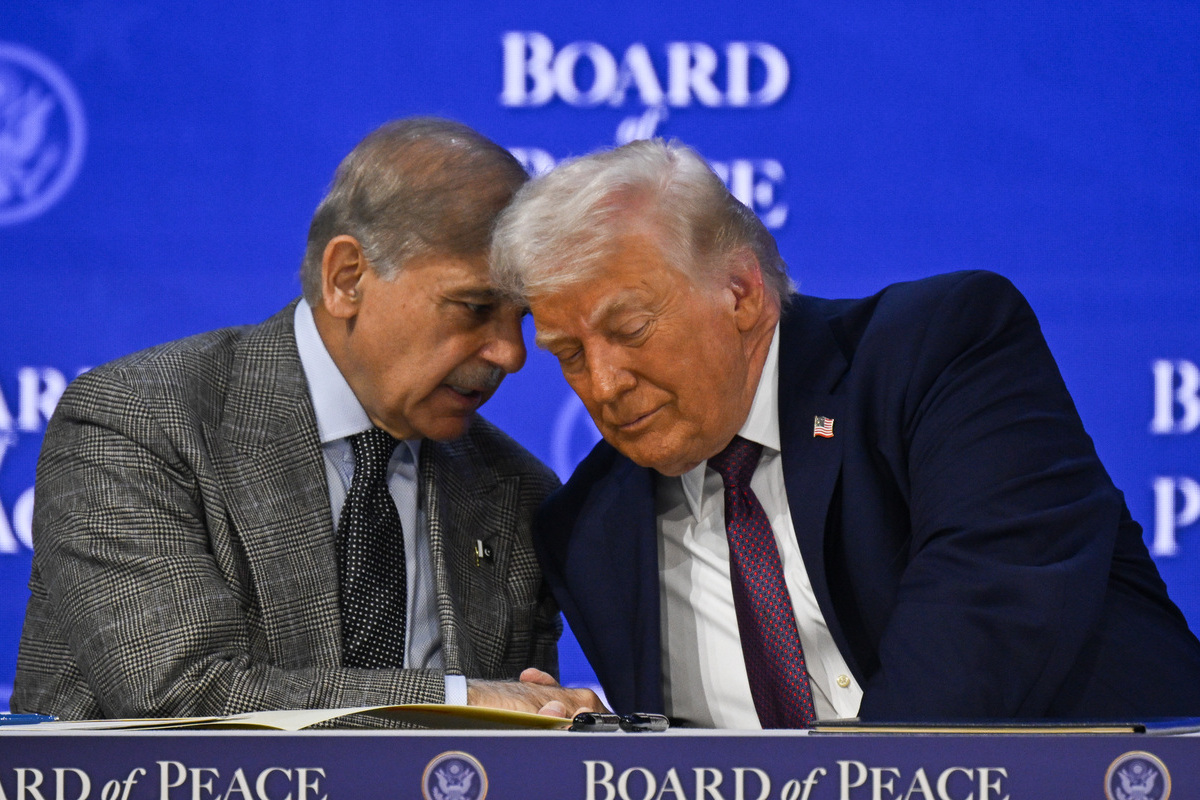
Pakistan named founding member of Trump's 'Board of Peace'
Pakistan has been named a founding member of President Trump's 'Board of Peace,' an initiative aimed at global conflict resolution. The board includes 26 countries and expands its mandate beyond Gaza.

ISLAMABAD/WASHINGTON: The United States President Donald Trump’s newly formed “Board of Peace” on Wednesday announced 26 countries as founding members of the initiative, with Pakistan included among the original participants.
The announcement came a week after President Trump formally unveiled the body during the World Economic Forum in Davos, Switzerland. On Wednesday, the board launched its official account on social media platform X, confirming the list of founding members.
“The Board welcomes Pakistan as a founding member of our growing international organization,” the post said.
According to the announcement, the founding members include Argentina, Armenia, Azerbaijan, Albania, Bahrain, Belarus, Bulgaria, Cambodia, El Salvador, Egypt, Hungary, Indonesia, Jordan, Kazakhstan, Kosovo, Kuwait, Mongolia, Morocco, Paraguay, Qatar, Saudi Arabia, Turkiye, the United Arab Emirates, Uzbekistan and Vietnam. The list reflects broad representation from the Middle East, Asia, Europe, Latin America and the Caucasus.
Notably absent from the founding roster are major European powers such as France, Germany and the United Kingdom, amid strained relations with the Trump administration over issues including Greenland and tariff policies.
Ukraine has raised concerns over potential participation alongside Belarus and Russia. While Belarus has accepted the invitation to join the board, Russia was not included, despite President Vladimir Putin’s earlier statement that Moscow was prepared to contribute $1 billion from Russian assets frozen by the previous US administration to support the board’s budget.
Meanwhile, President Trump rescinded Canada’s invitation to join the initiative, citing remarks by Prime Minister Mark Carney at the World Economic Forum in which he warned against economic coercion by major powers.
Trump announced the creation of the Board of Peace on January 15 as part of his broader Gaza plan, under which a ceasefire agreement was reached. The body was subsequently authorised under United Nations Security Council Resolution 2803, adopted in November 2025.
While the board was initially conceived to oversee the ceasefire and reconstruction process in Gaza, its charter significantly expands its mandate to include peace-building efforts in regions affected by conflict or at risk of instability worldwide.
Further details regarding the board’s leadership structure, operational framework and implementation timeline have yet to be formally announced.
Comments
No comments yet. Be the first to join the discussion!