

Dar arrives in Beijing to Co-Chair 7th Pakistan–China Strategic Dialogue tomorrow
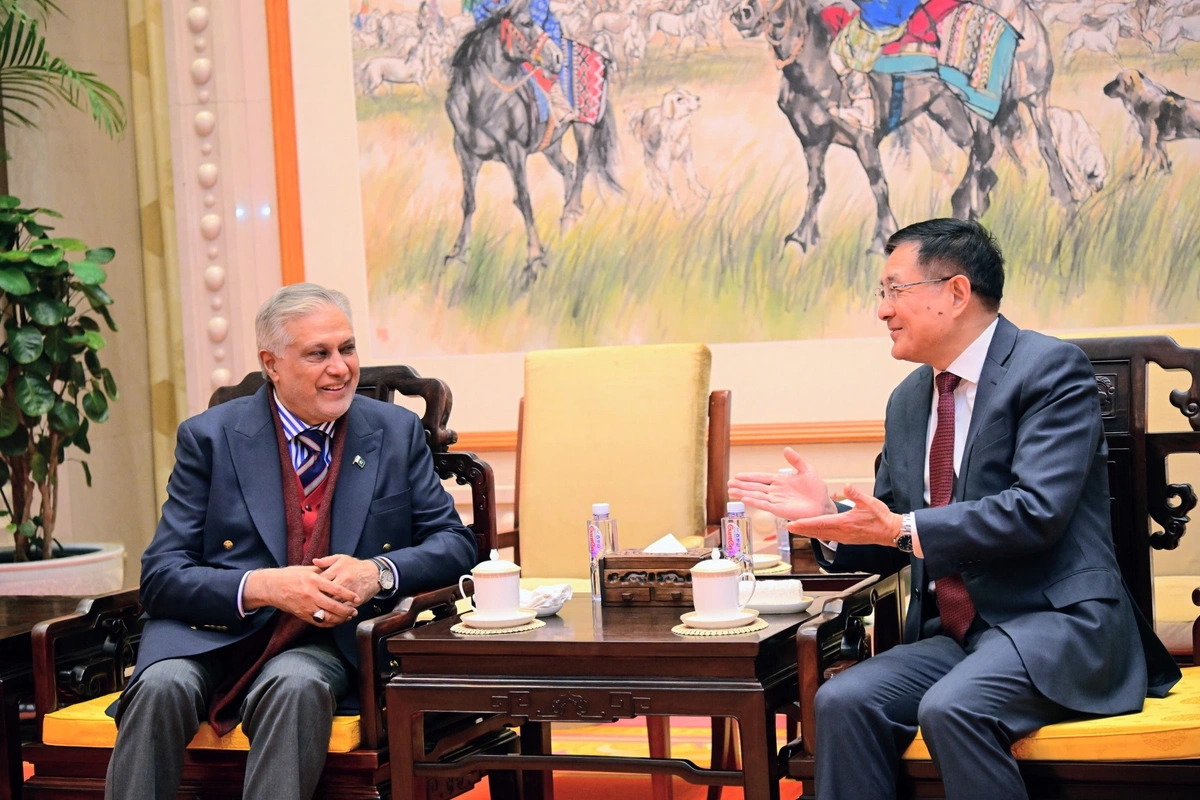
- Deputy PM first foreign dignitary to visit China in 2026 at Wang Yi’s invitation
- Dialogue to review full spectrum of bilateral cooperation and regional developments
- Visit to focus on events, initiatives to mark 75th anniversary of Pakistan–China diplomatic ties
- High-stakes visit underscores shared commitment to peace, development and long-term partnership
BEIJING: Deputy Prime Minister and Foreign Minister Ishaq Dar arrived in Beijing on Saturday to co-chair the seventh round of the Pakistan–China Foreign Ministers’ Strategic Dialogue, scheduled for Sunday, signaling a fresh push to deepen the “all-weather” partnership between the two countries, the Foreign Office (FO) announced on X.
According to the FO, Dar will be the first foreign dignitary to visit China in 2026, at the invitation of Chinese Foreign Minister Wang Yi, with whom he will jointly lead the dialogue. The visit comes amid intensified high-level exchanges, reflecting the growing depth of strategic coordination between Islamabad and Beijing. In 2025, both President Asif Ali Zardari and Prime Minister Shehbaz Sharif visited China in succession, underscoring the momentum of bilateral engagement.
Deputy Prime Minister and Foreign Minister Senator Mohammad Ishaq Dar @MIshaqDar50 arrived in Beijing this evening. At the airport he was recieved by China's Special Representative on Afghanistan Ambassador Yue Xiaoyong, Pakistan's Ambassador to China and officers of Pakistan… pic.twitter.com/3Q3LzMC11o
— Ministry of Foreign Affairs - Pakistan (@ForeignOfficePk) January 3, 2026
In August, Wang Yi, also a member of the Political Bureau of the Communist Party of China Central Committee, visited Pakistan to co-chair the sixth round of the strategic dialogue. Less than a year later, Pakistan’s foreign minister is visiting China, highlighting the “ironclad friendship” between the two nations, CGTN reported.
Dar was received at the airport by China’s Special Representative on Afghanistan, Ambassador Yue Xiaoyong, Pakistan’s Ambassador to China, and officials from the Pakistani Embassy. “DPM/FM will also attend events marking the 75th year of Pakistan–China diplomatic ties, with initiatives and commemorative activities planned throughout 2026,” the FO post added.
The dialogue will review the full spectrum of bilateral cooperation, identify new areas of partnership, and further advance the all-weather strategic cooperative partnership, the FO said. It described the forum as the “highest consultative mechanism” between the two countries, providing a structured platform to review bilateral, regional, and international developments of mutual interest.
During the dialogue, the two foreign ministers are also expected to announce a series of initiatives to commemorate the 75th anniversary of diplomatic relations, which were established on May 21, 1951. The visit forms part of regular high-level exchanges, reflecting both countries’ shared commitment to broaden and deepen their partnership while reaffirming dedication to regional peace, stability, and sustainable development.
The sixth round of the dialogue, held in Islamabad in August, saw Wang Yi meet Dar, Prime Minister Shehbaz Sharif, and President Zardari. At the time, China reaffirmed its commitment to working with Pakistan to promote regional peace, development, and stability.
Deputy Prime Minister and Foreign Minister Senator Mohammad Ishaq Dar has departed for Beijing to co-chair, with Foreign Minister Wang Yi, the 7th Pakistan–China Foreign Ministers’ Strategic Dialogue on 4 January 2026.
The DPM/FM is the first foreign dignitary to visit China in… pic.twitter.com/kpqYha6tol
— Ministry of Foreign Affairs - Pakistan (@ForeignOfficePk) January 3, 2026
Economic and Strategic Cooperation Anchors Ties
Economic and trade cooperation remains a cornerstone of the bilateral relationship. The China–Pakistan Free Trade Agreement, signed in 2006 and effective from July 2007, has paved the way for China to become Pakistan’s largest trading partner since 2014. According to China’s General Administration of Customs, bilateral trade reached $23.06 billion in 2024, up 11.1% year-on-year.
At the core of economic cooperation is the China–Pakistan Economic Corridor (CPEC), a flagship bilateral project under the Belt and Road Initiative launched in 2013. Focused on Gwadar Port, transport infrastructure, energy development, and industrial cooperation, CPEC has significantly bolstered Pakistan’s long-term economic framework.
Energy cooperation under CPEC has addressed chronic electricity shortages, with major projects such as the Sahiwal, Port Qasim, and Hub coal-fired power plants, the Karot Hydropower Project, Hualong One nuclear units at Karachi, and the Sachal Wind Power Project now operational. According to China Three Gorges Corporation, the Karot Hydropower Project generated 3.64 billion kWh in its first full year, powering over 5 million people. Chinese enterprises have also provided technology, training, and management expertise to support Pakistan’s energy self-sufficiency.
By the end of 2022, CPEC had created 236,000 jobs, added 510 km of highways, installed 8,000 MW of electricity capacity, and built 886 km of core national transmission lines, according to the Chinese Embassy in Pakistan.
Strategic Coordination and Regional Stability
Beyond economics, China–Pakistan strategic coordination plays a key role in regional stability. In 2024, terrorist attacks in Pakistan resulted in the deaths of seven Chinese nationals, prompting strong condemnation from Beijing and reinforcing counter-terrorism collaboration.
Both sides maintain high consensus on regional security, committing to strengthen defense cooperation, safeguard Belt and Road projects, and enhance strategic communication in multilateral frameworks. Joint counter-terrorism exercises, including an November 2024 drill involving over 300 PLA personnel, highlight the practical implementation of these commitments.
Military expert Zhang Junshe noted that these exercises deepen bilateral cooperation and contribute to regional peace, demonstrating the resilience of the China–Pakistan partnership amid global challenges. A joint February 2025 statement reaffirmed a zero-tolerance stance toward terrorism and pledged enhanced bilateral and multilateral counter-terrorism collaboration.
During Wang Yi’s visit to Pakistan last year, he lauded Pakistan’s “unremitting efforts and enormous sacrifices” in combating terrorism and expressed confidence that Islamabad would continue to protect Chinese personnel, projects, and institutions while deepening security coordination on regional counter-terrorism affairs.

Comments
No comments yet. Be the first to join the discussion!


