Security forces kill 16 terrorists as counterterror operations intensify in Balochistan
Security forces killed 16 terrorists in intelligence-based raids under Operation Al-Azm in Balochistan, dismantling hideouts and recovering weapons. Counterterror efforts continue as violence rises, including the killing of a judge in Mastung.

Operation Al-Azm dismantles terrorists hideouts, recovers weapons and explosives in ongoing intelligence-based raids
Counterterror offensive expands after recent attacks, while gunmen kill a district judge and his security guard in Mastung
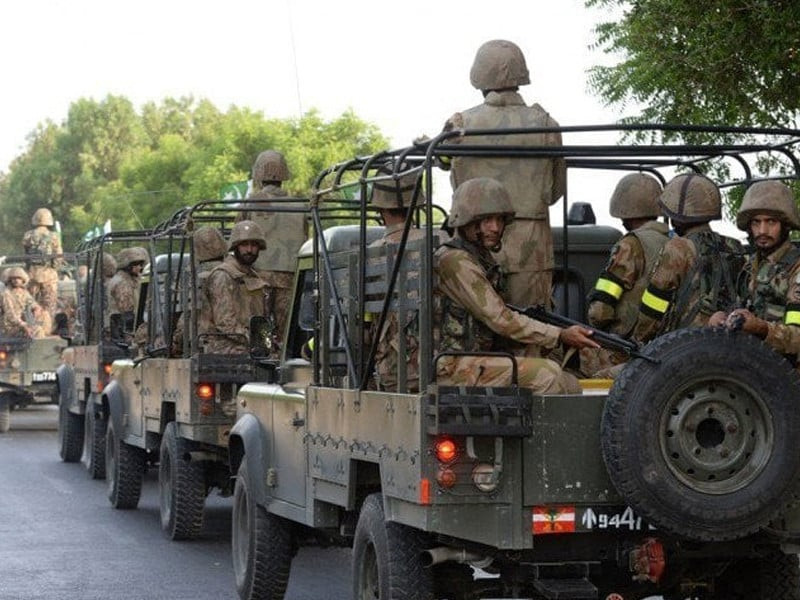
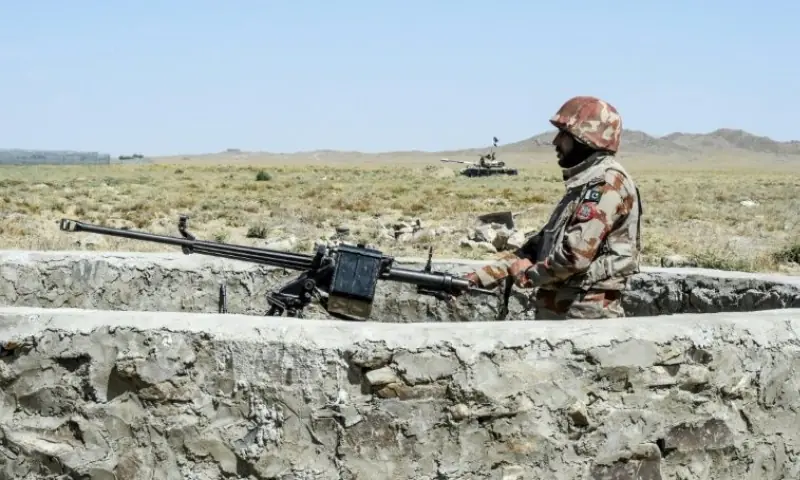
QUETTA/ISLAMABAD: Security forces have killed 16 terrorists in ongoing intelligence-based operations under Operation Al-Azm in Balochistan, dismantling multiple terrorists hideouts and recovering weapons and explosives, security sources said on Sunday.
The intelligence-based operations were launched in the aftermath of recent terrorist attacks in the area. Earlier, security forces had initiated Operation Shaban after terrorists attacked the Mangi Dam Police-Post, prompting an expanded security response.
The latest operations come as violence continued elsewhere in the province. A district and sessions judge and his security guard were killed after unidentified armed men opened fire on their vehicle on the national highway in Mastung, while an additional sessions judge and another person sustained serious injuries in the attack.
According to security sources, counterterrorism operations are continuing in several areas of Balochistan, including Killi Kundi Umrani, Khad Kocha and Mastung, where the group referred to by the state as Fitna al-Hindustan has suffered heavy losses.
Fitna al-Hindustan is the term used by the state for terrorists belonging to the banned Balochistan Liberation Army (BLA) and other militant groups operating in the province.
The sources said security forces destroyed multiple militant hideouts and ambush positions during the ongoing operations and recovered weapons and explosive material from the sites.
They added that the intelligence-based operations would continue until terrorism was eliminated from Balochistan and peace and order were fully restored across the province.
On Friday, Chief of Defence Forces and Chief of Army Staff Field Marshal Syed Asim Munir reaffirmed the military's resolve to dismantle terrorist infrastructure in Balochistan, saying sustained operations by security forces and law enforcement agencies, backed by the unwavering support of the people, would help restore lasting peace in the province.
Munir said, "Targeted operations against Fitna al Khawarij and Fitna al Hindustan will continue with full resolve until the menace of terrorism and its abettors are eliminated from Pakistan."
UNSC flags rise in TTP attacks from Afghanistan
Terrorist violence has increased significantly in Pakistan in recent days, particularly in Khyber Pakhtunkhwa and Balochistan, raising fresh concerns over the security situation in both provinces. In response, security forces have intensified counterterrorism operations targeting militant groups.
A United Nations Security Council (UNSC) report released in February also highlighted a series of attacks by the banned Baloch Liberation Army (BLA) against Pakistani security forces and projects linked to the China-Pakistan Economic Corridor (CPEC).
Referring to one such incident, the report stated: "On September 16, 2025, the BLA ambushed a Pakistani military convoy patrolling the corridor, killing 32 troops. While counter-terrorism operations by Pakistan restricted the BLA's operational space, it remained active."
The report further said some member states had informed the UNSC that the BLA collaborated with the Tehreek-e-Taliban Pakistan (TTP) and ISIL-K by sharing training camps and resources, while coordinating attacks and meetings between commanders. However, it noted that other member states assessed there was neither an established association nor growing ties between the BLA and Al Qaeda or ISIL.
It also highlighted that various militant groups in Afghanistan had acquired modern weapons and military equipment through cross-border smuggling and black-market networks.
According to the report, the TTP used advanced assault rifles, night-vision devices, thermal-imaging equipment, sniper systems and drone attack systems.
"Most of these were provided by the de facto authorities in conjunction with weapons permits and travel documents," the report said.
In August 2025, the UN's 1988 Taliban Sanctions Committee Monitoring Team also reported that the outlawed BLA, including its Majeed Brigade, and the TTP maintained "close coordination."
The UNSC report further noted that "some BLA attacks showed a high degree of complexity and brutality," citing the March 11, 2025 hijacking of the Jaffar Express in Balochistan, in which 31 people, including 21 hostages, were killed.
Comments
No comments yet. Be the first to join the discussion!