Dar, IAEA chief discuss US-Iran crisis as Middle east conflict enters fragile pause
Ishaq Dar met IAEA DG Rafael Grossi as the US and Iran paused attacks for a second day. Both sides urged sustained dialogue to revive the Islamabad ceasefire framework and nuclear talks.

FM Dar, IAEA DG Grossi stress sustained dialogue to secure a peaceful and durable outcome
Washington and Tehran halt attacks for a second day as efforts intensify to revive the Islamabad ceasefire framework
Pakistan's Islamabad MoU remains central to mediation aimed at restoring stability and advancing nuclear negotiations.
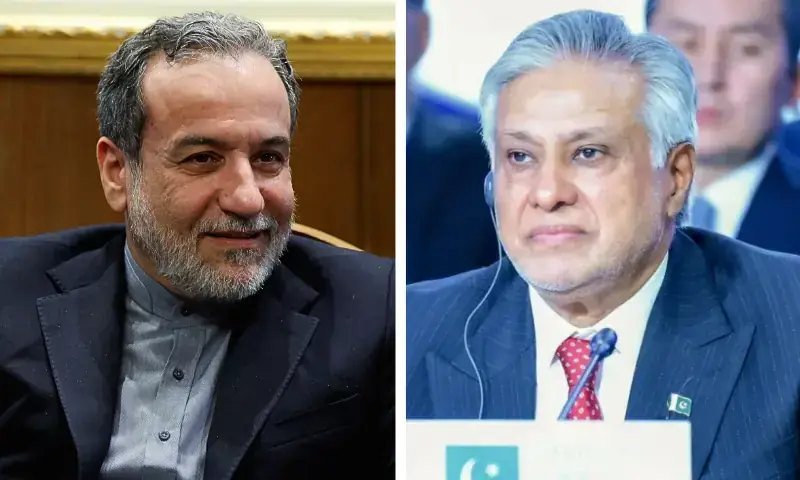
ISLAMABAD: Deputy Prime Minister and Foreign Minister Ishaq Dar and International Atomic Energy Agency (IAEA) Director General Rafael Mariano Grossi on Sunday discussed the evolving situation following the US-Iran conflict in the Middle East, with both sides emphasizing the importance of sustained diplomacy and dialogue as Washington and Tehran paused attacks against each other after nearly two weeks of fighting.
The diplomatic engagement came as efforts gathered pace to preserve fragile de-escalation and revive negotiations around an interim ceasefire arrangement that had been strained by recent exchanges of fire between the two countries.
The United States suspended its attacks on Iran for a second consecutive day on Sunday, while Tehran also announced it had halted military action, as diplomatic efforts continued to bring both sides back to negotiations on an interim ceasefire agreement.
The nearly two-week escalation began after Iran fired at ships attempting to transit the Strait of Hormuz, prompting US strikes on Iranian coastal areas and infrastructure. US Ambassador to the United Nations Mike Waltz told Fox News that President Donald Trump was "giving talks some space."
According to the Foreign Office (FO), Dar received a telephone call from IAEA Director General Grossi during which both leaders underscored the importance of continued diplomacy and constructive engagement in advancing regional and international peace and stability.
In a post on X, the Foreign Office said, "Director General Grossi expressed hope that the parties would sustain dialogue and engagement following the Islamabad Memorandum of Understanding, with a view to achieving a peaceful and durable outcome."
Deputy Prime Minister/Foreign Minister Senator Mohammad Ishaq Dar @MIshaqDar50 received a telephone call today from the Director General of the International Atomic Energy Agency (IAEA), Mr. Rafael Mariano Grossi.
They exchanged views on the latest regional developments and… pic.twitter.com/xYugFCjKlx— Ministry of Foreign Affairs - Pakistan (@ForeignOfficePk) July 26, 2026
Pakistan played a key facilitative role by helping establish contacts between senior US and Iranian officials that led to last month's interim peace agreement, known as the Islamabad Memorandum of Understanding (MoU). The agreement included a 60-day ceasefire, the reopening of the Strait of Hormuz, and a timetable for negotiating a final settlement covering both the conflict and Iran's nuclear programme.
The 60-day period, which began after the agreement was signed by both countries in mid-June, has now entered its second half. However, major issues originally intended for negotiations — particularly Iran's nuclear programme, which lies at the heart of the dispute — remain unresolved as mediators work to keep both sides engaged in dialogue.
A regional official involved in mediation efforts told the Associated Press (AP) that diplomatic contacts were continuing and described the pause in US and Iranian military action as "a positive signal that helps their efforts to de-escalate."
The official said both countries were seeking to return to the interim ceasefire framework and that discussions were focused on a compromise under which Iran would continue managing vessel transit through the Strait of Hormuz while easing restrictions on commercial shipping. The official spoke on condition of anonymity because they were not authorized to discuss the negotiations publicly.
Concerns nevertheless persisted over maritime security in both the Strait of Hormuz and the Bab al-Mandeb Strait, another critical shipping route connecting the Red Sea, after Iran-backed Houthi rebels in Yemen last week threatened to blockade Saudi shipping.
The uncertainty has continued to weigh on global energy markets, with gasoline prices rising amid fears of disruption to key maritime trade routes.
Iran said on Sunday it remained engaged in talks with Oman on ensuring the safe passage of ships through the Strait of Hormuz. Iranian Foreign Ministry spokesperson Esmail Baghaei said discussions had made progress and were continuing.
Baghaei also said the status of the strait remained unchanged. Tehran has maintained that the interim agreement with the United States allows Iran to manage shipping through the waterway for now, while objecting to US efforts to support an alternative shipping route passing closer to Oman. Before the conflict, the Strait of Hormuz had been regarded as an international waterway.
Meanwhile, the US military said on Saturday that its recently reimposed naval blockade against Iran remained in effect, adding that 12 commercial vessels had been redirected, two disabled, and two boarded.
US forces "remain highly vigilant, focused, lethal, and ready," the military said.

Comments
No comments yet. Be the first to join the discussion!