Indian TV crews face backlash as youth protests turn on mainstream media
Youth protests in India have spilled over into open anger at mainstream TV media, with one reporter saying he was assaulted while covering demonstrations in New Delhi. The backlash has renewed debate over trust in television news and media freedom under Narendra Modi’s government.

NEW DELHI: India’s youth-led protests against Prime Minister Narendra Modi’s government have also turned into a fierce rebuke of the country’s mainstream television news channels, with reporters facing abuse on the ground and one correspondent saying he was physically attacked while covering the demonstrations.
Television reporter Dev Kotak said he was assaulted by protesters during a live reporting assignment this week, as crowds accused major broadcasters of siding with the government and failing to reflect the demonstrators’ grievances. Footage recorded on mobile phones and later widely shared online showed the incident.
Kotak, 36, who reports general news for Times Now, said the confrontation came amid chants of godi media, a term used by critics for outlets seen as overly close to the ruling establishment. He said the crowd’s anger was driven by a belief that their version of events had not been shown properly by television channels.
Speaking about the assault, Kotak said:
“The mob might have actually killed me. There was a seething anger among them because they felt the media hadn’t reported their side of the story.”
He added:
“There were slaps, kicks, punches and water bottles being thrown. I was very scared and feared for my life; I just wanted to get out alive.”
Kotak also said protesters repeatedly shouted that journalists had ignored their account of the unrest. He rejected that accusation, saying he had covered casualties on both sides. Times Now editor-in-chief Navika Kumar did not respond to multiple requests for comment.
Anger after police action
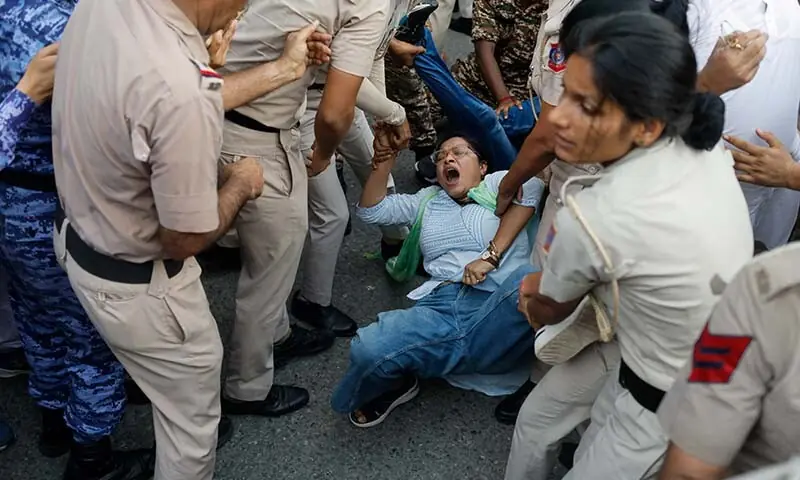
Hostility toward TV crews has intensified since a police crackdown on tens of thousands of demonstrators marching toward parliament on Monday left many students injured. Through the protests, crews from nearly all major television channels have been heckled and verbally abused, with participants calling them pro-government and sold out.
The Editors Guild of India condemned attacks on journalists and referred to the anger aimed at media organisations considered close to the government and the ruling party. At the same time, biased coverage can deepen a crisis and weaken the media’s standing as a pillar of democracy.
The Information and Broadcasting Ministry, Modi’s office and a spokesperson for the Bharatiya Janata Party did not immediately comment.
Debate over media freedom
The confrontation has fed into a wider argument about press freedom in India during Modi’s time in office since 2014. Reporters Without Borders’ World Press Freedom Index placed India 122nd in 2010, but the country fell to 157th out of 180 countries in 2026. The Paris-based organisation linked the decline to attacks on journalists, concentration of media ownership in businesses aligned with the government, and rising political polarisation.
Veteran journalist Ravish Kumar, who is credited with popularising the phrase godi media, said the label has spread because it rhymes with Modi and is now used for most television channels and some national newspapers that critics say show little scrutiny of the government.
Kumar said:
“The godi-media is anti democracy, anti-people, anti-opposition.”
He added:
“They vilify any opposition, label critics as agents of foreign governments, and barely ever feature voices of political parties from opposition.”
Protest organisers urge restraint
A spokesperson for the protest movement, which is led by the Cockroach Janta Party, said organisers had repeatedly asked participants not to target journalists. Deepak Baliyan said the group wanted reporters to be allowed to work and that no one should be mistreated at the protest sites.
“We have urged and we keep urging protesters to not misbehave with godi-media,” said Deepak Baliyan. “Let them do their job. We want to make sure that no one gets mistreated here.”
Manisha Pande, editorial director of the news website Newslaundry, said distrust of television news had built up over years of disillusionment and had sharpened since 2014. She said the larger shift had been in the way news had become anti-people.
“We have always had propaganda, partisanship, opinion-driven prime-time news,” Pande said. “But what has really happened after 2014 is that you have seen a clear shift in how news has become anti-people.”
Digital commentator Akash Banerjee, a former Times Now journalist whose YouTube channel now draws millions of followers, said the failure of traditional media to question the government had pushed audiences toward independent digital platforms.
“The fact that the media has stopped questioning the government has resulted in a rise of alternative digital media, which would not have happened otherwise,” said Banerjee.
Pande also warned that the growing fury carried risks of its own, saying protesters increasingly no longer viewed a reporter as an individual but as a symbol of a media establishment they blame for their suffering.
“The worrying part is that the anger has now taken on a life of its own,” Pande said. “For many protesters, a reporter is no longer seen as an individual but as the face of a thick-skinned media establishment that is responsible for their pain.”
Comments
No comments yet. Be the first to join the discussion!