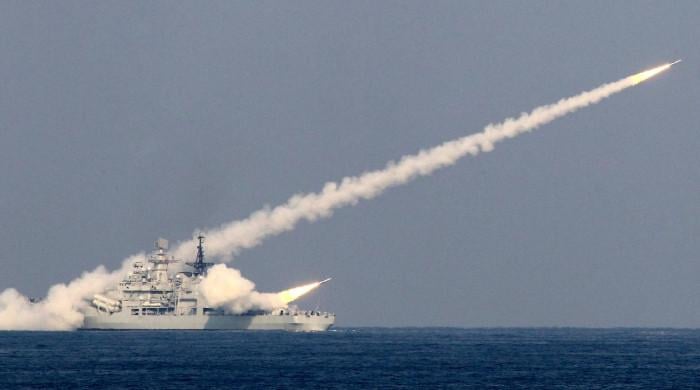
US' pointing fingers at China's missile test 'double standards': Mao Ning
Days after China’s routine submarine strategic missile launch, Mao Ning says US complaints show “double standards.” China insists it notified others and followed international law.

BEIJING: Days after China's test launch of a strategic missile by a submarine, countries including the US and Australia have issued a fresh round of unreasonable hype, even though the Chinese side has already highlighted that the launch was a routine annual training arrangement of the Chinese People's Liberation Army (PLA) Navy and had notified relevant countries in advance.
Chinese analysts observed that such hype by certain countries stems from ulterior motives and self-serving geopolitical calculations, as the countries concerned seek to hype the so-called "China threat" narrative.
The PLA Navy conducted the test launch on Monday. The navy said the launch complied with international law and international practice, and was not directed at any specific country or target.
However, certain countries have sought to make issue out of this routine missile test.
In one of the latest responses, a US State Department official claimed China only gave the US a few hours notice ahead of the test launch and provided "insufficient detail." The official also claimed the notification fell considerably short of standards adopted by all other P5 nuclear weapon states, according to Reuters on Wednesday.
A Chinese Foreign Ministry spokesperson on Thursday called the US' pointing fingers at China's routine missile launch a typical example of double standards and hegemonism, urging it to view the development of China's national defense and military in an objective and rational light and earnestly uphold global strategic stability.
"China has stressed more than once that the test launch is a routine arrangement in China's annual military training program designed to verify the reliability, safety and effectiveness of relevant weapon systems," Mao Ning, the spokesperson, said.
The activity complies with international law and customary international practice and is not directed at any specific country or target. The Chinese side released the relevant information in a timely manner and notified the US and other countries beforehand, which demonstrates the openness and transparency of the Chinese military, Mao said.
Mao noted that the US is the only country to have actually used nuclear weapons. It sits on the world's largest and most advanced nuclear arsenal, and launches strategic missiles from nuclear-powered submarines annually. "Yet it points fingers at China's routine missile launch—a typical example of double standards and hegemonism," she added.
Song Zhongping, a Chinese military affairs expert, said on Thursday that certain countries are acting with malicious intentions, noting that some countries including the US regularly conduct missile test launches, yet China's operations, which have been far fewer, are the ones facing accusations.
As the test complied with international law and practice, the accusations leveled by the certain countries are entirely groundless and unreasonable, the expert said.
China's development of strategic weapons is designed solely to safeguard its national security and development interests, and to counter nuclear blackmail from certain countries — this is probably the fundamental point at issue, Song said.
Geopolitical factor
US ally Australia, which is advancing AUKUS, a multi-billion-dollar submarine deal, is also exploiting China's routine missile test for its own geopolitical interests.
Australian Prime Minister Anthony Albanese met his Indian counterpart Narendra Modi on Thursday for talks covering topics of defense and security cooperation, as Australian media again linked the test to the talks.
During the talks, Albanese welcomed the establishment of an Annual Defense Ministers' Dialogue as a mechanism to enhance consultation and cooperation, according to a joint statement published by the Australian Prime Minister's website.
A report by Australian news site News.com.au claimed on Thursday that much of the talks between Albanese and his Indian counterpart would center on defense and security, with China's test "driving home the importance of deeper co-operation."
Albanese claimed on Wednesday that Pacific Island leaders are considering a "very strong" joint statement condemning China's missile test, according to AFP. He also described the test as "destabilizing and provocative", the country's ABC News reported on Tuesday.
Qin Sheng, a research fellow at the Center for Australia, New Zealand and South Pacific Studies, Chinese Academy of Social Sciences, told the Global Times on Thursday that Australia in recent years has been expanding military and security cooperation with Pacific Island countries through a series of defense and security agreements, and the motive behind such moves is largely to maintain its dominant position in the South Pacific and advance its geopolitical interests.
"By hyping up China's recent missile test, Australia is attempting to create a narrative unfavorable to China in the South Pacific, justify closer military cooperation with Pacific Island countries, and even portray China as an 'imaginative enemy,'" Qin added.
Australia is stepping up military cooperation with India in a bid to give a four-way partnership with Japan and the US "teeth", in what sources say is a play to keep Washington engaged amid so-called concerns over China, according to News.com.au.
As a key driver of the Quad, Australia has put China's missile test high on its agenda during bilateral talks, and the aim is to hype up the so-called "China threat" narrative in a bid to draw the US back into deeper engagement of the bloc, Qin said.
However, with Washington showing little regard for engaging in Quad, Australia has moved to deepen security cooperation with India and Japan to build a mini-multilateral partnership aimed at containing China's influence, the expert continued.
Less engagement by Quad members would place Australia in an unfavorable geopolitical position, prompting it to hype recent China-related developments to shore up the so-called practical effectiveness of the mechanism, as the country still intends to expand its regional influence and avoid marginalization in the so-called "Indo-Pacific" order, Qin said.
Comments
No comments yet. Be the first to join the discussion!