Ukraine's deep-strike drone teams operate under extreme secrecy
KYIV: Ukrainian personnel carrying out long-range drone strikes inside Russia are operating under stringent secrecy, with hidden identities, encrypted communications and strict limits on daily life. AFP said the teams are targeting Russian fuel infrastructure as part of Kyiv’s retaliatory campaign.

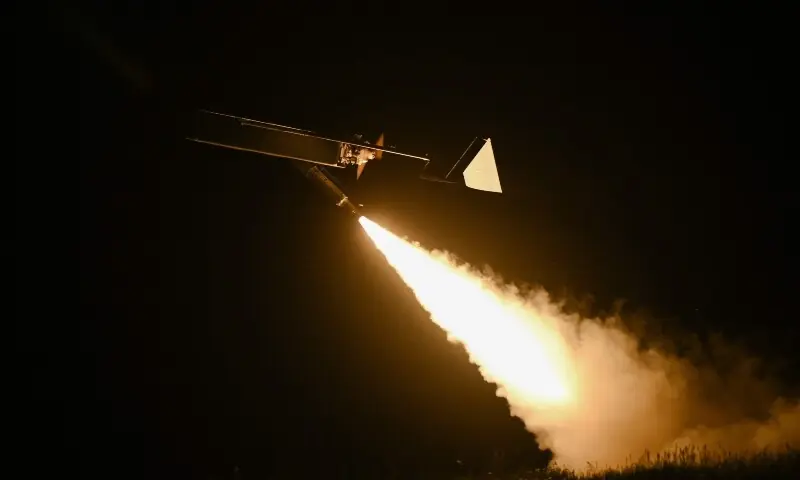
KYIV: Ukrainian soldiers involved in long-range drone attacks inside Russia are living under strict secrecy, with even close relatives often unaware of their roles.
Members of the teams behind strikes on Russian military facilities and oil infrastructure use encrypted communications, avoid public attention and rely on cash for purchases. Kyiv regards the attacks as retaliation for Russia’s repeated strikes on Ukrainian cities and has been targeting fuel depots and refineries on a near-weekly basis in an effort to disrupt Moscow’s energy income.
Denys, a serviceman whose name was changed, said he had been involved in such operations since 2025 and that even his parents and friends did not know about his work because of the rules imposed by his unit, Centre No. 1 of Ukraine’s drone forces. The unit has carried out major attacks inside Russia, including a June strike on an oil refinery in Moscow that sent black smoke over the capital, and another strike on Saint Petersburg as a major international conference was opening there.
Speaking to AFP, Denys said the unit’s importance made secrecy essential.
"Don’t draw attention to yourself, don’t brag. You’ll never be able to talk about what you’ve done, even after the war,"He also said, "We are a very high-value and priority target for the enemy."
Strict concealment in daily life
The names and ages of personnel in the unit are kept secret, and they cannot be photographed or filmed without concealing their faces. Journalists were required to follow strict security measures to gain access earlier this year to one of the launch sites used for the long-range strikes.
Another soldier at Centre No. 1, using the call sign Voron, said the risk extended to both personnel and their families.
"We ourselves understand how high the price can be for our loved ones and for us — that’s why the primary, conscious decision we make is to stay as much as possible in the shadows,"Voron said Russia would do "everything possible to hunt down at least one of these deep-strike groups" and added that he had previously served in a Ukrainian unit tasked with locating and targeting Russian long-range drone teams.
Before the war, Voron worked as a painter and martial arts trainer. Married and with a child, he said his wife likely understood the general nature of his work but did not ask about it. He told AFP that even an indirect public connection to his current unit was forbidden, and that he maintained the appearance online of still serving with a former special forces unit so that friends and relatives would believe he remained there.
Voron said members of the team were not outwardly identifiable in everyday life.
A military intelligence officer from the GUR, using the call sign Wolf, similarly told AFP that the operatives worked to blend in.
"In daily life, you wouldn’t recognise us. We maintain discretion… to pass for ordinary people,"Security measures and operational limits
Words linked to operations, including takeoff and wing, are avoided in public. Team members buy everything with cash, vary the ATMs they use and are barred from joining petrol station loyalty programmes.
The three people interviewed said their phones must remain in flight mode at all times, whether they are on a mission or not, and may only connect through a personal portable router. For military communication, they use special encrypted phones, while any device carrying geolocation capability is prohibited. Lie detector tests are used if there are concerns about a leak and also when screening recruits.
Ukraine’s campaign has caused a fuel crisis across large parts of Russia, though its broader effect on Moscow’s war finances remains difficult to measure. Denys said the team’s growing challenge was no longer a shortage of drones, but a shortage of time.
He said he hoped one day to be involved in a launch that struck the Kremlin and described the effect of the long-range campaign in stark terms.
“We are doing everything we can so that it gives way beneath them.”
Comments
No comments yet. Be the first to join the discussion!