June 28, 2026
Tobacco growers oppose plan to end weighted average price mechanism
Tobacco growers in Swabi have opposed a planned move to abolish the weighted average price mechanism, saying farmers were not consulted and official profit figures were misleading. They urged the federal government to conduct an independent survey before changing tobacco laws.

June 28, 2026
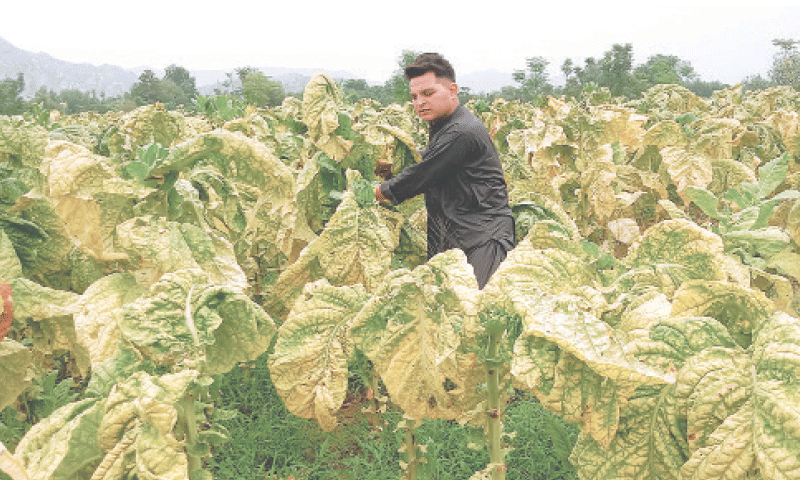
SWABI : Tobacco growers and their representatives on Saturday called on the federal Ministry of National Food Security to consult farmers before making any move to abolish the tobacco weighted average price mechanism or amend relevant tobacco laws, saying official profit figures placed before the federal cabinet did not reflect growers’ actual earnings.
Speaking at a press conference, former Pakistan Tobacco Board director Muhammad Ayaz Khan said the government was considering changes to the Tobacco Marketing Rules, 2016, and Martial Law Order 487 in order to scrap the weighted average price, or WAP, system used to set the annual minimum indicative price for tobacco. He said the cabinet had been told that tobacco farmers earned a profit of 26.41 per cent under the minimum indicative price in 2024-25, while returns under the WAP were presented as 67.33 per cent. Growers rejected those calculations and said actual profits were far lower.
Mr Khan said tobacco cultivation differed from other crops because of its high costs and difficult working conditions. “Tobacco is completely different from other crops. It costs about Rs2 million per hectare to cultivate, and farmers grow it in unbearable heat,” he said.
Growers challenge profit calculations
The growers said the ministry had used misleading figures on farmers’ earnings to support the proposed removal of the WAP mechanism. According to them, inflation and markup were counted as part of farmers’ income even though those items were part of production costs and should not have been treated as profit.
Mr Khan said the Pakistan Tobacco Board had estimated tobacco output in 2023-24 at 3,630 kilogrammes per hectare, while production at the board’s research stations was about 2,100kg per hectare. He said windstorms damaged the crop and reduced average yield to around 2,900kg per hectare. With the WAP fixed at Rs709 per kg, gross income came to Rs2,056,100 per hectare. He said PTB data put the cultivation cost for one hectare at Rs1,750,749, leaving net income of Rs305,351. Spread over eight months, he said, that worked out to roughly 17 per cent profit rather than the 67 per cent presented to the cabinet.
For 2024-25, Mr Khan said PTB had estimated production at 3,623kg per hectare and put cultivation costs at Rs1,804,000. He said the WAP was fixed at Rs719 per kg, but companies signed agreements with farmers for the purchase of only 2,100kg per hectare. Natural calamities again damaged the crop, he said, reducing average production to about 2,750kg per hectare. Under the agreements, companies bought 2,100kg at the WAP, while the remaining 650kg was purchased at the minimum indicative price of Rs545 per kg after the crop was declared surplus.
He said farmers earned Rs1,509,900 from selling 2,100kg at Rs719 per kg and another Rs354,250 from selling 650kg at Rs545 per kg, taking gross income to Rs1,864,150. After deducting cultivation costs of Rs1,804,000, net income was only Rs60,150. “This means the profit for eight months’ work was only about 3.3pc in 2024-25, not 67pc,” he said.
Call for consultations and survey
Mr Khan said 2022-23 was the only year in which tobacco growers made substantial profits. He said that although the minimum indicative price had been fixed at Rs310 per kg, lower supply and stronger demand had created competition among companies and pushed the market price up to Rs700 per kg. As a result, he said, farmers earned about Rs1,571,000 in profit over eight months, making it one of the few years in which growers posted reasonable returns.
Iqbal Khan Shewa, patron-in-chief of the Khasthkar Ittehad Association, said 2024-25 had been a calamity-hit year and the tobacco crop had suffered extensive damage. He alleged that companies had declined to buy low-grade tobacco and that large quantities were still lying in farmers’ warehouses. “The losses pushed tobacco farmers deep into debt. If the federal government wants the facts, it should conduct an independent survey of tobacco farmers,” he said.
The growers reiterated their demand that the federal ministry engage with farmers before introducing any change to the tobacco pricing mechanism or the existing legal framework governing tobacco marketing.
0 Comments
No comments yet. Be the first to join the discussion!