

June 28, 2026
Govt reappoints bureaucrats to PARCO
The federal government has reconstituted PARCO’s board, retaining most existing Pakistani directors and replacing only one member. The finance ministry’s latest report also shows a sharp drop in the company’s sales and profit in FY2025.

June 28, 2026
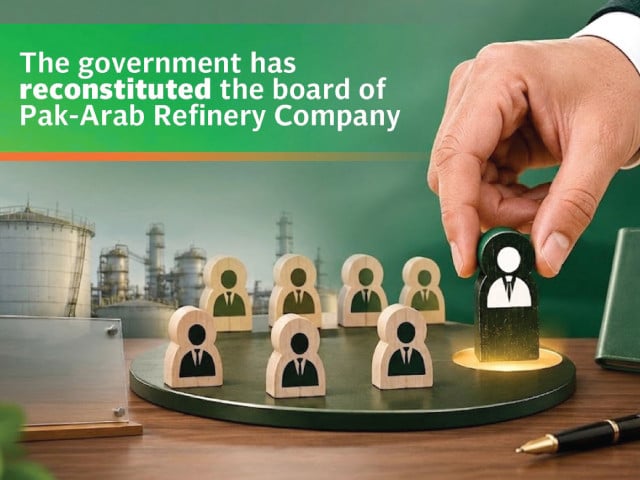
ISLAMABAD: The federal government has reconstituted the board of Pak-Arab Refinery Company (PARCO), keeping a federal minister and all but one of the existing Pakistani directors in place for another three years, a federal cabinet decision stated.
Under the company’s structure, Pakistan is entitled to nominate six members to the 10-seat board, while the remaining positions are filled by the United Arab Emirates side, which holds a 40% stake in the company. The new arrangement replaces Jahanzeb Khan with Rabab Sikandar Sultan, a grade-22 officer of the Pakistan Customs Service. Her husband, Chief Election Commissioner Sikandar Sultan Raja, had also served on the board previously.
Among the Pakistani nominees, four are serving bureaucrats, including two ex-officio members, along with one federal minister. Petroleum Secretary Hamed Yaqoob Sheikh will continue as board chairman, while Finance Secretary Imdadullah Bosal remains an ex-officio director. Ahad Khan Cheema, the federal minister for economic affairs, has also been reappointed for a three-year term. Rashid Langrial, who is secretary of the revenue division and chairman of the Federal Board of Revenue, was recommended by the Board Nomination Committee in his official capacity, but the Prime Minister’s Office appointed him in his personal capacity. He had only recently joined the board before its previous term ended on May 21 and has now been reappointed for another three years.
The reconstituted board is scheduled to meet in Vienna on July 2. Board members are entitled to a fee of $3,500 for attending a meeting. However, it remains unclear whether that amount will be paid for the Vienna meeting in light of the prime minister’s instructions. Any change to fee arrangements would require a board resolution, as government instructions are not binding on the board.
Company status and board appointments
PARCO is described as a strategically important integrated oil company in Pakistan’s energy supply chain. It is a joint venture between Pakistan, which owns 60%, and the Abu Dhabi Petroleum Investment Company, which holds the remaining 40%.
Although the government owns a majority stake, PARCO has not been declared a state-owned enterprise. The finance ministry nonetheless monitors its operations and includes the company in its performance reporting. The government’s position has been that PARCO cannot be classified as an SOE because of the participants’ agreement between Pakistan and the UAE partner. It has previously maintained that the SOEs Act, 2023 does not apply to the company because of its distinct legal and corporate structure. The Securities and Exchange Commission of Pakistan, the Lahore High Court and the attorney general of Pakistan have also expressed views on the company’s legal status.
PARCO is not the only partially or fully state-owned entity where bureaucrats serve on boards. The finance ministry has also appointed serving and retired bureaucrats to bilateral development finance institutions, including Pak-Brunei Investment Company, Pak-Kuwait Investment Company, Pak-Oman Investment Company and Saudi-Pakistan Industrial and Agriculture Investment Company, where board fees are reported to be higher than those paid by some state-owned enterprises.
Finance Minister Muhammad Aurangzeb had decided to reorganise these development finance institutions after taking office, but no public restructuring or revamping plan was subsequently disclosed to remove bureaucrats from those boards. Prime Minister Shehbaz Sharif has twice tried to cap the annual fees that a bureaucrat can receive from all boards, first at Rs600,000 and later at Rs1 million. Deputy Prime Minister Ishaq Dar is also opposed to large board payments to bureaucrats serving either ex-officio or in their personal capacity. The bureaucracy’s position is that such board roles carry risks and should therefore be compensated financially.
Finance ministry flags pressure on margins
The finance ministry’s latest annual report on state-owned enterprises said PARCO faced major operational and financial pressures in FY2024-25. It pointed to a steep fall in refining margins, saying the company’s profitability remains exposed to global oil price cycles. The ministry also highlighted the company’s dependence on imported crude, which leaves it exposed to exchange-rate risk, and said there was no oil hedging in place.
Other concerns identified included large cash outflows from dividend payments during periods of weak margins, which strained liquidity, as well as lower throughput and reduced efficiency in asset utilisation. The ministry added that higher finance costs further compressed net margins in a period of elevated interest rates.
According to the finance ministry’s last available SOE performance report, PARCO’s net sales and services fell from Rs1.14 trillion in FY2024 to Rs965 billion in FY2025, a decline of about 15%. The decrease was attributed to lower international crude prices, reduced throughput and weaker domestic demand, especially in diesel and furnace oil. Net profit after tax dropped to Rs22.2 billion in FY2025 from Rs55.1 billion a year earlier, representing a 60% contraction in bottom-line profitability. Despite those pressures, the company’s joint ventures continued to generate dividends, indicating healthy investment returns despite headwinds in the sector.
0 Comments
No comments yet. Be the first to join the discussion!


