June 23, 2026
Interstellar comet may be far older than the Solar System, astronomers say
Astronomers say interstellar comet 3I/ATLAS may be up to 12 billion years old, making it far older than the Solar System. New telescope data suggests it formed in an extremely cold environment and is unlike known Solar System objects.

June 23, 2026
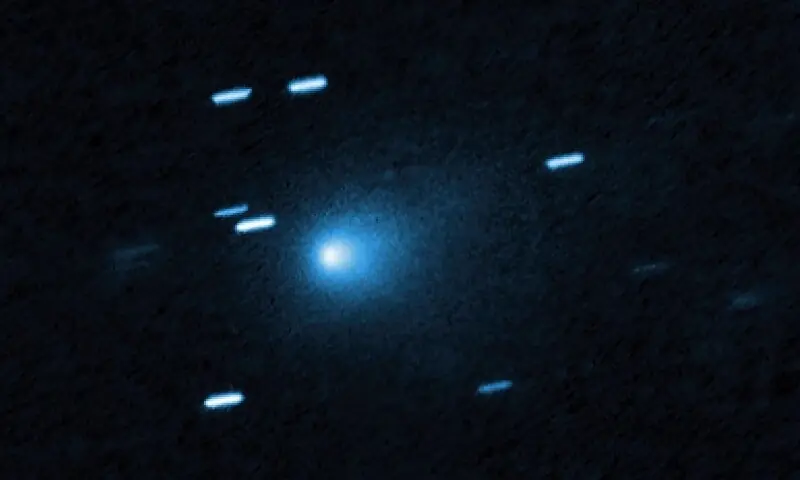
PARIS: Astronomers said on Monday that an interstellar comet that passed by the Sun last year may be almost three times older than the Solar System, with new observations suggesting it is unlike any object previously seen in our cosmic neighbourhood.
The comet, known as 3I/ATLAS, is only the third object from beyond the Solar System ever observed by humanity. Scientists said its unusual brightness has given researchers a rare chance to closely examine material that appears to have originated elsewhere in the Milky Way. After it was first detected in July last year, the object drew widespread attention online, including speculation from a prominent Harvard researcher that it might be an alien spacecraft, a possibility that Nasa rejected.
According to a new study published in the journal Nature, 3I/ATLAS could be as old as 12 billion years. The Solar System is thought to have formed about 4.5 billion years ago. Martin Cordiner, the study’s lead author from Nasa’s Goddard Space Flight Center, said the object may be exceptionally ancient.
Cordiner also said there could be “edge-case scenarios” that might explain the comet’s unusual chemistry in other ways.
Unusual chemical signature
The research relied on isotope ratios measured by the James Webb Space Telescope and the ALMA observatory in Chile. The study said those readings showed an elemental makeup not seen in any known body from the Solar System.
A Nasa statement said the comet contains about 30 times more deuterium than comets found in the Solar System. Deuterium is a form of hydrogen commonly present in heavy water. Cordiner said such a large amount of heavy water points to formation in an extremely cold setting.
“That high abundance of heavy water can only really happen, according to our understanding of astrochemistry, in a very cold environment,” the statement said.
Based on the isotopic evidence, scientists said the comet likely formed in conditions around minus 243 degrees Celsius, making it one of the coldest objects ever detected within the Solar System.
Possible relic from an earlier era
Researchers said they still do not know exactly where in the Milky Way the comet originated. Interstellar objects are believed to form in much the same way as comets in the Solar System, before being thrown out during the turbulent birth of planets. Cordiner said that, no longer bound to any star, 3I/ATLAS probably spent billions of years travelling on “vast unimaginable trajectories around our galaxy,” before reaching our part of space.
Scientists also found what was described as an unusual lack of chemical enrichment, which suggests the comet formed relatively near regions where stars were being born. Cordiner said it may even be a “relic” from the era known as “cosmic noon”, when star formation was especially active around 10 billion years ago.
The two previously detected interstellar visitors — 1I/’Oumuamua, discovered in 2017, and 2I/Borisov, seen in 2019 — were not bright enough for isotopic measurements of this kind. Harvard professor Avi Loeb, who had earlier stirred debate by suggesting that ’Oumuamua might have been an alien spacecraft, raised similar ideas about 3I/ATLAS. Nasa has dismissed that suggestion, and last month the Search for Extraterrestrial Intelligence Institute said it had found “no evidence of extraterrestrial technology” linked to the comet. Steve Croft, an Oxford University researcher with SETI’s Breakthrough Listen Initiative, said all observations so far “are consistent with it being a natural astrophysical object”.
0 Comments
No comments yet. Be the first to join the discussion!