June 23, 2026
Europe’s heatwave exposes rail network weaknesses
A sustained heatwave in Europe is disrupting rail services as older tracks, overhead lines and cooling systems struggle under extreme temperatures. Operators in France and Belgium have already cut services and adopted preventive measures.

June 23, 2026
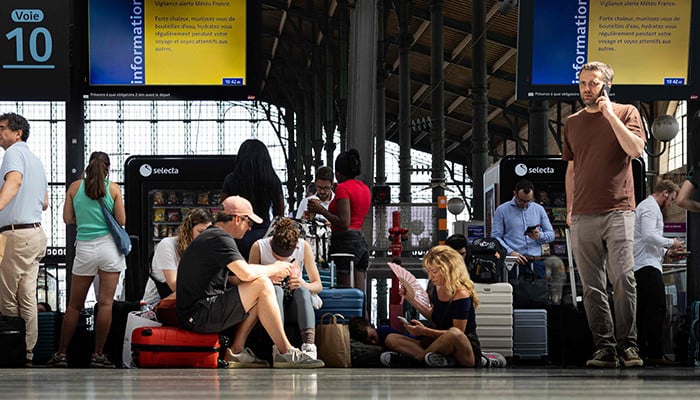
PARIS: A prolonged spell of extreme heat across much of Europe is disrupting rail services by exposing the limits of infrastructure built for cooler conditions, with delays, cancellations and warnings for some passengers.
The main problems affecting train operations include overhead electric lines expanding and sagging in the heat, tracks widening by small margins under direct sunlight, and air-conditioning systems coming under strain. Maintenance investment on some lines has also fallen behind.
Older networks under pressure
Service reductions have been more common in countries such as France and Belgium, where large parts of the rail network and rolling stock are decades old, despite the presence of newer high-speed lines. On trains that do have air conditioning, the system can shut down automatically if carriages become too hot, leading operators to cancel services in advance on routes most exposed to high temperatures.
Belgium’s national rail operator SNCB has taken trains without air conditioning out of service during rush hours. In France, SNCF has withdrawn 10% of trains in the Paris region to reduce the risk of tracks overheating and becoming permanently deformed.
Heat is also affecting catenaries, the overhead power lines used by electric trains. As metal expands, those lines can droop, increasing the risk that they may catch on passing trains. Severine Lepere, SNCF’s director for the greater Paris region, said a broken power line was "very strongly suspected" as the cause of a major freight train disruption at Paris Gare de l’Est station on June 18.
Why this heatwave is proving harder to manage
The current heatwave is especially difficult because temperatures have remained extremely high for several days, with little relief at night, and forecasts still showing several more days at or above 40C. Track temperatures can climb even higher, reaching 60C, which can cause metal rails to stretch or widen to dangerous levels.
John Lawrence, chair of the Railway Technical Network at the UK’s Institution of Engineering and Technology, said engineers are most concerned about track distortion and damage to overhead systems. He said these problems can raise derailment risks and disrupt train movements, while signalling equipment can also fail in extreme heat.
Lawrence said, "Track buckles and dewirements are what really worry engineers."
He added, "That brings derailment risks, and overhead lines can sag and catch on pantographs, halting train movements or forcing lengthy reroutes."
Why Europe faces a distinct challenge
Trains also operate in very hot countries such as India and parts of Africa, but those systems generally do not depend as heavily on high-speed services like France’s TGVs, which can reach 320 km/h. Pierre Plaindoux, a rail specialist at consultancy MC2I, said Europe’s higher speeds require much tighter standards for track reliability.
Plaindoux said, "The high speeds we have in Europe require extremely reliable tracks and and better quality network — you can't have the slightest gap."
He also said that in the United States and Canada, where passenger rail is less widespread, overhead power systems are rarely used. "The vast majority of rolling stock is diesel trains on major lines," he said.
Possible fixes under discussion
Among the solutions highlighted are better monitoring of rail temperatures so operators can impose speed restrictions instead of cancelling trains as a precaution. Plaindoux said that in countries with lower labour costs, inspectors are deployed across the network, while France is moving towards installing more sensors.
Another measure is painting tracks white so they reflect heat rather than absorb it, a method that is becoming more common in countries including Britain and Italy. Antonios Kanellopoulos, associate professor in innovative construction materials and director of the Centre for Engineering research at the University of Hertfordshire, said, "Reflective paint can shave five to 10 degrees Celsius of rail temperature."
Rigid power lines could reduce the sagging risk seen with wire catenaries during heatwaves. Plaindoux said France has already installed such systems over a couple of dozen kilometres on busy routes, although he added that extending them over long distances would be too costly.
0 Comments
No comments yet. Be the first to join the discussion!