

June 19, 2026
Why Karbala Hurts More as I Grow Older
How aging, fear of losing parents, and raising children make Karbala’s tragedies feel painfully real
June 19, 2026

"Ammi, why are you and everyone else crying so much?"
I remember asking this as a little girl while attending a Majlis. I must have been five or six. The room was filled with grief. People were reciting Noha (elegy), mourning Imam Hussain (A.S.), and remembering the painful tragedies of Karbala. I could see tears on so many faces. I could hear the sorrow in every voice.
I was sad too. I knew Karbala was tragic. I knew Imam Hussain (A.S.) and his family had suffered. But I could not understand why the adults around me cried as if the pain had happened right in front of them.
At that age, I thought I understood grief.
Now I know I had only heard about it.
With time, Karbala has not changed. I have.
As I grew older, as I became a daughter who feared losing her parents, a sister who understood separation, and now a mother who sees her own children's bond with their father, the grief of Karbala began to reach places in my heart I did not even know existed.
There was a time when I cried because Karbala was painful.
Now I cry because I understand pain differently.
As a child, I listened to the tragedy of Karbala with sadness. I felt sorrow for Imam Hussain (A.S.), for his family, for the children, for the thirst, for the cruelty. But childhood has a way of protecting the heart. It allows us to feel pain without fully knowing its depth.
Then life happens.
We grow older. We love more deeply. We fear losing people. We witness illness. We understand helplessness. We learn that separation is not just a word. We learn that waiting can break a heart. We learn that some wounds are not seen but carried quietly for a lifetime.
And then Karbala begins to feel different because our hearts become more aware of what was lost.
When I hear about Bibi Sughra (A.S), left behind and separated from her family, my heart aches in a way it never did before. I imagine her waiting. I imagine her longing to see her brothers, Ali Akbar (A.S.) and Ali Asghar (A.S.), her little sister Bibi Sakina (A.S), and her loved ones just one more time.
As a child, I heard about her separation.
Now, I feel the fear of it.
I think of my own siblings. I think of the bond we share, the comfort of knowing they are there, the pain of even imagining a life where that bond is taken away. Bibi Sughra’s grief is not just the grief of distance. It is the grief of waiting for footsteps that will never return, for voices that will never be heard again, for faces she would long to see for the rest of her life.
When I hear about Bibi Sakina (A.S), the little daughter who could not sleep without her Baba, Imam Hussain (A.S), my heart breaks in a way I cannot explain.
As a child, I related her pain to my own love for my father. I used to imagine how unbearable it must have been for a little girl to lose the father she loved so deeply.
But now, as a mother, it hurts differently.
Now I see my own daughter’s face. I see the way a little girl looks at her father with complete trust. I see the way she runs to him, searches for him, feels safe in his presence, and believes that as long as he is near, nothing can harm her.
And then I think of Bibi Sakina (A.S).
Her earrings being snatched. Her ears bleeding. Her tears being answered with cruelty. Her innocent heart longing for her Baba. Her little body surrounded by darkness, loneliness, and fear in a prison far from home.
I cannot hear this and remain the same.
It is no longer only a tragedy I heard as a child.
It feels painfully real.
When I hear about Beemar-e-Karbala, Imam Zain-ul-Abideen (A.S.), I feel his suffering differently too. I know what it means to live around illness. I know what it means to care for someone you love. I know the worry, the arrangements, the fear, and the helplessness that come with sickness.
My siblings and I see it while caring for our parents.
Illness changes the atmosphere of a home. It makes every small comfort feel important. It makes every moment of pain difficult to watch. It makes you wish you could take the suffering away from the person you love, even when you know you cannot.
And then I think of Imam Sajjad (A.S.).
Ill, weak, and grieving, yet forced to travel as a prisoner in heavy chains. He had witnessed the greatest losses. He had seen the family of the Prophet (S.A.W.W.) surrounded by cruelty. He carried illness in his body and grief in his heart, yet he became the voice that kept Karbala alive.
The thought is unbearable.
And then there is the thirst.
Today, we have fans, air conditioners, cold water, shade, comfort, and still we complain about the heat. We feel restless if we are thirsty for even a short while. We cannot imagine children crying for water and no one being allowed to give it to them.
But in Karbala, the family of the Prophet (S.A.W.W.) was denied water for days under the scorching heat of Iraq.
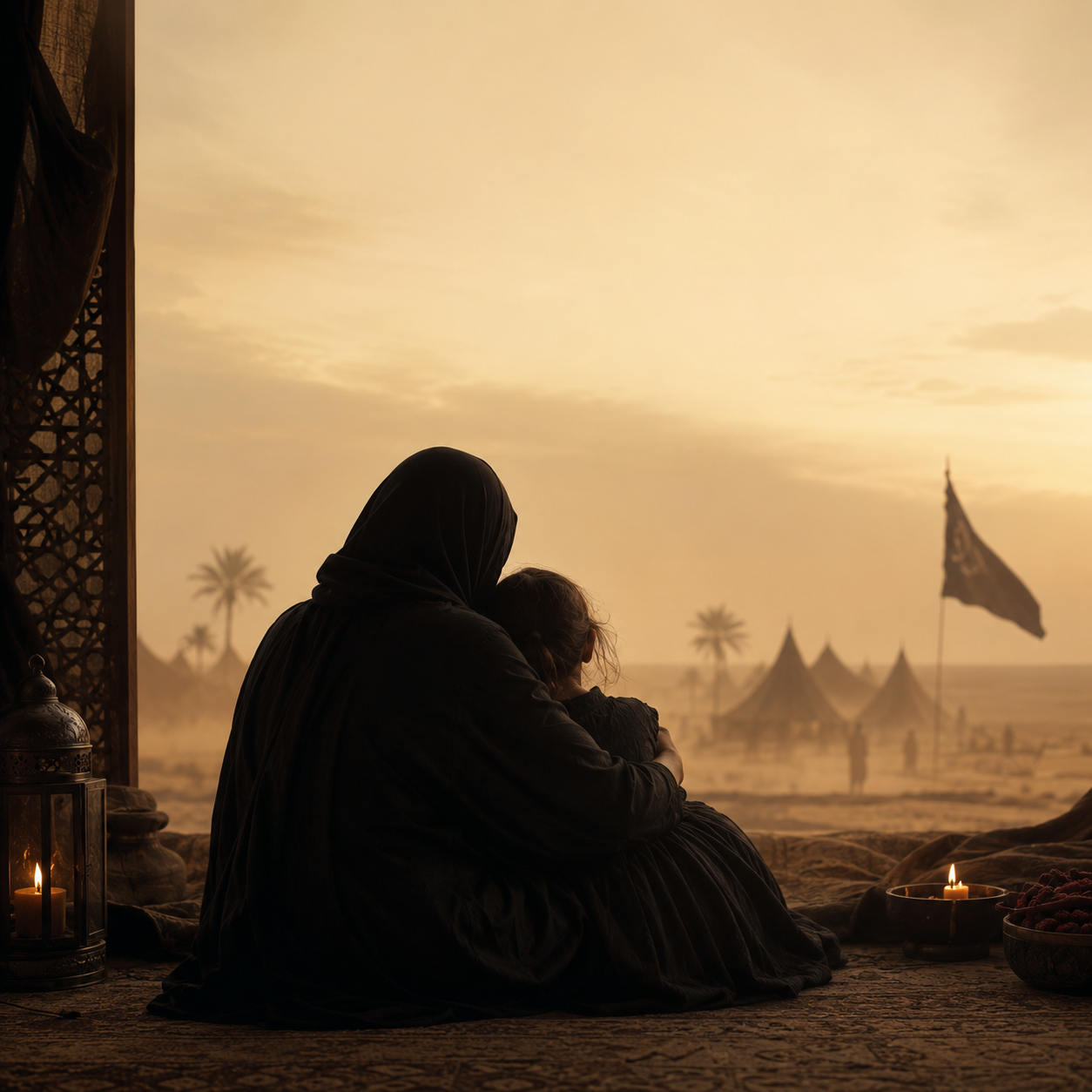
Children cried from thirst. Mothers watched helplessly. The tents were filled with grief, hunger, fear, and longing. Bibi Zainab (A.S) endured loss after loss, yet stood with a strength the world can never fully comprehend.
She lost brothers, nephews, sons, and loved ones. She saw the tents burn. She saw the children tremble. She carried the responsibility of the surviving family with a heart shattered by grief, yet she never allowed falsehood to win through silence.
Karbala teaches us so much.
It teaches us that faith must come before comfort. It teaches us that truth must never bow before falsehood. It teaches us not to give allegiance to an unjust and unworthy ruler. It teaches us the beauty of sacrifice, the strength of patience, the pain of betrayal, the value of family, and the ugliness of the hunger for power.
As a child, I used to wonder why it did not rain. I used to wonder why no one stopped it. I used to wonder what could have prevented such a tragedy.
But now I understand that Karbala was not only an event to be remembered.
It was a lesson for humanity.
A lesson in love.
A lesson in loss.
A lesson in courage.
A lesson in faith.
A lesson in standing for truth, even when the whole world stands against you.
Perhaps this is why Karbala hurts more as we grow older.
Because we no longer only hear about separation. We begin to fear it.
We no longer only hear about thirst. We begin to imagine it.
We no longer only hear about a child crying for her father. We see our own children in her place.
We no longer only hear about illness. We remember the people we love who suffer quietly.
We no longer only hear about betrayal, cruelty, and power. We begin to recognize the same darkness in the world around us.
Karbala is not distant.
Karbala lives in every heart that understands pain, love, sacrifice, and truth.
Perhaps this is why the famous line feels so true:
Islam zinda hota hai har Karbala ke baad.
Because Karbala was not the end of truth.
It became the reason truth could never be buried.
That is why we cry.
Not only because it happened.
But because, with time, we finally begin to understand what it meant.
Manal Jaffery is a news editor at Pakistan Today with extensive experience in journalism, reporting, newsroom editing and digital content production. Her work covers national and international news, with a focus on accuracy, clarity and timely reporting.
View all articles →0 Comments
No comments yet. Be the first to join the discussion!


