June 17, 2026
Iran will 'work closely' with the US on removing enriched uranium: Trump
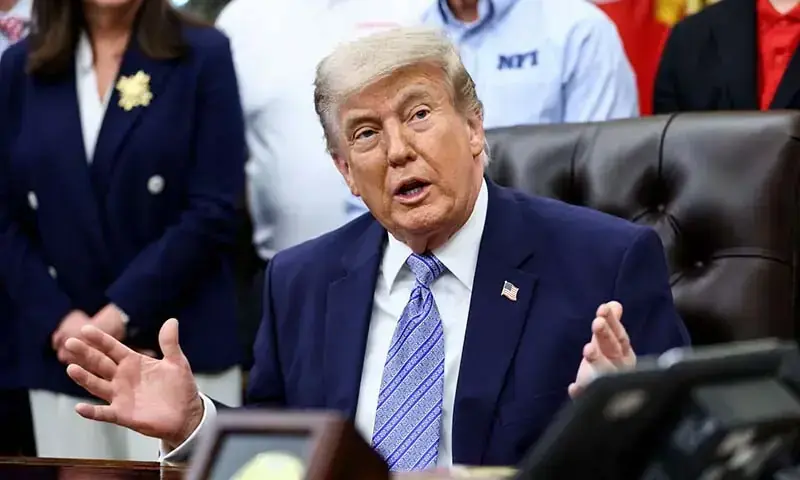
At the G7 summit, President Donald Trump said Iran will work closely with the US to remove enriched uranium. He expects the Iran accord to be signed shortly, while noting uncertainty on the exact date.

WASHINGTON: US President Donald Trump on Wednesday said Iran will 'work closely' with the US on removing enriched uranium, adding, he expected the accord with Iran ending the Middle East war to be signed "shortly" but added uncertainty over the exact date.
"The deal we reached with Iran on Sunday will be signed shortly, tomorrow (Thursday), maybe the next day (Friday)," Trump said at the G7 summit, after previous announcements that it would be signed Friday in Switzerland.
"We are going to most likely sign a deal," he added.
Trump told reporters at the final press conference of the G7 that he was prepared to "bomb the hell" out of Iran if they violated the agreement.
"If they are not behaving they will be hit again," he said.
But he added: "They don't want to get bombed, they don't want to get hit".
In a long succession of comments on his dealings with Iran, Trump recalled at length how he had in 2020 issued the order to kill Qassem Soleimani, the head of foreign operations for the Revolutionary Guards, who he described repeatedly as a "mad genius".
Trump also recalled the February 28 air strike that killed supreme leader Ayatollah Ali Khamenei and other senior figures, who he said were "having breakfast" at the time.
Trump was also asked about the deadly strike on an Iranian school in Minab on the first day of the war, which left 155 dead, according to the Iranian authorities.
Initially describing the question as "strange", Trump said: "Nobody did it on purpose. Mistakes are made, war is nasty."
"I know it is under investigation," he said, telling the reporter to address the question to Defence Secretary Pete Hegseth instead.
A US Tomahawk cruise missile hit the elementary school due to a targeting mistake, according to the preliminary findings of a US military investigation reported by The New York Times.
Trump also thanked Russian President Vladimir Putin and Chinese President Xi Jinping for staying "neutral" in the Middle East war.
Trump defends US-Iran deal
While defending the US deal with Iran, Trump said he did not want to see an economic catastrophe that could have been triggered by a continued war in the Middle East.
"So, the one thing I didn't want to see is, I didn't want to see economic catastrophe. If you kept this going, that could have happened," he said.
The US president said he did not want to be like Herbert Hoover, who was serving as US president in October 1929 when the stock market crashed, causing the loss of billions of dollars and triggering what became known as the Great Depression.
He said Washington "did send a copy" of its accord with Iran to end the Middle East war, following reports of tensions with Prime Minister Benjamin Netanyahu.
Insisting he maintains a good relationship with Netanyahu, Trump reaffirmed his criticism at the G7 summit of Israel's campaign against Hezbollah in Lebanon, saying "they (Israel) could do a much better job".
Netanyahu and Trump have repeatedly clashed over Israel's refusal to constrain its pursuit of Iran-backed Hezbollah in Lebanon, where a cessation of hostilities is a key Iranian demand.
"Netanyahu happens to be a good man, gets a little excited sometimes," Trump said. "We have a little dispute over Lebanon. I say you can do a little softer touch, Bibi. You don't have to knock down a building every time somebody walks into it that's from Hezbollah."
The war, which began with US and Israeli strikes on Iran on February 28 and spiralled into a broader regional war, has sent energy prices up sharply, renewed inflationary pressures and sparked concerns about a major food supply crisis in developing countries.
Economists say the peace deal spells good news for the global economy, but warn of huge risks if the deal falls through and the conflict intensifies. They add that getting trade flows back to normal will also take months, if not longer, while fuel sector analysts and maritime experts say it could take a year for bunker fuel supplies to return to normal.
Trump says Iran deal not final
Earlier, the US President said that the memorandum of understanding on Iran was not final, and that he could resume a bombing campaign if he did not like it.
He made the remarks as he and Egyptian President Abdel Fattah el-Sisi addressed reporters at the G7 summit in France with comments focusing on the US-Iran negotiations.
"It's a memorandum of understanding. And if I don't like it, we'll go back to shooting at them, dropping bombs on their head. If I don't like it, if they don't behave, we'll go right back to dropping bombs right smack in the middle of their head, OK?" he said.
Trump also claimed that he had spoken with the Syrian leader about combating Hezbollah.
Additionally, Trump said there was a 99.99% chance that Iran will never have a nuclear weapon.
“What is really happy is the [stock] market that has gone wild. It’s gone through the roof. And oil has tumbled down,” the US president said. “That speaks louder than words.”
The US president reiterated his view that the US-Iran framework deal was “very strong”.
“Nobody knows what it is, but it’s very strong,” he said.
Trump added that the Strait of Hormuz would be fully open in the next “day or two”.
Trump said news reports that the US-Iran deal includes provisions for $300b in reconstruction funds to go to Tehran are false.
“We’re not putting up 10 cents,” Trump said. “We are not investing, and we do not have a fund.”
Trump said he’s not asking Gulf countries to invest in Iran but “if they do it, fine”.
“I would say they won’t be doing it for a while until they find out the behaviour [of the Iranians],” he added.
Opening Hormuz will be 'massive step forward': NATO chief
NATO chief Mark Rutte on Wednesday hailed the US-Iran deal to end the Middle East war, saying the planned reopening of the Strait of Hormuz would be a "massive step forward".
"The restoration of free passage through the Strait of Hormuz will be a massive step forward, and I know that many allies, through the initiative led by France and the United Kingdom, are ready to support," Rutte told a press conference in Brussels.
0 Comments
No comments yet. Be the first to join the discussion!