June 16, 2026
Budget 2026-27: The paper recovery
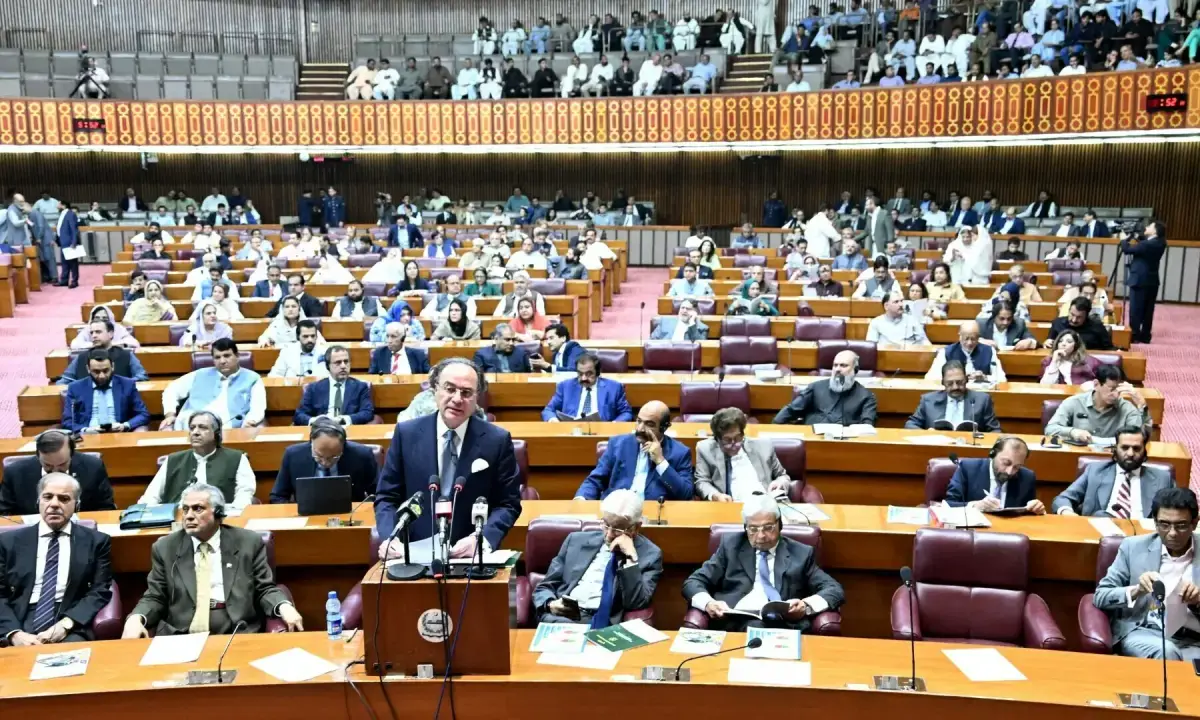
Pakistan’s Rs18.8tn Budget 2026-27 signals a shift toward recovery, with 4% growth and 3.6% deficit targets. Yet debt servicing and limited development spending leave a fragile, unproven transformation.
June 16, 2026

Pakistan’s Rs18.8 trillion federal budget for FY2026-27 is presented as a turning point, framed as a shift from stabilisation to growth, from austerity to recovery, and from constraint to renewed confidence. Yet beneath this carefully constructed optimism lies a more uneasy reality. The state is attempting to grow while still absorbing the costs of survival. The result is a budget that signals movement, but not yet transformation.
At the macro level, the picture appears controlled. Growth is projected at around 4 percent while inflation is expected near 8.2 percent. The fiscal deficit is targeted at 3.6 percent of GDP. External inflows provide some breathing space. Remittances are expected to reach about 41 billion dollars. Pakistan has also returned to international capital markets through a 750 million dollar Eurobond and raised over 500 million dollars through Panda Bonds. Investor participation in the domestic market has widened with more than 173000 new entrants to the stock exchange.
These indicators suggest stability returning to the system. But they do not answer a deeper question about structure. The budget does not present a clear roadmap for education, health, or long-term productivity. There is little visible direction for agriculture, industry, technology, artificial intelligence, or small and medium enterprises. For an economy where weakness lies in productivity and human development, this silence matters as much as the numbers that are presented.
The expenditure side explains the limits of ambition. Debt servicing takes around 8045 billion rupees. Defence follows at about 3000 billion rupees. Pensions require nearly 1169 billion rupees while civil administration stands at around 1071 billion rupees. Subsidies add another 1091 billion rupees, largely tied to energy support. Social protection programmes including cash transfers and regional allocations account for about 280 billion rupees. These fixed commitments leave very little room for development spending. The budget is therefore not simply allocating resources. It is operating under constraint.
Within this space the government has introduced selective relief. Salaries and pensions are increased by 7 percent. The minimum wage is raised by 10 percent. Tax relief is provided to parts of the salaried class, particularly those earning between 2.2 million and 7 million rupees annually. The surcharge on very high incomes above 10 million rupees is removed. Taxes on sanitary products and contraceptives are abolished, a small but important correction in a system where indirect taxation often falls unevenly.
But for low-income households these adjustments are limited in impact. Inflation continues to shape daily life more strongly than policy announcements. Food, electricity, and transport costs remain the most pressing burden. Much of the workforce in Pakistan remains informal and outside the reach of formal wage adjustments. The result is a gap between policy relief and lived experience.
The most debated element of the budget is its growth strategy. It relies heavily on real estate and construction. Property transaction taxes are reduced. Deemed rental income provisions are removed. Housing related subsidies of around 71 billion rupees are introduced. This approach is designed to stimulate activity quickly. It may generate short term growth and visible movement in markets. But it does not build export capacity or industrial strength. Pakistan has followed this path before. It tends to produce cycles of speculation followed by correction rather than sustained development.
At the same time the government has set a tax revenue target of 15.26 trillion rupees. This represents an increase of nearly 18 percent. Yet it comes alongside broad tax reductions including cuts in super tax rates and relief for exporters. This creates a difficult contradiction. Higher revenue expectations are being placed on a narrow and already strained tax base. An estimated 800 billion rupee shortfall from previous years further complicates the challenge. If revenue falls short the pressure will likely shift to development spending or require mid year adjustments.
Another major shift is in fiscal balance between the federation and provinces. Provinces are expected to contribute nearly 8848 billion rupees to federal revenues while their share under the NFC framework remains unchanged. At the same time they are expected to generate surpluses of around 1.8 trillion rupees to meet consolidated targets. This effectively moves fiscal pressure downward. The centre maintains its spending structure while provinces absorb adjustment.
For ordinary citizens the consequences are less abstract. A salaried worker may see a small increase in income but faces rising rent and utility bills. A pensioner receives a 7 percent increase but loses purchasing power to inflation. A low-income household may not engage with fiscal targets but experiences their effects in daily expenses. Stability at the macro level does not automatically translate into relief at the household level.
The central tension of this budget lies here. It projects confidence in growth while preserving the same underlying structure of the economy. It seeks expansion without major reform. It supports consumption more than productivity. It shifts fiscal pressure rather than resolving it. It offers relief but within tight boundaries defined by debt and external dependence.
Pakistan is not standing still. But it is not yet changing direction either. It is moving within limits set by its past choices and present constraints. The question that remains is whether this path leads to real transformation or simply to another cycle of temporary stability followed by renewed strain.
The writer has a PhD in Political Science, and is a visiting faculty member at QAU Islamabad. He can be reached at [email protected] and tweets @zafarkhansafdar
View all articles →0 Comments
No comments yet. Be the first to join the discussion!