June 15, 2026
Senators warn rising debt is shrinking space for public spending
Senators from across the aisle criticised the FY27 budget in the Senate, citing the rising debt burden, heavy interest payments and limited space for development spending. Opposition lawmakers also challenged the budget’s tax and subsidy measures.

June 15, 2026
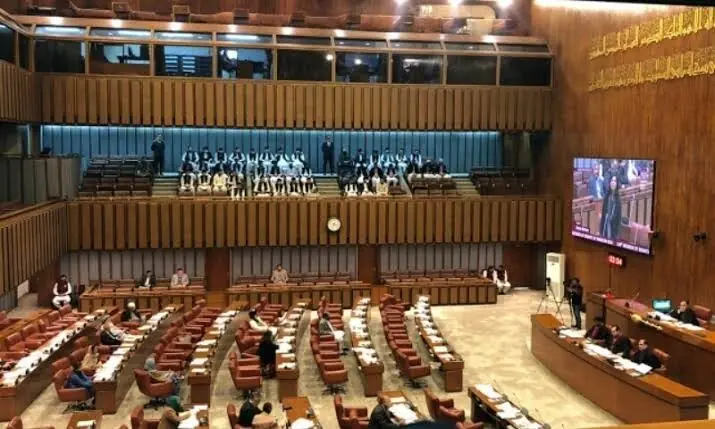
ISLAMABAD: Senators from both treasury and opposition benches on Monday voiced concern over Pakistan’s rising debt burden during the Senate’s discussion on the federal budget, arguing that growing repayments were leaving limited room for development and public welfare spending.
The government presented the budget for FY27 on June 12, setting aside Rs8,054 billion for interest payments. Pakistan Peoples Party vice president and Senate parliamentary leader Sherry Rehman said around 42.8 per cent of the federal budget was being consumed by debt servicing, including interest as well as principal repayments.
During her speech, Rehman said the scale of debt obligations was reducing the government’s fiscal space for development, social protection and public investment. She also said state-owned enterprises remained a major strain on public finances, stating that their losses had reached Rs832.848bn in FY2025 and cumulative losses stood at Rs6.563 trillion, while another Rs451bn had been earmarked for them in the current budget.
She called for governance and expenditure reforms, including rationalising ministries, departments and institutions that continued to place a high operating burden on the national exchequer. Rehman also urged a fairer tax structure based more on direct taxation and a wider tax base, saying heavy dependence on indirect taxes was hurting ordinary citizens and weakening fiscal sustainability.
She further raised concern over what she described as a growing reliance on the Petroleum Development Levy and said services, trade and retail should be brought into the tax net to create more fiscal space. Rehman also criticised a decline in climate-related allocations, saying climate levies were being collected even as climate financing remained insufficient and related budgets were shrinking despite Pakistan’s high vulnerability to climate change.
Opposition criticism
Leader of the Opposition in the Senate Raja Nasir Abbas described the budget as a document that, in his view, failed to protect the public’s political independence and was taking the country deeper into foreign economic control. He said the budget had ignored ordinary citizens and questioned whether it could deliver economic freedom.
Abbas said debt had increased every year since the current government took office and stated that the public would pay Rs8 trillion in interest this year. Referring to the government’s poverty threshold of Rs8,432 in monthly income, he questioned the benchmark and said that by that measure 70 million people were poor, adding that 20 million more had fallen below the poverty line this year.
He alleged that the budget favoured the affluent while burdening poorer segments through levies, including on fuel used by motorcycle riders. He also said the government had not reduced its own expenditures. Abbas added that provinces had no wheat stocks left and that strategic food security reserves were diminishing. He also questioned national spending on education and criticised political conditions, saying politicians were being imprisoned and branded traitors while those who had broken the Constitution and imposed martial law were not treated the same way.
The opposition leader also accused the federal government of compelling provinces to surrender funds in violation of the 18th Amendment. He concluded by calling for dialogue and reforms.
PTI senator attacks budget
Pakistan Tehreek-i-Insaf Senator Mohsin Aziz also sharply criticised the government, alleging election rigging from the 2024 general election to the Gilgit-Baltistan polls and saying the budget had offered no relief to the public. He said he would have acknowledged the government’s performance if fuel prices had come down, people had received relief and the national exchequer had improved, but instead prices and debt had both surged.
Aziz said Pakistan’s debt had stood at Rs44 trillion over 74 years but had risen to Rs97 trillion in the last four years. He linked the situation to political instability and said that without stability, such outcomes were inevitable. He also compared Pakistan’s exports with India’s $440bn and said the country was moving backwards.
The PTI senator said wheat flour prices had risen from Rs1,100 to Rs2,600 per maund and that other essential items had also gone beyond the reach of many people. He criticised the Petroleum Development Levy for being collected directly from the public and described the budget as empty.
Aziz also objected to the 200-unit electricity subsidy structure, saying households using 200 units received relief but those using 202 units lost it altogether. He said many poor consumers had installed small solar systems to avoid this and alleged they were then labelled robbers. He also rejected the idea of non-filers, saying such a concept existed nowhere else in the world.
He said two political parties had given the country nothing except false promises and maintained that political stability was essential for improvements in education and development. Aziz also urged the government to part ways with the IMF and pursue policies aimed at public relief rather than higher taxation.
0 Comments
No comments yet. Be the first to join the discussion!