Pakistan slams India at UNSC over Kashmir, rejects ‘integral part’ claim
Pakistan assailed India at the UNSC, accusing it of “misleading” the council over Kashmir. Islamabad rejected India’s “integral and inalienable” claim and renewed calls for UN-supervised plebiscite and self-determination.

Islamabad accuses New Delhi of ‘misleading’ UNSC over Kashmir narrative
India rejects claims, reiterates Kashmir as ‘integral and inalienable’ part
Right of reply sees sharp exchange over legality, human rights allegations as Islamabad cites UN resolutions, calls for plebiscite and self-determination
Pakistan pushes UNSC reform slogan: 'Reform for all, privilege for none'
NEW YORK/ISLAMABAD: Pakistan on Friday criticised India for what it called an attempt to “mislead” the United Nations Security Council (UNSC) on the Kashmir dispute, as the two South Asian rivals once again traded sharp remarks at the world body, with Islamabad reiterating its call for a resolution of the long-standing issue.
Speaking during the presentation of the UNSC’s Annual Report to the General Assembly, Pakistan’s Permanent Representative to the UN Ambassador Asim Iftikhar Ahmad stressed that the Jammu and Kashmir dispute—on the Council’s agenda for more than seven decades—continues to engage its attention.
Pakistan had coordinated and drafted the introduction to the UNSC Annual Report presented to the General Assembly.
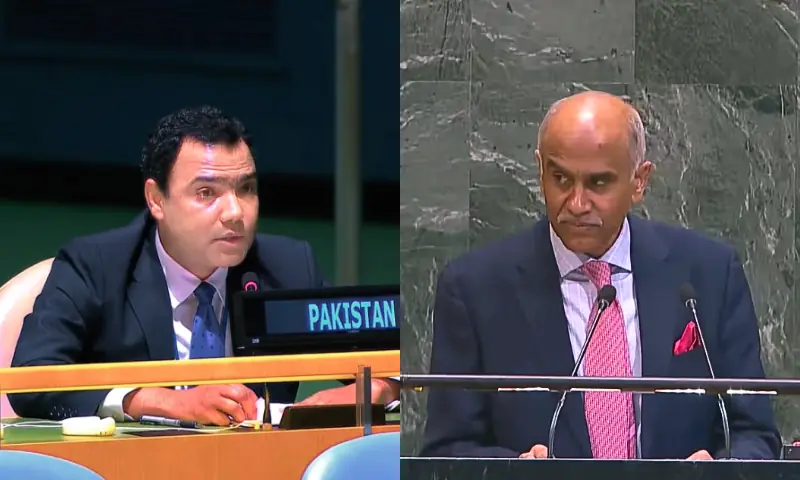
In response, India’s UN envoy Harish Parvathaneni accused Pakistan of misusing UN platforms for what he termed “divisive political interests,” reiterating New Delhi’s position that Jammu and Kashmir “was, is and will always remain an integral and inalienable part of India.”
Exercising the right of reply, Political Coordinator at the Pakistan Mission Gul Qaiser Sarwani rejected the Indian claim, stating that Jammu and Kashmir “remains an internationally recognised dispute on the agenda of the Security Council.”
“No amount of obfuscation can alter the historical, legal and international character of this dispute. Jammu and Kashmir never was, neither is, and nor will ever be so-called an integral part of India,” he said.
He advised the Indian delegation to “carefully read the report rather than denying facts, deflecting attention and misleading the august Assembly,” adding that the Annual Report itself reflects these facts.
Sarwani further said that nearly eight decades after UNSC resolutions calling for a UN-supervised plebiscite, the people of Kashmir continue to be denied their right to self-determination.
He alleged that “arbitrary detentions, restrictions on fundamental freedoms, demographic engineering and other human rights violations continue in Indian illegally occupied Jammu and Kashmir,” adding that these concerns were reflected in a Joint Communication issued by UN Special Procedures on 16 October 2025.
He further argued that India’s failure to implement UNSC resolutions constitutes a violation of its obligations under the UN Charter, including Article 25, which requires member states to accept and carry out Council decisions.
Sarwani also accused India of a “troubling record,” alleging involvement in sponsoring terrorism in Pakistan, state terrorism in IIOJK, assassination campaigns abroad, incitement against minorities, destabilising activities in the region, and violations of international law, including its attempt to hold the Indus Waters Treaty in abeyance.
Continued relevance of Kashmir, Palestine issues
In his remarks, Ambassador Asim Iftikhar Ahmad said the UNSC’s Annual Report 2025 highlights the continued relevance of long-standing disputes on its agenda, including Jammu and Kashmir and the Question of Palestine.
He said Pakistan believes durable peace in South Asia requires a just settlement of the Jammu and Kashmir dispute in accordance with relevant UNSC resolutions and the aspirations of the Kashmiri people, who must be allowed to exercise their right to self-determination.
He noted that more than 20 communications concerning the India-Pakistan Question were brought before the Council during the reporting period, adding that closed consultations were also held under this agenda item in May 2025.
On Palestine, the ambassador called for implementation of UNSC Resolution 2083, adopted in November 2025 and endorsing US President Donald Trump’s peace plan for Gaza, noting that the ongoing crisis in the Occupied Palestinian Territory, particularly Gaza, remains high on the Council’s agenda.
Referring to the unanimous adoption of Pakistan-sponsored Resolution 2788 in July 2025, Ambassador Ahmad said it reflects a shared commitment to peaceful dispute resolution and fuller use of the UN Charter’s mechanisms for conflict prevention and resolution.
He added that Pakistan, as Council President in July 2025, coordinated and drafted the introduction to the UNSC’s Annual Report, aiming to make it “comprehensive, objective, analytical, and consensus-based,” while acknowledging further improvements remain possible.
Underscoring the need for a more democratic and accountable multilateral system, the envoy also expressed concern over the use of veto power and called for reforms within the UNSC.
He opposed the expansion of permanent seats and veto privileges, arguing such steps would undermine reform objectives, and reaffirmed Pakistan’s position for comprehensive UNSC reform encapsulated in the principle: “Reform for all, privilege for none.”
Comments
No comments yet. Be the first to join the discussion!