

Fact check says Attabad Lake has not dried up despite viral videos
A fact check has found that viral claims saying Attabad Lake has dried up are misleading. While recent videos do show exposed sediment and reduced visible water in some areas, researchers and an expert said the changes are tied to natural silting and hydrological factors.

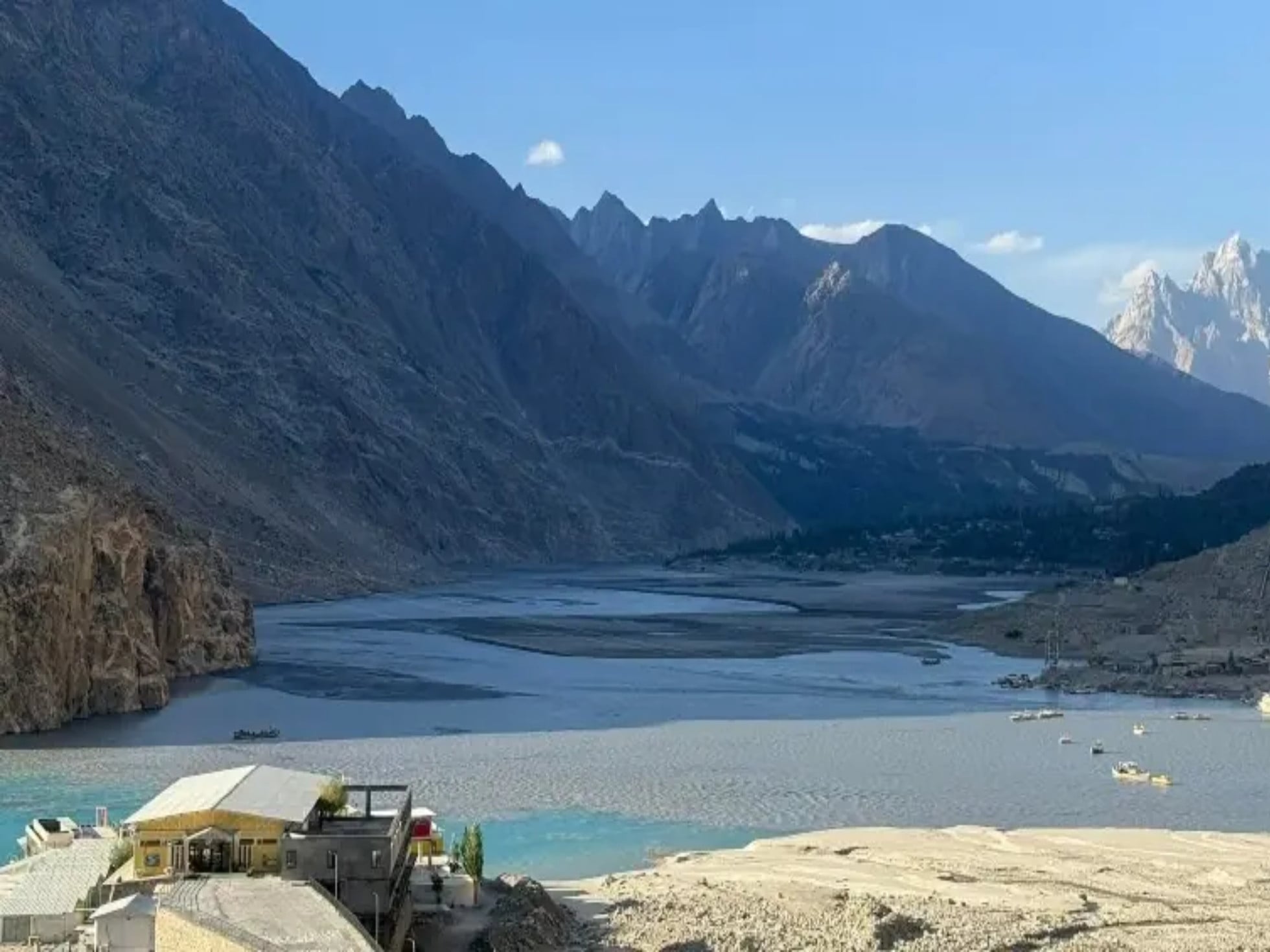
ISLAMABAD: A fact check has found that social media claims portraying Hunza’s Attabad Lake as having completely dried up are misleading, even though recent viral videos do show large exposed stretches where water once covered the area.
The lake, widely known as one of Gilgit-Baltistan’s main tourist attractions, came into existence after a major landslide struck Attabad village in Gojal Valley on January 4, 2010, blocking the Hunza River. In recent days, clips shared across X, Facebook and Instagram showed parts of the lake bed appearing dry, prompting posts that suggested the lake was gone or in severe decline.
According to the fact check, some social media users linked the visuals to environmental degradation in Pakistan’s northern areas, citing increasing tourism, unplanned activity and natural changes. Others, however, said fluctuations in the lake’s appearance were a recurring phenomenon, leading to debate over what the videos actually showed.
Reports and verification
A search for local media coverage found earlier reports highlighting visible changes in the lake’s appearance. The fact check also said Jamil Nagri, Dawn’s correspondent in Gilgit-Baltistan, confirmed that the circulating visuals were authentic.
However, the images should be understood in the context of how Attabad Lake was formed and how it behaves. A 2024 research paper cited in the fact check described Attabad as a landslide-dammed reservoir rather than a typical natural lake. Because it was created when a landslide blocked a river, its water level and shape depend on inflows from the Hunza River and glacier-fed tributaries, rainfall, and outflow management through spillways built to ease pressure on the natural dam.
Research points to sedimentation
The study found that the lake’s surface area gradually decreased between 2010 and 2020. Its authors said sediment had built up in the upstream northern estuary over time, increasing exposed deposits and changing the surrounding landscape.
The paper stated:
"Because of its proximity to the source of the Hunza River, the lake experiences rapid silting. Over time, this natural sedimentation gradually shrinks the active water area and alters the surrounding landscape,"The same broad assessment was supported by a Gilgit-Baltistan-based climate expert, who told iVerify Pakistan by phone that the lake was shrinking because of heavy silt accumulation rather than drying up entirely.
"The lake has not dried up; instead, it is shrinking due to high levels of silt in the lake, which is a natural phenomenon,"He added:
This is something we have seen in most rivers across northern areas.
Explaining the process further, the expert said sand and soil are carried downstream during summer from upstream tributaries, which are the lake’s main water source. When that flow slows as it enters the lake, much of the material settles to the bottom, gradually creating mudflats and sandy patches.
"Water is still coming into the lake; however, it varies due to climatic factors. The huge amount of silt accumulating in the Attabad Lake makes it look like the lake has dried up,"Future changes remain uncertain
The fact check said the lake’s condition cannot be reduced to a simple claim that it has dried up. Future changes in exposed areas will depend on a combination of glacier melt, river inflows, sediment deposition and related hydrological factors, making the lake’s longer-term appearance difficult to predict with certainty.
The report concluded that while the viral footage accurately captures visible changes and exposed sediment, describing Attabad Lake as dried up is misleading.
Comments
No comments yet. Be the first to join the discussion!


