June 3, 2026
Budget postponed amid IMF talks, coalition disputes
The government has delayed the budget to next week as it tries to resolve spending disputes with the IMF and coalition partner PPP. Key issues include development allocations, power subsidies, BISP funding and tariff cuts.

June 3, 2026
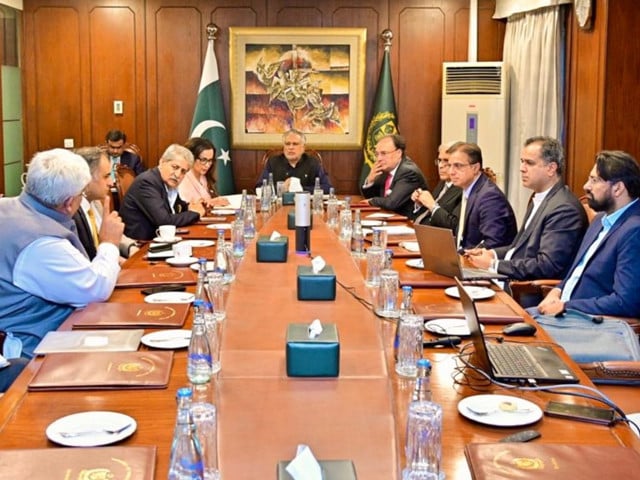
ISLAMABAD: The federal government has pushed the announcement of the new budget to next week after failing to settle key issues related to spending allocations and concerns raised by coalition partners, according to people involved in the discussions.
The delay came as the finance ministry sought the International Monetary Fund's consent this week to revise major expenditure heads just days before the budget's tentative June 5 date. According to the same sources, the IMF was not receptive to the proposals and instead asked the government to share the suggested changes along with their justification.
The National Economic Council meeting, originally set for Wednesday under Prime Minister Shehbaz Sharif, was also postponed because questions remained unresolved over the Public Sector Development Programme, power sector subsidies and how social safety spending under the Benazir Income Support Programme would be treated. The meeting, which was to bring together the provincial chief ministers to clear the national development budget and macroeconomic targets for the next fiscal year, is now expected on Thursday or Friday.
Officials are now considering June 8 or June 10 for the budget presentation, depending on how quickly the pending issues are resolved. The finance ministry did not comment on the reasons for the postponement.
Coalition and spending pressures
One of the unresolved matters is the size of the next fiscal year's development budget and the inclusion of projects proposed by coalition allies. The Pakistan Peoples Party and the government have been holding regular meetings on resource distribution and expenditure allocations, as the PPP's backing remains important for the coalition led by Prime Minister Shehbaz Sharif.
Planning Minister Ahsan Iqbal said on Monday that the government was setting aside Rs87 billion for projects proposed by coalition partners, including schemes of a provincial nature, describing it as the cost of running a coalition arrangement. The PPP had sought bigger allocations for projects it wanted implemented, mainly in Sindh through federal funding.
For the upcoming fiscal year, the government has proposed a federal development budget of Rs1.126 trillion. Ahsan Iqbal said this was negative in real terms by Rs15 billion. According to the sources, the prime minister asked the finance ministry to create room for another Rs200 billion increase in the PSDP.
IMF discussions on BISP and subsidies
The finance ministry approached the IMF to seek flexibility in proposed allocations for power subsidies and the BISP. For the next fiscal year, the total estimated cost of BISP payments and administration stands at Rs838 billion. Another Rs830 billion has been proposed for power subsidies, including Rs300 billion meant to settle the cost of inefficiencies, theft and weak bill recovery.
The government had the option of cutting power subsidies by Rs200 billion, but that could affect either the settlement of old liabilities or the subsidy available to lower-end consumers. According to the sources, Islamabad wanted some reallocation room to create fiscal space for higher development spending and other pressing requirements.
The government also proposed to the IMF that any cut in agreed federal BISP spending for the next fiscal year could be offset through social protection spending by the provinces. The federal government wanted the provinces to assume at least half of the BISP burden, but provincial governments were unwilling to take on that expense.
Separately, the federal government is seeking additional fiscal space of Rs1.7 trillion from the four provinces, mainly Punjab and Sindh, for the next fiscal year through changes linked to the National Finance Commission award and by shifting some expenditure responsibilities, according to those aware of the talks.
NFC and tariff questions still unresolved
Another pending issue concerns the composition of the federal divisible pool to be shared between the Centre and the provinces. The federal government wants customs duties excluded from the divisible pool, arguing that there is no constitutional basis for including them. Some stakeholders, however, oppose removing customs duties from the NFC Award that President Asif Ali Zardari would sign for fiscal year 2026-27.
The NFC's five-year award expired in 2015, and since then it has been extended each year by the president because a new consensus has not been reached among all parties.
At the same time, Pakistan has committed to the IMF that over five years it will bring the overall simple average tariff down from 20.2% in 2025 to 9.7% in 2030. In the first year, tariffs were reduced to 16.56%, and from next month the government is required to lower them further to 13%.
According to the sources, there are differing views inside the government on how quickly trade liberalisation should proceed, with the industry ministry opposed to a sharper reduction. They said a group of independent economists, trade specialists and foreign consultants is urging the government to reduce tariffs by another 3.56% to 13% from next month. The government on Tuesday also postponed the Tariff Policy Board meeting that was due to approve those reductions.
Under the agreed plan with the IMF, the government is committed to eliminating the 5% customs duty slab and abolishing the 2% additional customs duty charged on the 16% duty slab. It also pledged to halve the 4% additional customs duty on the 20% slab and reduce the additional duty by 2% on the highest import slab. The plan also requires a substantial cut in regulatory duty rates in fiscal year 2026-27.
There have also been concerns over the effect of trade liberalisation on the external sector. When the liberalisation was being designed, the World Bank and the commerce ministry had projected a 14% rise in exports and a 7% increase in imports. But during the first 10 months of the current fiscal year, exports fell 6.2% while imports rose by more than 7%.
0 Comments
No comments yet. Be the first to join the discussion!