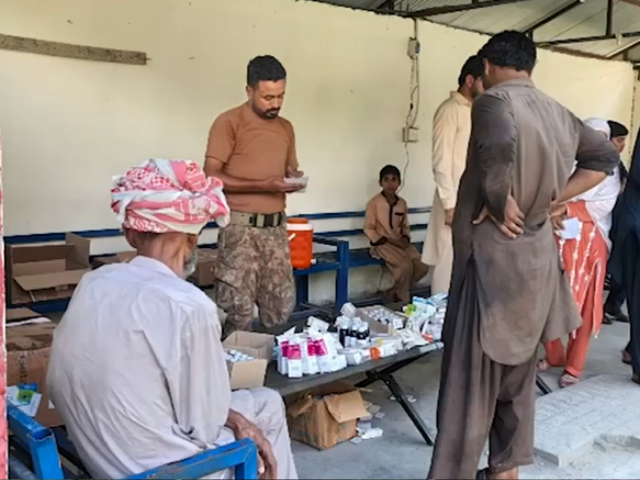
Aid cuts deepen strain on Pakistan’s fragile health system
Shrinking donor support is disrupting family planning, immunisation, HIV and TB services in Pakistan, according to a report cited by Dawn. Health officials and frontline workers say closures, layoffs and funding gaps are weakening preventive care and disease control.


ISLAMABAD: Shrinking international assistance is disrupting key parts of Pakistan’s already overstretched health system, with family planning, immunisation, HIV, tuberculosis and other preventive programmes facing mounting pressure as donor-backed support contracts.
A report by think tank Tabadlab, cited by Dawn, said the global pullback in development assistance since 2025 has hit several health programmes in Pakistan. The country spends 0.9 per cent of its GDP on public health, well below the World Health Organisation’s 5pc benchmark for universal health coverage. Pakistan’s life expectancy stands at 67.3 years, while infant and maternal mortality remain high at 50.1 deaths per 1,000 live births and 155 deaths per 100,000 live births, respectively.
Overseas development assistance has historically covered functions that domestic budgets did not adequately fund, including supply chains, cold storage, procurement, monitoring and technical support across maternal and child health, family planning, immunisation, HIV-AIDS, malaria and TB programmes. Although such aid accounted for around 1pc of public health spending, it supported critical system functions.
Family planning and frontline services
In Lyari, Karachi, community health worker Amna Sualeh told Dawn that the cost of reproductive health services has risen sharply after donor support receded. She said women who once relied on low-cost services are now struggling to access them.
"Before, with donor support, we could perform IUD insertions for just Rs500. Now it costs up to Rs10,000 in private clinics. Many simply can’t afford it anymore," she added.
Many of her clients, most of them working-class mothers, have started missing visits or turning to unsafe alternatives as household incomes come under pressure during Pakistan’s prolonged macroeconomic crisis.
Closures, layoffs and programme reductions
According to the Tabadlab report cited by Dawn, USAID’s suspension led to the closure of more than 60 UNFPA-run health facilities in Khyber Pakhtunkhwa, affecting care for 1.7 million people. It also halted HIV-AIDS programmes in Sindh that had been providing medication to patients.
Reductions in commitments by multilateral donors, including Gavi and the Global Fund, compounded the pressure. Gavi-related drawdowns affected vaccination efforts and led to the layoff of more than 200 vaccinators in Lahore alone. A $27.2 million reduction from the Global Fund cut TB support by half in several provinces, reduced financing for diagnostic kits by 75pc, and put treatment for more than 42,000 HIV-positive patients at risk.
Preventive health programmes under pressure
Preventive healthcare has been hit particularly hard because it has long received limited attention in domestic budgets and from policymakers focused on visible infrastructure. Donor-backed programmes had supported disease surveillance, monitoring systems and training for frontline workers.
Dr Ilyas Gondal, former director general of health in Punjab, told Dawn that donor support had filled major gaps in immunisation, AIDS, hepatitis and TB programmes through training, outreach, awareness material and logistics.
"Preventative healthcare has not been given its due importance here. Donors filled critical gaps in programmes such as the Expanded Programme for Immunisation (EPI), AIDS, Hepatitis and TB through support for training, outreach, health awareness, literature, and logistics. Now, most of that work has stopped across all of these programmes," he added.
He warned that gains in vaccine-preventable disease coverage could be reversed if replacement financing is not arranged.
Ejaz Mahmood, a community health worker at Indus Hospital in Faisalabad, said the Global Fund-backed Infection Prevention and Control programme had trained 10,000 frontline workers nationwide and helped establish IPC committees after the Covid-19 pandemic. He told Dawn that many of those committees are no longer functioning and training has largely stopped.
"No one is there to train health workers anymore. We are already seeing needle-stick injuries rising, with over 111 such cases in Faisalabad this year, along with rising cases of HIV-AIDS and Hepatitis B," he said.
Pakistan has recorded one of the fastest-growing HIV epidemics in the WHO Eastern Mediterranean region, with infections rising by 200pc between 2010 and 2024. Recent media investigations in Punjab and Sindh found multiple HIV outbreaks linked to health facilities, with reused syringes, unscreened blood samples and unsafe medical and waste management practices identified as causes.
Tuberculosis services face a funding gap
Pakistan ranks fifth in the world for TB burden, with nearly 650,000 cases and 70,000 deaths each year, according to figures cited by Dawn. More than half of all cases go undetected. Provincial TB control programmes have long relied on donor financing for service delivery, detection, surveillance and commodity stocks, while provincial governments mainly provided infrastructure.
Dr Sher Afghan, director of the TB Control Programme in Balochistan, described the scale of the shortfall in remarks carried by Dawn.
"We currently face an 80pc funding gap."
The cuts led to a 50pc reduction in programme human resources. Dr Afghan said monitoring and surveillance staff had been halved, prevalence surveys postponed, and capacity-building activities affected.
Comments
No comments yet. Be the first to join the discussion!