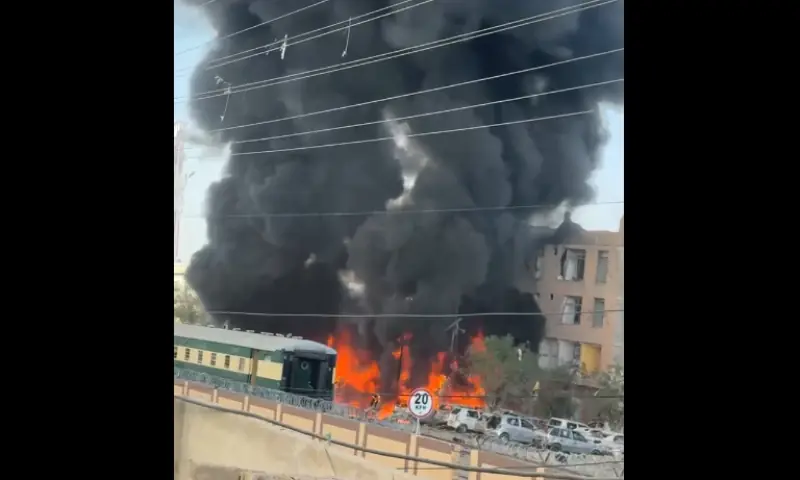
Blood on the tracks
The May 24 Quetta shuttle train bombing killed dozens and injured many, highlighting the human cost of terrorism in Balochistan. Pakistan warns hostile actors exploit instability through proxies and cross-border sanctuaries.

The tragic bombing of a shuttle train in Quetta on May 24 is not merely another security incident in Pakistan’s long and painful struggle against terrorism. It is a stark reminder that while Pakistan continues to advocate regional stability, dialogue, and peace, forces of chaos remain determined to trap the country in cycles of violence and instability. The attack, which claimed dozens of innocent lives and injured many others, once again exposed the human cost of a conflict that Pakistan has been fighting for decades, often alone, often misunderstood, and too often ignored by the international community.
Balochistan has long stood at the center of this struggle. Its vast geography, porous borders, strategic importance, and immense mineral wealth have made it vulnerable not only to internal grievances but also to external manipulation. Militant organizations operating under separatist slogans have repeatedly targeted civilians, infrastructure, security personnel, and national projects aimed at bringing economic opportunity to one of Pakistan’s most underdeveloped regions. The victims are rarely just soldiers, they are ordinary Pakistanis, workers, passengers, families, children, and citizens trying to live normal lives amid persistent uncertainty.
What makes this tragedy even more painful is the broader regional context. Pakistan, despite severe economic pressures and security challenges, has consistently attempted to play a constructive role in reducing tensions in the region. From facilitating diplomatic engagement in Afghanistan to advocating restraint during periods of escalation, Pakistan has repeatedly emphasized dialogue over confrontation. Yet even as the country speaks the language of peace, hostile actors continue to exploit instability through proxies, misinformation, and covert support for militant violence.
Pakistan has repeatedly expressed concerns over the use of Afghan soil by militant organizations hostile to the state. Successive governments and security institutions have pointed to cross-border sanctuaries, arms flows, and operational networks that enable terrorist groups to function with alarming sophistication. The situation has become even more complex after the shifting political realities in Afghanistan, where ungoverned spaces and weak border controls have created opportunities for extremist and separatist outfits to regroup and reorganize.
At the same time, many in Pakistan view unrest in Balochistan through the lens of a wider geopolitical contest. Pakistani officials and security analysts have long alleged that hostile intelligence networks linked to regional rivals seek to destabilize the country by supporting insurgent proxies and fueling separatist narratives. These concerns intensified after the arrest of Kulbhushan Jadhav in 2016, whom Pakistan described as an Indian intelligence operative involved in destabilizing activities inside Balochistan. While such accusations remain contested internationally, within Pakistan they reinforce a broader perception that the country faces not only domestic militancy but also a coordinated hybrid threat aimed at weakening national cohesion and strategic confidence.
The attack on the train also reveals a disturbing evolution in militant tactics. Railways represent more than transportation; they symbolize national connectivity, civilian life, and economic continuity. Attacking trains is an assault on the idea of normalcy itself. It sends a message of fear, attempting to convince citizens that nowhere is safe, not roads, not markets, not schools, and not even public transport. Terrorism succeeds not merely through explosions but through psychological warfare, which is why such incidents carry consequences far beyond the immediate casualties.
This nation has buried thousands of civilians and security personnel in the war against terrorism. Entire communities have suffered displacement. Soldiers have fought in mountains, deserts, and urban centers against ruthless networks backed by ideology, money, and foreign facilitation. Despite this, Pakistan did not collapse. It rebuilt cities devastated by terrorism, restored markets and schools, and dismantled major urban terror networks through determined intelligence and military operations. Most importantly, it preserved the social and institutional structure of the state against extraordinary odds.
The people of Balochistan themselves deserve special recognition in this struggle. Too often, the province is discussed only through the language of insurgency and conflict, while the voices of ordinary Baloch citizens who desire peace, education, development, and dignity are ignored. Extremist groups do not represent the aspirations of the entire province. The future of Balochistan cannot be decided through fear and violence, but through inclusion, investment, political dialogue, and trust-building between the federation and the people.
This tragedy should also compel the international community to rethink selective approaches toward terrorism. Militancy cannot be condemned in one region while ignored in another because of geopolitical convenience. The world must recognize that attacks on Pakistan’s civilians and infrastructure are part of the same global threat that destabilizes regions, fuels extremism, and undermines peace everywhere. No country can fight such evolving transnational threats effectively in isolation.
Pakistan’s response to this attack must be decisive, but also farsighted. Security measures are essential, yet lasting peace can only emerge through stronger intelligence coordination, effective border management, regional cooperation, economic stability, and a firm resistance to extremist ideologies. Terrorism aims to spread fear and fracture society; the real response lies in unity, resilience, and institutional strength.
The smoke rising from the railway tracks in Quetta is not just a sign of tragedy, but a reminder that Pakistan continues to face forces determined to destabilize it. Yet history has shown time and again that despite pain, sacrifice, and repeated attacks, Pakistan has never allowed terror to break its resolve.

The writer has a PhD in Political Science, and is a visiting faculty member at QAU Islamabad. He can be reached at [email protected] and tweets @zafarkhansafdar
View all articles →Comments
No comments yet. Be the first to join the discussion!