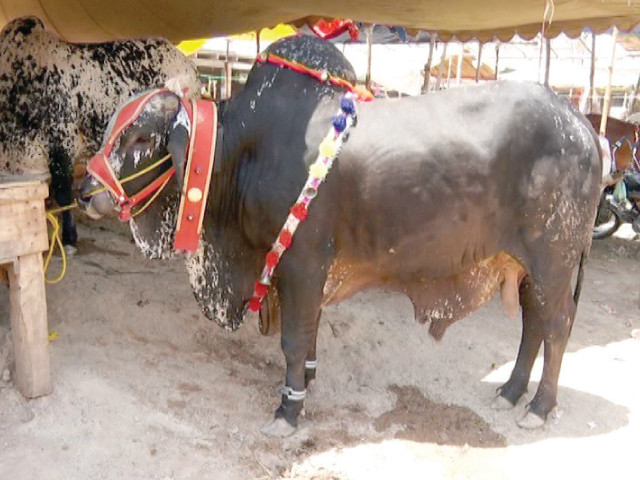
Sacrificial animal prices climb ahead of Eid amid surging inflation
Sacrificial animal prices have risen across cattle markets ahead of Eidul Azha, with traders citing higher input costs and buyers calling the rates excessive. Officials say there is no formal mechanism in Pakistan for fixing animal prices.

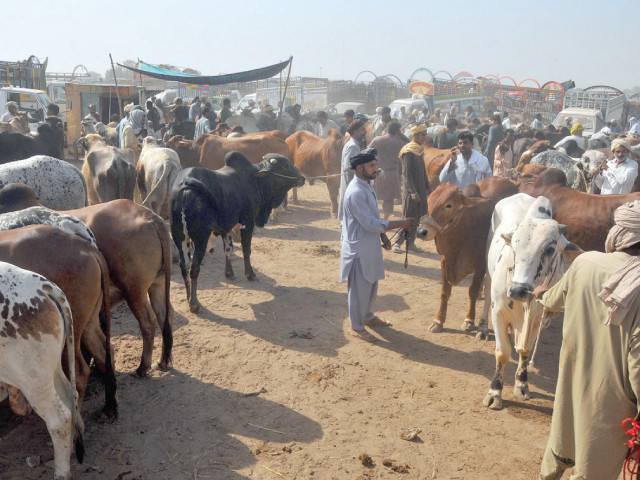
LAHORE: Prices of sacrificial animals have risen sharply in cattle markets ahead of Eidul Azha, with buyers calling the rates unusually high and traders saying mounting costs and market factors are shaping valuations.
According to market participants and officials cited in the report, Pakistan has no official pricing formula or regulatory system for sacrificial animals. Prices are generally determined by a combination of factors, including age, weight, breed, health, appearance and overall demand in the market.
Wide price ranges across animal categories
In cattle markets, ordinary goats and sheep are being sold for between Rs90,000 and Rs125,000, while premium breeds are priced from Rs200,000 to Rs400,000. Medium-sized bulls and calves are available in the range of Rs300,000 to Rs700,000, whereas heavier and high-breed animals are being offered for Rs800,000 to Rs1.5 million. Camel prices are ranging from Rs500,000 to Rs2 million.
Livestock traders said animal prices cannot be fixed using a single benchmark because several characteristics influence value. Abdul Rehman, a trader who brought goats from Bahawalpur, said pricing is decided after evaluating breed, weight, health, size, appearance and demand.
"Animals of superior breeds and attractive appearance usually attract higher demand, which naturally increases their prices," he said.
Another trader, Mian Shafiq, said the rising cost of fodder, medicines, transport and general care has also pushed up prices. He added that animals with stronger demand command better rates, while those with weaker demand are sold at lower prices.
Rana Mubashir Hassan, who owns a breeding farm, said producing quality animals requires heavy spending, which is reflected in market prices. He said farms continue to incur expenses on feed, healthcare and vaccination.
Buyers describe rates as excessive
On the buying side, citizens said the prevailing rates are beyond the reach of many households. Aftab Ahmed described the prices being sought by traders as excessively high.
He added that while sellers set rates according to breed and weight, buyers usually make offers based on what they can afford.
No official price mechanism, says company spokesperson
Sheikh Asad Zafar, spokesperson for the Punjab Cattle Market Management and Development Company, said there is no official formula or standard mechanism for fixing sacrificial animal prices. He said traders independently set rates on the basis of breed, weight, health and appearance, and the company does not interfere in pricing.
He added that action is taken whenever complaints of fraud or deception are received from either buyers or sellers. The spokesperson also advised citizens to purchase animals only from registered cattle markets and designated enclosures established by the company, and to avoid roadside sellers.
Zafar further said sacrificial animals are not officially tagged or numbered under any formal system.
Supply rises but buyer turnout remains subdued
Competition between traders and buyers has intensified across cattle markets. Supply of both small and large sacrificial animals has visibly increased, but buyer turnout remains relatively low. Despite the larger number of animals available, the number of buyers has not risen in the same proportion, creating tougher bargaining over prices and sales.
Comments
No comments yet. Be the first to join the discussion!