

EU-funded justice programme completed successfully
An EU-funded justice sector initiative concluded in Islamabad after five years of work in Islamabad, Balochistan and Khyber Pakhtunkhwa. Officials and stakeholders reviewed its impact on access to justice and rule of law reforms.

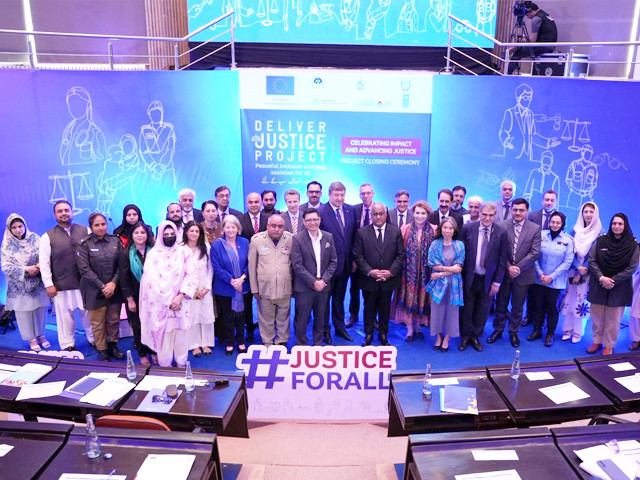
ISLAMABAD: A European Union-funded initiative aimed at improving access to justice and supporting rule of law reforms in Pakistan formally concluded at a ceremony in Islamabad on Thursday after five years of work.
The Deliver Justice Project was jointly carried out by the United Nations Development Programme, the United Nations Office on Drugs and Crime and UN Women. According to the reported details, the programme was implemented in Islamabad, Balochistan and Khyber Pakhtunkhwa, where it worked with justice and security institutions, civil society organisations and local communities.
The closing event brought together representatives from the Supreme Court, the Ministry of Economic Affairs, provincial justice and security institutions, civil society, the media and community groups. Participants reviewed the project’s impact and the partnerships developed during its implementation.
Justice champions from Khyber Pakhtunkhwa and Balochistan were also acknowledged at the ceremony for their role in promoting justice services designed to be more inclusive and easier to access.
Officials highlight justice sector support
European Union Ambassador to Pakistan Raimundas Karoblis said the bloc would continue backing efforts for a justice system in Pakistan that is more efficient, safer and easier for people to access. He added that the project had helped strengthen the justice sector in Khyber Pakhtunkhwa and Balochistan.
The event also included testimonials from women lawyers, women police officers and community members who had benefited from legal awareness activities, legal aid and other justice-related services provided under the initiative.
An interactive Impact Hub was set up to present the project’s achievements, research findings and personal accounts from different programme areas.
Supreme Court judge addresses closing ceremony
Supreme Court Justice Shahid Waheed attended the ceremony as chief guest and spoke about the broader role of justice institutions.
He said such institutions around the world were expected not only to settle disputes, but also to ensure that justice remained accessible, inclusive, transparent and responsive to the needs of society. He further said that in developing democracies, justice institutions had an additional responsibility to safeguard constitutional rights and strengthen public confidence.
The project’s conclusion marked the end of a five-year effort focused on people-centred services and institutional support in parts of Pakistan. The ceremony served as a review of the initiative’s work across its programme areas and highlighted the experiences of those who took part in or benefited from its activities.
The reported details said the programme supported a range of stakeholders, including public institutions, civil society groups and communities, as part of efforts to improve access to justice and advance reforms linked to the rule of law.
Comments
No comments yet. Be the first to join the discussion!


