

AI-led chip race, taxes weigh on mobile phone output
Pakistan's mobile phone manufacturing sector is facing pressure from rising AI-driven component costs and domestic taxes, according to industry representatives. Official data shows local output fell 35% month-on-month in April 2026.

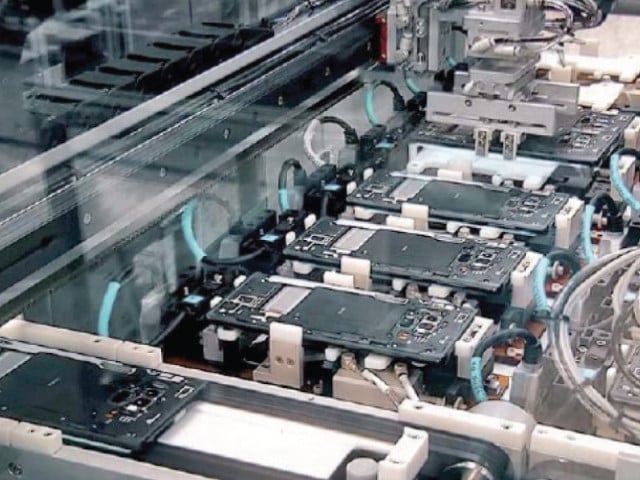
ISLAMABAD: Pakistan's mobile phone manufacturing and assembly sector is facing pressure from higher global component costs linked to the artificial intelligence boom and from domestic taxation, according to industry representatives and official production data.
Industry stakeholders say the worldwide expansion of AI infrastructure and data centres has pushed up the prices of memory chips and other essential electronic parts, increasing handset production costs across markets, including Pakistan. Aamir Allawala, chief executive officer of Tecno Pack Electronics, said industry estimates suggest global memory chip prices have almost doubled as semiconductor supplies are increasingly being directed towards AI-focused data centres.
Attributing the trend to tightening supplies, he said the cost burden is especially difficult for Pakistan's mobile manufacturing industry because it is still at an early stage of development.
Allawala also said the situation worsened after the imposition of an 18% sales tax on mobile phones last year, which he said raised retail prices and weakened consumer demand. According to manufacturers, the combination of more expensive inputs and higher taxation has resulted in stockpiles of unsold inventory and financial losses for assemblers.
Referring to the impact on output, he said the slowdown is now visible in official production figures. "The resulting supply squeeze has raised handset production costs internationally, including in Pakistan, where the industry is still in a nascent stage. The slowdown is now becoming visible in production data as well."
Production declines in April
Figures released by the Pakistan Telecommunication Authority and compiled by Topline Securities show that local mobile phone manufacturing and assembly fell 35% month-on-month in April 2026 to 1.81 million units, compared with 2.79 million units in March.
For the first four months of 2026, cumulative local manufacturing and assembly reached 9.17 million units. Pakistan met 83% of domestic mobile phone demand through local manufacturing and assembly in April, down from 89% in March. The ratio for the January-April 2026 period stood at 85%.
Industry footprint and localisation
Despite the recent decline, industry officials say Pakistan has built a substantial local manufacturing base in recent years. According to the Pakistan Mobile Phone Manufacturers Association, around 37 companies currently hold PTA licences for mobile phone manufacturing and assembly in the country. Of these, roughly 10 to 12 are making smartphones, while the rest are assembling 2G feature phones.
The sector directly employs about 50,000 people in electronics manufacturing and has drawn major international brands including Samsung, Xiaomi, Tecno, Oppo, Vivo, Infinix, Redmi, Realme, Nokia and Honor.
Industry representatives say Pakistan moved from complete reliance on completely built unit imports before 2019 to becoming a domestic assembly base after the Mobile Device Manufacturing Policy was introduced in 2020. According to industry data, more than 90% of phones sold in Pakistan are now manufactured or assembled locally.
Allawala said the country also has export potential because of relatively lower labour costs and the presence of international brands in the local market.
Policy concerns and export incentives
Industry representatives say inconsistent policies and tariff distortions are limiting deeper localisation of components such as chargers, batteries and cables. They identify reverse cascading as a major structural problem, saying raw materials and parts imported for local manufacturing often face duties of 20% to 25%, while some finished imported accessories are subject to lower or zero duties.
According to manufacturers, this makes local production less viable and imported finished products relatively cheaper. Allawala said the current tax structure discourages localisation and reduces the willingness of global brands to invest in local parts manufacturing.
Manufacturers are urging the government to ensure policy continuity, maintain stable tariff and tax structures, remove reverse cascading and support investment in local components, technology transfer and exports. They also say that although Pakistan had earlier announced a 3% research and development allowance for exports, it was never implemented.
The industry is now looking to the upcoming mobile policy for an 8% export allowance to support exports and localisation. Stakeholders have also pointed to India, where a production linked incentive scheme offered incentives of about 10% to manufacturers such as Apple, Samsung and Xiaomi. According to industry representatives, India's policy consistency and tariff support helped it expand localisation and mobile exports to more than $25 billion a year.
Industry projections suggest that sustaining Pakistan's local mobile industry from 2026 to 2031 could save more than $2.3 billion in foreign exchange. They also project that by 2030-31, foreign exchange outflows under a local manufacturing model could remain 32% lower than under a fully import-based model.
Comments
No comments yet. Be the first to join the discussion!


