

Dutch journalists challenge Indian diplomat during Modi visit to The Hague
A press briefing during Narendra Modi’s visit to the Netherlands turned contentious after Dutch journalists questioned an Indian diplomat over concerns about press freedom and minority rights. The exchange followed remarks by Dutch Prime Minister Rob Jetten on developments in India.

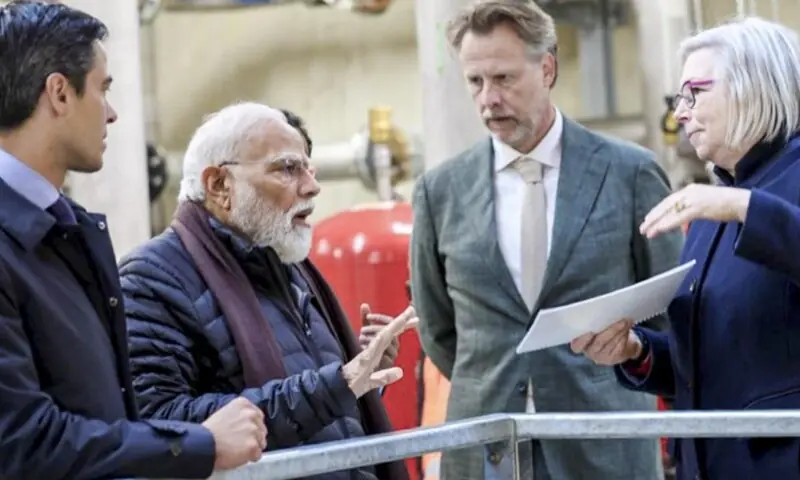
THE HAGUE: A media exchange during Indian Prime Minister Narendra Modi’s official visit to the Netherlands drew attention after Dutch journalists pressed an Indian diplomat over concerns about press freedom and minority rights in India, issues that had also been raised by Dutch Prime Minister Rob Jetten, according to a report originally published by The Wire and reproduced by Dawn.
The visit was officially aimed at upgrading relations between India and the Netherlands to a strategic partnership, with trade, defence and semiconductor technology among the key areas in focus. However, the discussion at a press briefing in The Hague shifted to questions about democratic freedoms in India.
Ahead of a dinner for Modi hosted at Catshuis, the official residence of the Dutch prime minister outside The Hague, Jetten spoke to local reporters and said there were concerns in the Netherlands and other European Union member states about developments in India under Modi’s Bharatiya Janata Party government.
At the official media briefing, Ashwant Nandram of De Volkskrant asked why both prime ministers were not available for questions after the visit, saying this was customary in the Netherlands, and also sought the Indian government’s response to concerns cited by Jetten regarding press freedom and minority rights, including the Muslim community and smaller communities.
India’s Ministry of External Affairs Secretary (West) Sibi George responded by saying the question reflected insufficient understanding of India. "We face these kinds of questions basically because of the lack of understanding of the person who asked the question."
George then referred to India’s population of 1.4 billion people, large voter participation and what he described as a noisy democracy supported by 900 million smartphones. He also said the minority population in India had increased from 11 per cent at independence to more than 20pc, and cited India’s long pluralistic history, saying religions such as Christianity, Islam and Judaism had found refuge there without institutional persecution.
Another Dutch journalist, Merel Thie of NRC, then intervened to say the concerns had not originated with reporters but had been voiced by the Dutch prime minister. "My name is Merel Thie and I’m from the Dutch newspaper NRC. And as you were referring to my colleague, he was actually citing our Prime Minister who said he was worried about minorities and press freedom in India. So, does it upset you when our Prime Minister says this?"
"No, I was giving the factual position of that. So that remains to be the factual position. You need to have more understanding of India to appreciate what India is," George replied.
"So, Prime Minister [Jetten] should have more understanding because it’s not something we say," Thie then responded.
"I haven’t seen that statement. I am referring to the question which, you know, about that topic which was raised about the freedom and I think I have clarified how beautiful a country India is. Thank you," George answered.
Questions over media access
The exchange highlighted the strain between Dutch expectations of open media access and the Indian government’s tightly managed public communications. Throughout more than 12 years in office, Modi has avoided press conferences, including unscripted bilateral press conferences during foreign visits, and has instead generally limited appearances to prepared joint statements with host leaders.
It also referred to a 2023 joint news conference announced by the White House during Modi’s visit to the United States. At the time, a White House official told Reuters it was a big deal because Modi was known for not taking questions from the media in India. Those were the first questions Modi had answered in an open press conference since November 2015 in London.
During that appearance, a Wall Street Journal reporter asked Modi about allegations by human rights groups that his government had discriminated against religious minorities and tried to silence critics, and asked what steps his government would take to improve the rights of Muslims and other minorities and uphold free speech. Modi responded by referring to the constitution.
In the days after that exchange, reporter Sabrina Siddiqui faced intense online harassment and attacks from Hindutva politicians and supporters, prompting a strong condemnation from the Biden administration.
Press freedom ranking cited
The report also cited Reporters Without Borders’ 2026 World Press Freedom Index, released on April 30, which placed India at 157th out of 180 countries.
Dawn noted that the article was originally published by The Wire and reproduced with permission.
Comments
No comments yet. Be the first to join the discussion!


