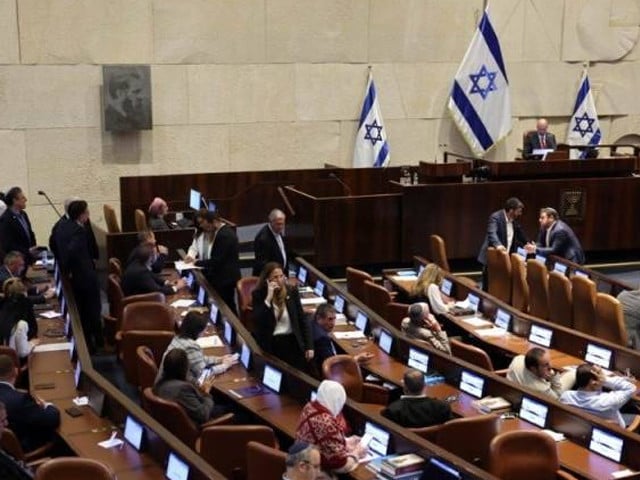
Israel moves closer to snap election after Knesset backs dissolution bill
Israel’s parliament has given initial approval to a bill to dissolve the Knesset, moving the country closer to a snap election. The step comes amid coalition tensions, war on multiple fronts and mounting pressure on Prime Minister Benjamin Netanyahu.

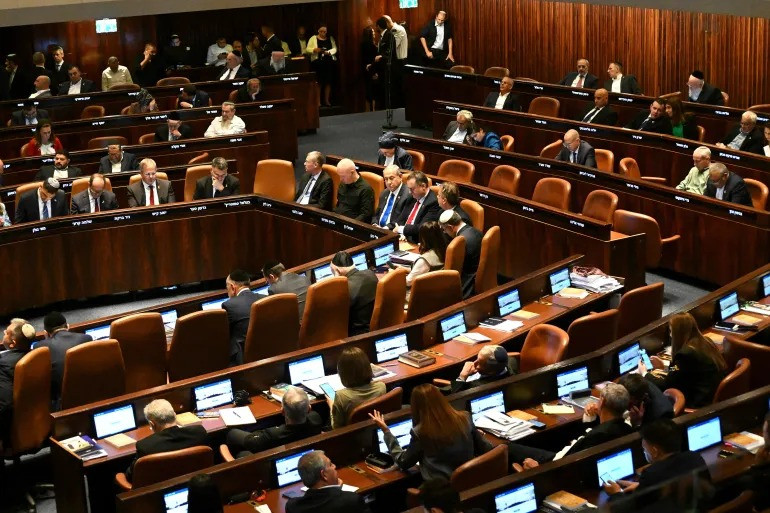
JERUSALEM: Israel took a step closer to an early general election on Wednesday after lawmakers gave initial approval to a bill seeking to dissolve parliament.
The 120-member Knesset voted in a preliminary reading on the proposal to disband itself, with 110 lawmakers supporting the measure and no votes cast against it or recorded abstentions. The bill must still pass further stages before becoming law, a process could take weeks.
If the legislation receives final approval, Israel could go to the polls several weeks before the current deadline of October 27. The bill will now move to committee, where lawmakers are expected to agree on an election date before it returns to the Knesset for final passage.
The move came after Prime Minister Benjamin Netanyahu’s own coalition introduced the dissolution bill. An ultra-Orthodox faction that has traditionally been close to Netanyahu accused him of failing to fulfil a commitment to advance legislation exempting its community from compulsory military service.
Political pressure on Netanyahu
The development comes at a sensitive moment for Netanyahu, who is Israel’s longest-serving prime minister and heads the most right-wing government in the country’s history.
Israel remains engaged in conflict with Hamas in Gaza, Hezbollah in Lebanon and Iran, with those fronts still unstable and potentially influential in any election campaign.
Netanyahu is also still facing a long-running corruption trial. President Isaac Herzog is mediating discussions aimed at securing a plea agreement in the case. Such a deal, could result in Netanyahu, 76, leaving politics.
His health has also drawn attention. Netanyahu recently disclosed that he had been successfully treated for prostate cancer. He was fitted with a pacemaker in 2023.
Polls and coalition uncertainty
Opinion surveys since October 2023 have consistently shown Netanyahu’s governing coalition well short of the numbers needed for a parliamentary majority. Those polling trends suggest he would lose the first national election held since 2023.
At the same time, there remains a possibility that opposition parties would also be unable to assemble a governing coalition. In that scenario, Netanyahu could remain in charge of an interim government until the deadlock is resolved.
The preliminary vote therefore marks an important procedural step, but it does not by itself trigger an immediate election. Further parliamentary approval is still required before the Knesset is dissolved and a final election timetable is set.
Comments
No comments yet. Be the first to join the discussion!