Pakistan, Russia hold strategic stability talks in Moscow amid expanding bilateral cooperation
Pakistan and Russia co-chair the 16th Consultative Group meeting in Moscow, exchanging views on international security, arms control and non-proliferation, and agreeing to hold the 17th round in Islamabad next year.

ISLAMABAD: Pakistan and Russia held high-level strategic consultations in Moscow on international security, arms control and global stability, reflecting the growing coordination between the two countries on regional and global issues.
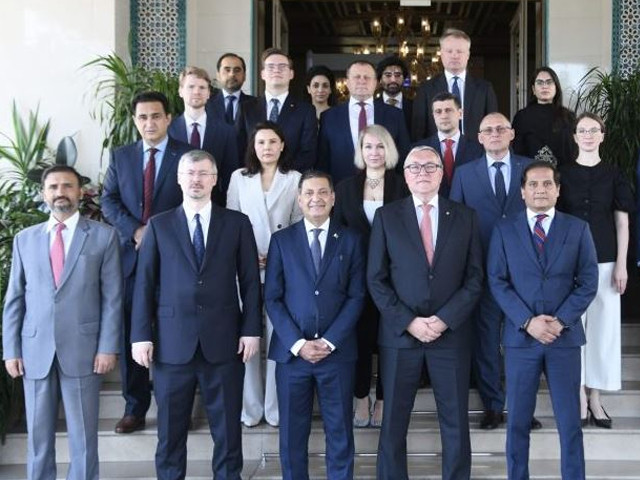
According to a statement issued by the Foreign Office (FO) on Tuesday, Pakistan’s Additional Secretary and Foreign Office Spokesperson Tahir Andrabi co-chaired the 16th meeting of the Pakistan-Russia Consultative Group on Strategic Stability alongside Russian Deputy Foreign Minister Sergey Ryabkov.
The two sides held what the FO described as a “confident and detailed exchange of views” on key international security challenges, including arms control, disarmament and non-proliferation issues.
“The meeting confirmed the affinity of approaches of Russia and Pakistan on most of the discussed issues,” the FO said, adding that both countries reaffirmed their commitment to continuing coordination and engagement at relevant international forums.
Officials from both sides also agreed to hold the 17th round of the strategic dialogue next year in Islamabad, underscoring the continuity of institutional cooperation between the two countries.
The latest talks come at a time when Pakistan and Russia are steadily expanding engagement in energy, trade, regional connectivity and diplomatic coordination.
Last week, Pakistan’s Ambassador to Russia Faisal Niaz Tirmizi said Islamabad was considering increasing oil imports from Russia amid ongoing disruptions linked to tensions in the Strait of Hormuz.
Speaking about Pakistan’s growing energy needs, the envoy noted that the country imports nearly 90 per cent of its energy requirements, largely from Gulf states, and was now actively exploring alternative supply routes and long-term energy partnerships.
“We are also considering future pipeline connectivity from Central Asia and Russia,” Tirmizi said, adding that Pakistan envisioned broader Eurasian integration through transport corridors, railways, pipelines and economic cooperation.
Russia has also publicly appreciated Pakistan’s diplomatic role in regional peace efforts, particularly its mediation initiatives between Iran and the United States amid escalating tensions in the Middle East.
Last month, Deputy Prime Minister and Foreign Minister Ishaq Dar held a telephonic conversation with Russian Foreign Minister Sergey Lavrov, during which both sides discussed coordination at multilateral forums in support of international peace and security.
In recent months, Moscow and Islamabad have further strengthened cooperation in trade and counterterrorism. Earlier this year, Russia opened its seafood market to Pakistan, while Russian President Vladimir Putin reiterated Moscow’s desire to deepen bilateral cooperation, including collaboration against terrorism.
In February, President Putin expressed solidarity with Pakistan following a deadly suicide attack in Islamabad and reaffirmed Russia’s readiness to expand security cooperation.
He had earlier described Pakistan-Russia ties as “mutually beneficial in the truest sense”, noting that cooperation between the two countries was steadily expanding under the framework of the Shanghai Cooperation Organisation and broader regional engagement.
Comments
No comments yet. Be the first to join the discussion!