

Indian court declares Bhojshala mosque complex a temple, ends Friday prayers
A court in India’s Madhya Pradesh has declared the Bhojshala-Kamal Maula mosque complex a Hindu temple, ending a long-standing worship arrangement. The ruling has drawn criticism from Muslim lawyers, politicians and historians.

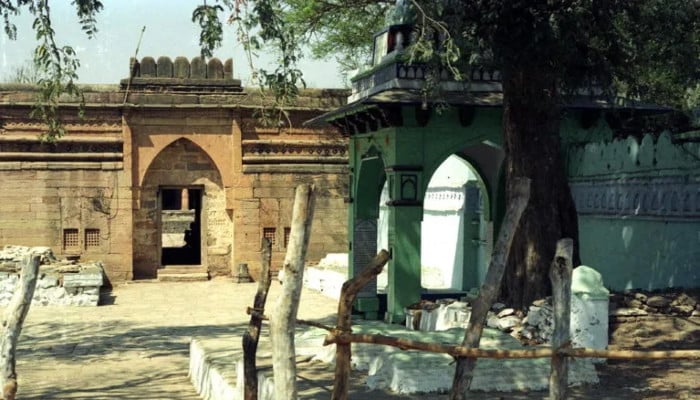
NEW DELHI: A court in India’s Madhya Pradesh has ruled that the disputed Bhojshala-Kamal Maula mosque complex in Dhar district is a Hindu temple, a decision that has ended a two-decade arrangement under which Muslims were allowed to offer Friday prayers at the site.
The Indore bench of the Madhya Pradesh High Court held that the complex was a temple dedicated to goddess Vagdevi, also known as Saraswati. Following the ruling, the Archaeological Survey of India (ASI) issued an order on May 16 permitting Hindu devotees to worship at the site every day.
The new order replaces earlier directions, including a 2003 arrangement that had allowed Hindus to worship on Tuesdays while Muslims could offer Friday prayers. Advocate Vishnu Shankar Jain, who appeared for the Hindu petitioners, said Hindus could now visit and worship at the complex
without any restriction
The ASI said the site would continue to be treated as a protected monument under the Ancient Monuments and Archaeological Sites and Remains Act, 1958. Worship timings would be set by the superintending archaeologist in consultation with the district administration.
Basis of the ruling
The court relied on a 2024 ASI report which, according to Indian media, stated that the Bhojshala-Kamal Maula mosque complex had been built using remains from earlier temples and that the mosque structure was added centuries later.
The court also said the Muslim side could seek land from the state government at another location in Dhar district for the construction of a mosque. Dhar city Qazi Waqar Sadiq indicated that the Muslim petitioners would move the Supreme Court and said the Muslim community did not intend to accept alternative land.
Long-running dispute
The monument has remained the subject of a prolonged dispute. Hindu groups say the site is a temple dedicated to Saraswati, while Muslims maintain that it is the Kamal Maula mosque. According to Al Jazeera, the ruling has effectively placed the mosque out of bounds for Muslims in Dhar, where it had been used for prayers for decades.
The decision has prompted criticism from lawyers representing the Muslim side, as well as historians and politicians, who say it undermines protections for Muslim places of worship in India. Lawyer Ashhar Warsi, who argued the case for the Muslim side, described the verdict as
an erroneous judgement
a clear violation of the established rule of law
Asaduddin Owaisi, a five-time member of parliament, told Al Jazeera that the ruling sent a message of, "grave threat to Muslim places of worship in India. He also said the Babri judgement had opened the floodgates for similar claims. Al Jazeera also quoted historian Audrey Truschke as saying that the present pattern of targeting mosques in India formed part of the entrenched Islamophobia of Hindu nationalism."
Wider context
The dispute comes amid a broader Hindutva campaign focused on medieval mosques and monuments from the Islamic period in India, with campaigners alleging that such structures were built over Hindu temples. These claims have gathered pace since Prime Minister Narendra Modi came to power in 2014.
Comments
No comments yet. Be the first to join the discussion!


