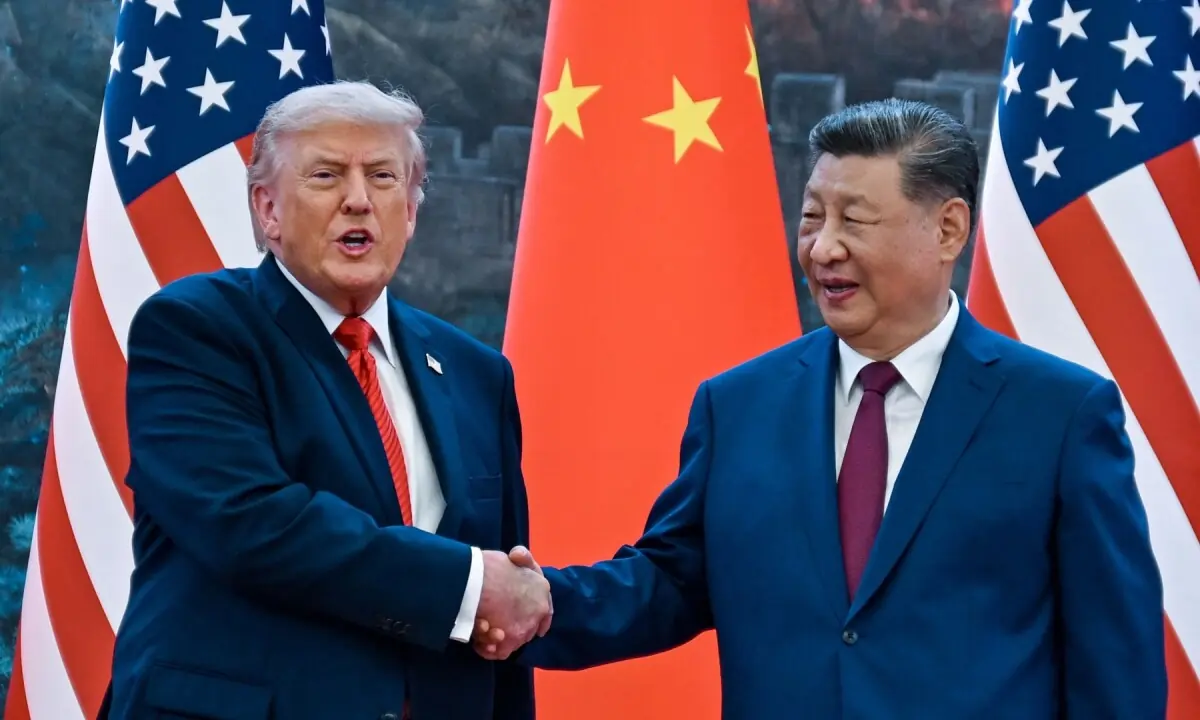
The summit of equals
The Xi–Trump summit goes beyond diplomacy, projecting China as an equal—and sometimes challenger—to US dominance. Analysts note Xi’s confidence, Trump’s weaker leverage, and the limits of tariffs.

Xi Jinping humbles Donald Trump
The recent summit between Chinese President Xi Jinping and US President Donald Trump was far more than a carefully choreographed diplomatic engagement. It was a defining geopolitical moment that signaled a dramatic shift in the global balance of power. For decades, US presidents approached China from a position of unquestioned supremacy, confident that Washington alone shaped the rules of the international order. This summit, however, revealed a different reality: China no longer sees itself as a rising power seeking acceptance from the West. Under Xi Jinping, Beijing now projects itself as an equal— and in some respects, a challenger— to US dominance.
What made the summit remarkable was not merely the optics of statecraft, but the unmistakable confidence with which Xi Jinping engaged Donald Trump. The Chinese leader appeared calm, methodical and strategically disciplined, while Trump, despite his trademark bravado, found himself navigating a political and economic environment far less favourable than during his first presidency. Xi entered the talks with the advantage of preparation, continuity and long-term vision. Trump arrived seeking economic concessions, strategic leverage and political victories that could reinforce his domestic standing. The contrast was visible throughout the summit.
For years, Trump built his political image around confronting China. He launched tariffs, accused Beijing of unfair trade practices and repeatedly framed China as the USA’s greatest economic adversary. Yet the summit demonstrated the limitations of coercive pressure against a country that has transformed itself into an economic, technological and military superpower. Xi Jinping did not approach the negotiations defensively. Instead, he projected the confidence of a leader who believes history is gradually tilting in China’s favour.
The symbolism mattered enormously. Chinese diplomacy traditionally emphasizes patience, stability and national dignity. Xi used the summit to reinforce all three. Beijing ensured that every visual detail underscored China’s stature: the ceremonial welcome, the strategic messaging, the carefully calibrated public statements and the emphasis on “mutual respect.” China was no longer presenting itself as a junior partner in global affairs. It was demanding recognition as a co-equal architect of the international system.
In many ways, Trump walked into a diplomatic environment designed to elevate Xi. The US president sought breakthroughs on trade, investment access and regional stability, but Xi succeeded in reframing the entire conversation around parity between the two powers. That alone represented a strategic victory for Beijing. For decades, Washington insisted that China adapt itself to a US-led order. Now, the summit suggested that the USA itself may have to adjust to a world where China shares— and sometimes contests— global leadership.
Economically, the summit highlighted how deeply interconnected the two nations remain despite years of rivalry. Trump wanted greater market access for US companies, protection for US industries and assurances regarding trade imbalances. Xi, meanwhile, sought stability in economic relations, reduced tariff pressures and a predictable environment for Chinese exports and investments. While both sides announced areas of cooperation, it was China that appeared more composed and less desperate for immediate outcomes.
The summit did not produce a definitive winner in conventional terms, but in the battle of perception, prestige and strategic confidence, Xi Jinping appeared to hold the stronger hand. China no longer approaches the USA as a subordinate power seeking accommodation. Under Xi, it now approaches the USA as an equal— and increasingly, as a rival determined to shape the 21st century on its own terms.
The reality confronting Washington is that economic decoupling from China is far more difficult than political rhetoric suggests. China remains central to global manufacturing, supply chains, rare earth processing and increasingly advanced technologies. Even after years of trade wars and sanctions, US businesses continue to depend heavily on Chinese production networks. Xi understood this leverage and used it carefully. Rather than appearing confrontational, he positioned China as a responsible global economic stakeholder willing to cooperate— provided it is treated with respect.
Another critical outcome of the summit was the strengthening of China’s image across the developing world. Many nations in Asia, Africa, Latin America and the Middle East watched the meeting closely. For these countries, the summit reinforced the perception that the era of uncontested US unipolarity is fading. China’s rise is no longer theoretical; it is visible in infrastructure projects, technological investments, military modernization and diplomatic influence across continents.
Xi Jinping has successfully cultivated an image of China as an alternative center of global power— one that offers investment without political conditions and partnership without overt ideological pressure. Whether this perception fully matches reality is another debate, but diplomatically it has proven highly effective. The summit with Trump strengthened that narrative considerably.
For Trump, the meeting still carried important advantages. He demonstrated to domestic audiences that he could directly engage the world’s most powerful rival and seek practical outcomes rather than engage in endless confrontation. Any easing of trade tensions or improvement in economic cooperation would also benefit US markets and businesses. Trump likely viewed the summit as an opportunity to portray himself as a dealmaker capable of managing strategic competition while avoiding catastrophic conflict.
Yet politically and psychologically, the greater beneficiary appeared to be Xi Jinping. The Chinese president emerged looking steady, disciplined and globally statesmanlike. Trump’s style— improvisational, confrontational and heavily personality-driven— contrasted sharply with Xi’s carefully controlled approach. In diplomatic contests, perception often matters as much as policy, and the perception after the summit was unmistakable: China now possesses the confidence and capacity to stand shoulder-to-shoulder with the USA.
Perhaps the most profound consequence of the summit was what it revealed about the emerging world order. The post-Cold War era was defined by overwhelming US dominance. The USA shaped global finance, military alliances, technological standards and diplomatic norms with limited resistance. China’s rise has fundamentally altered that equation. Today, the world increasingly resembles a dual-power system in which Washington and Beijing compete simultaneously for influence, markets, technology and strategic legitimacy.
Xi Jinping understands that China does not need to defeat the USA militarily to surpass it geopolitically. Beijing’s strategy is broader and more patient: expand economic influence, dominate key technologies, deepen global trade networks, modernize military capabilities and present China as a stable alternative to an often polarized and unpredictable USA. The summit reflected that confidence. Xi was not seeking validation from Trump; he was demonstrating that China no longer requires it.
The meeting also exposed the deeper anxieties within US strategic thinking. Washington recognizes that China’s rise is not temporary. Unlike previous challengers to US power, China combines massive economic strength, technological ambition, industrial capacity and civilizational continuity. This makes Beijing uniquely capable of sustaining long-term competition with the USA.
Ultimately, the summit will likely be remembered less for specific agreements and more for its symbolism. It marked another moment in the steady transition from an US-dominated world toward a more contested global order. Xi Jinping emerged from the meeting having reinforced China’s image as an indispensable world power equal to the USA. Trump, meanwhile, secured dialogue and practical engagement but also confronted a geopolitical reality that many in Washington are still reluctant to fully accept: the age of unquestioned US supremacy is over.
The summit did not produce a definitive winner in conventional terms, but in the battle of perception, prestige and strategic confidence, Xi Jinping appeared to hold the stronger hand. China no longer approaches the USA as a subordinate power seeking accommodation. Under Xi, it now approaches the USA as an equal— and increasingly, as a rival determined to shape the 21st century on its own terms.

The writer is Head of News at Pakistan Today. He has a special focus on current affairs, regional and global connectivity, and counterterrorism. He tweets as @mian_abrar and also can be reached at [email protected]
View all articles →Comments
No comments yet. Be the first to join the discussion!