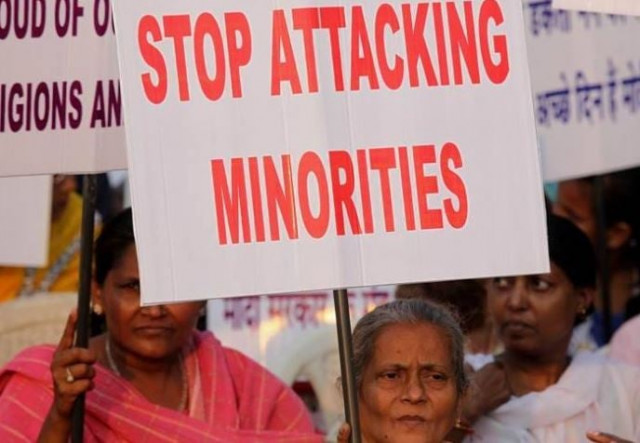
Oppression against minorities in India
USCIRF tells the US State Department to designate India a “country of particular concern,” citing 2026 findings of ongoing, systematic religious freedom violations and minority targeting.

USCIRF has again exposed India
The United States Commission on International Religious Freedom (USCIRF) has once again urged the US State Department to declare India a “country of particular concern,” citing its 2026 assessment and hearing over “ongoing, systematic, and egregious religious freedom conditions” in the country.
Last Thursday, during an in-person hearing on the issue in Washington attended by commissioners, lawmakers, scholars, and legal experts, very pertinent and authentic observations were made on the issue which are worth noting by all those who believe in freedoms given in the UN Charter.
USCIRF Chair Vicky Hartzler said, “India’s trajectory on religious freedom has continued to decline. The Indian government at both the national, state and local levels continues to facilitate and tolerate religious freedom violation through the use of discriminatory legislation, arbitrary detention of religious leaders and failure to intervene in attacks against religious minority communities.”
USCIRF Vice Chair Asif Mahmood in his written observations claimed that “The Indian government has also targeted religious minorities and advocates beyond its borders including assassination attempts predominantly of Sikhs in North America.”
Even the UN is helpless in this regard. Nonetheless it is encouraging to note that there are entities which do not hesitate to highlight criminal behavior by states like India
US House of Representatives member Chris Smith said, “The government of India has long tolerated and, at times, facilitated serious rights violations against religious minorities, especially Christians, Muslims, and Sikhs.”
Stephen Rapp, former ambassador-at-large for global criminal justice, stated, “For the past decade, atrocities against minorities are showing signs of becoming less episodic, more normalized, where everyday violence and open calls to violence have become routine. Throughout this grim history, it is seldom that perpetrators have been held to account, and justice done – deeply entrenching impunity.”
Scholar Angana Chatterji of the University of California, Berkeley, maintained, “Under an authoritarian regime, freedom of religion is imperilled for minority communities. This maelstrom of religionization has progressively polarized ‘majority’ against ‘minority,’ neighbour against neighbour, endangering religious pluralism.”
Raqib Naik, executive director of the Centre for the Study of Organized Hate, said, “State-led violence and dispossession against Muslims have reached an unprecedented scale.”
The foregoing views represent an irrefutable corroboration of the report of the US Commission on International Religious Freedoms. It is worth noting that the commission in its successive annual reports has been highlighting the oppressive treatment meted out to minority communities in India during the last decade, since Narendra Modi became Prime Minister.
The fact is that the communal politics pursued by the Modi government have also tarnished the secular face of India. Modi is a staunch disciple of the RSS ideology of ‘Hindutva’ which is inherently anti-Muslim. He lost no time after coming into power to promulgate anti-Muslim laws as pointed out in the US commission report. To begin with, the BJP government compiled the National Register for Citizens in Assam and deprived nearly two million Muslim residents of Indian citizenship. The government claimed that the exercise had been undertaken to deport undocumented immigrants from neighbouring Bangladesh contrary to the fact that those people had been living in Assam for decades.
In 2019 the Citizenship Amendment Act was promulgated. It was discriminatory against Muslims and consequently sparked violent clashes in which nearly 50 Muslims lost their lives.
Former Indian Prime Minister Manmohan Singh, lamenting the violence in an article published in The Hindu, said, ”Delhi has been subjected to extreme violence over the past few weeks. We have lost nearly 50 of our fellow Indians for no reason. Several hundred people have suffered injuries. Communal tensions have been stoked and flames of religious intolerance fanned by unruly sections of our society, including the political class. University campuses, public places and private homes are bearing the brunt of communal outbursts of violence, reminiscent of the dark periods in India's history. Institutions of law and order have abandoned their dharma to protect citizens. Institutions of justice and the fourth pillar of democracy, the media, have also failed us. With no checks, the fire of social tensions is rapidly spreading across the nation and threatens to char the soul of our nation. It can only be extinguished by the same people who lit it. Every act of sectarian violence is a blemish on Mahatma Gandhi's India. Just in a matter of few years, India has slid rapidly from being a global showcase of a model of economic development through liberal democratic methods to a strife ridden majoritarian state. Government should withdraw or amend the Citizenship Act, end the toxic social climate and foster national unity.”
In September 2024 the Modi government pushed through the parliament a law called ‘The Waqf Properties Amendment Act’ to govern the management of properties and assets donated by Muslims to these bodies over the centuries as charitable giving.
The proposed act seeks to formalize these donations with documentation, raising the spectre of government interference. It was feared that it would empower the government to gain unprecedented control over these religious properties. The proposed inclusion of non-Muslims on Waqf boards, judicial intervention in disputes previously handled by Waqf tribunals, and the creation of a centralized registry within six months all suggest an intrusive role for the government. These changes threaten to alter the delicate balance that has allowed India’s diverse communities to manage their religious affairs with a measure of autonomy. It is pertinent to mention that Congress had expressed staunch opposition to this legislation and has also challenged it in the Supreme Court.
In 2024 alone, there has been an alarming rise in anti-Muslim activities. Two mosques were demolished in Uttarakhand state and the capital New Delhi within days of each other. The ensuing clashes and curfews killed at least six people as religious polarization continues to metastasize across India. Author Nilanjan Mukhopadhyay, commenting on the situation in India, said, “This is the worst possible time to be a Muslim in India. It has become normal to demolish mosques. The stigmatization of Muslims is an old story, seen as a new normal. It no longer shocks the people.”
Regrettably the recommendations of the US Commission and other ground realities have only an academic value. The USA and its allies would never want to annoy or embarrass India with whom they have a strategic alliance in regards to the ‘contain China’ policy. They look at international relations through the prism of their commercial and strategic interests rather than the UN charter. That is a bitter reality. Even the UN is helpless in this regard. Nonetheless it is encouraging to note that there are entities which do not hesitate to highlight criminal behavior by states like India.

Malik Muhammad Ashraf is an academic. He can be contacted at: [email protected].
View all articles →Comments
No comments yet. Be the first to join the discussion!