SBP says recovery remains tied to imports not exports
The State Bank of Pakistan says the economy’s recovery in the first half of FY26 was driven mainly by domestic demand, imports and remittances, while exports and productive investment remained weak.

ISLAMABAD: Pakistan’s economic recovery in the first half of FY26 remained dependent on domestic consumption, imports and workers’ remittances rather than exports and productive investment, the State Bank of Pakistan’s Half-Year Report on the State of Pakistan’s Economy FY26.
The central bank said macroeconomic conditions improved during the first six months of the fiscal year, with GDP growth accelerating to 3.8%, inflation easing and foreign exchange reserves rising to $16.1 billion. However, the recovery was driven mainly by industrial activity, consumer demand and overseas inflows instead of stronger export competitiveness or productivity improvements.
"It has become imperative to move towards an export oriented and investment led growth model," the SBP said in the report.
Large-scale manufacturing returned to growth after three years of contraction, supported chiefly by automobiles, textiles and petroleum products. The SBP said auto sales increased because of lower borrowing costs, stable prices, promotional offers and the introduction of new SUV models. Construction activity also picked up on the back of higher development spending and concessional housing schemes.
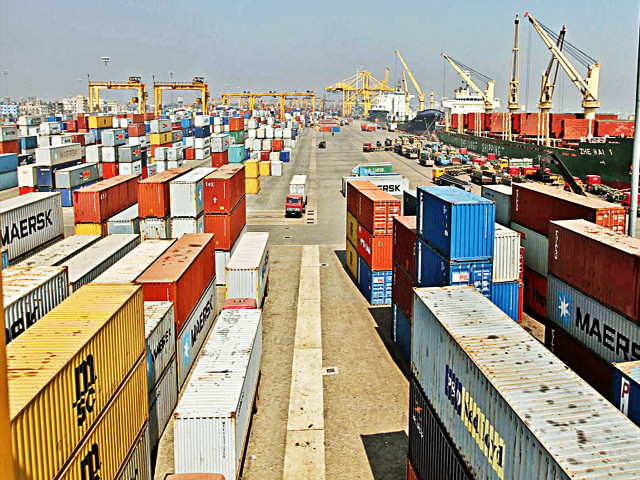
Despite stronger domestic demand and a recovery in global trade, Pakistan’s exports fell in the first half of FY26. It attributed the decline mainly to lower rice exports, limited diversification and weakening competitiveness.
The SBP said imports increased sharply in machinery, transport and metals after tariff rationalisation under the National Tariff Policy 2025-30, pushing the trade deficit up by nearly 36%.
"The downtrend in exports is due to a host of structural issues, including low productivity, policy inconsistencies, weak integration with global value chains, and lack of products and market diversification," it stated.
The central bank said the economy was still heavily reliant on remittances to cover external financing gaps. It reported that remittances reached $19.7 billion in the first half of FY26 and remained the main support for foreign exchange reserves and exchange rate stability despite weak export earnings. Remittances had reached almost $38 billion in the 10 months of FY2026.
The report also pointed to a growing dependence on migration-related income. Referring to findings from the Household Integrated Economic Survey, the SBP said non-labour income, especially remittances and transfers, was becoming increasingly important for household survival.
It also warned that the benefits of the recovery were not evenly shared. Income and consumption disparities widened, indicating that economic gains were distributed unevenly across income groups and that poorer households benefited less from the recovery.
On investment, the SBP said foreign direct investment remained concentrated in lower-risk and market-seeking sectors, including fast-moving consumer goods, automobiles and power, instead of export-oriented industries. It attributed weak productive investment to poor project preparation, policy inconsistency, governance shortcomings and weaknesses in the financial sector.
Reforms in governance, deregulation, trade liberalisation, labour markets and access to credit were necessary to improve productivity and competitiveness and support a shift to an export-oriented, investment-led growth model.
On prices, the SBP said overall consumer inflation slowed to 5.2% in the first half of FY26 due to lower energy prices and exchange rate stability, although core inflation remained elevated. The central bank also said corporate profit margins had played a role in keeping inflationary pressures persistent.
"Firms in some sectors increased product prices despite falling input costs," it said while discussing elevated core inflation.
The SBP said private sector credit growth fell sharply to 0.9% year-on-year by December 2025, compared with 22.8% a year earlier, reflecting weak business appetite for investment despite lower interest rates.
The report also identified climate change as an emerging macroeconomic risk, saying floods, rising temperatures and supply disruptions were already affecting growth and inflation and exposing weak preparedness for climate adaptation.
"Improvement in both the fiscal and current account balances signals that macroeconomic stabilisation efforts are beginning to yield results. The real test now is whether policymakers can convert this temporary stability into sustainable growth through structural reforms, export competitiveness and stronger investment confidence," JS Global Research Head Waqas Ghani Kukaswadia said commenting on the report.
Comments
No comments yet. Be the first to join the discussion!