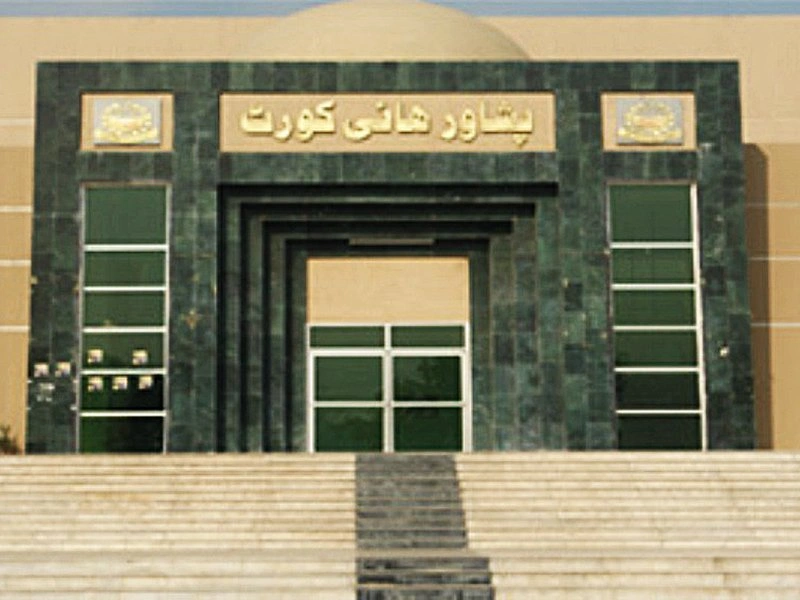
PHC upholds KP law authorising Nadra to issue succession certificates
The Peshawar High Court has upheld the KP law authorising Nadra to issue letters of administration and succession certificates. It also asked provincial authorities to place before the cabinet a proposal to consider an amendment similar to one introduced in Punjab.


PESHAWAR: The Peshawar High Court (PHC) on Thursday upheld a Khyber Pakhtunkhwa law that authorises the National Database and Registration Authority (Nadra), instead of civil courts, to issue letters of administration and succession certificates, ruling that the provincial assembly was constitutionally empowered to legislate on the matter.
A bench comprising PHC Chief Justice S M Attique Shah and Justice Mohammad Ijaz Khan announced that, The provincial assembly of Khyber Pakhtunkhwa was legally and constitutionally competent to enact Khyber Pakhtunkhwa Letters of Administration and Succession Certificate Act, 2021.
The ruling came in two petitions. One had been filed by senior lawyer Saleem Shah, who had asked the court to strike down the law and the rules framed under it as unconstitutional. The other was moved by the Peshawar Bar Association (PBA), which had sought a declaration that Sections 10 and 12 of the law were unconstitutional.
The bench dismissed the petition filed by the lawyer, while disposing of the PBA petition with directions to the provincial authorities to place before the cabinet the question of amending the law in line with changes introduced in Punjab.
"While disposing of the writ petition of Peshawar Bar Association, we in the light of the discussion in para-13 of this judgement direct the chief secretary as well as the secretary of law, parliamentary affairs and human rights department to place before the provincial cabinet to consider an amendment in the existing legal framework as provided by Khyber Pakhtunkhwa Letters of Administration and Succession Certificates Act, 2021, in line with the amendment as made by the provincial government of Punjab through its provincial assembly by enacting an Act namely, Punjab Letters of Administration and Succession Certificates (Amendment) Act, 2025, whereby after the word ‘authority’ the words ‘or a civil court’ has been inserted," it noted.
In its 26-page detailed judgement authored by Justice Ijaz, the bench held that a law enacted by parliament or a provincial assembly could not be invalidated merely because it caused hardship or inconvenience to those subject to it. "An Act of parliament/provincial assembly could not be struck down on ground of hardship or inconvenience of its subject nor the subject could claim as a matter of right that it should be subjected to a particular procedure of his choice."
Under the 2021 law, civil courts were barred from exercising jurisdiction over the subject, and the statute was given overriding effect over other laws in the field. The petitioners had argued that the provincial government enacted the KP Letters of Administration and Succession Certificate Act in 2021, under which Nadra was made responsible for issuing the documents. They said Section 4 of the law created a succession facilitation unit within Nadra for that purpose.
The petitioners also contended that the rules framed under the law introduced a complicated procedure, prescribed forms and a hefty fee structure. According to them, the process had become both difficult and expensive, while Section 10 barred court jurisdiction and Section 12 gave the law overriding effect.
Additional Attorney General Sanaullah and Additional Advocate General Asad Jan Durrani appeared for the federal and provincial governments, respectively, and defended the law. Senior lawyer Aamir Javed appeared as amicus curiae and told the court that the 2021 law had been enacted by the KP Assembly within its legal competence.
Court explains legislative competence
The bench observed that from the creation of Pakistan until the 18th Constitutional Amendment in 2010, the subject of wills, intestacy and succession, except in relation to agricultural land, was part of the concurrent legislative list, allowing both federal and provincial legislatures to make laws on it.
However, the court said that after the 18th Amendment abolished the concurrent list, the subject was not included in the Federal Legislative List. It held that parliament could therefore no longer legislate on the matter because of the restriction contained in Article 142 of the Constitution.
The bench also rejected the petitioners’ contention that the existence of the Succession Act, 1925, prevented the KP Assembly from enacting the 2021 law. It held that the objection was not legally or constitutionally sustainable, observing that the 2021 statute only laid down a procedure for obtaining letters of administration and succession certificates and made verification through digitalised and electronic sources and devices mandatory.
During the hearing, counsel for the PBA produced a copy of an amendment passed by the Punjab Assembly under which civil courts were also empowered alongside Nadra in the relevant Punjab law. They asked the court to direct the KP government to introduce a similar amendment.
The bench said it could not order a legislative body to enact a particular law or amendment, citing the trichotomy of powers under which the legislature legislates, the courts interpret laws and the executive implements them. However, it said the matter could be sent to the provincial government for consideration and placement before the provincial assembly.
Comments
No comments yet. Be the first to join the discussion!