

IHC rules CII cannot decide criminal liability
The Islamabad High Court has ruled that the Council of Islamic Ideology cannot determine criminal liability and set aside its 2025 opinion against Engineer Muhammad Ali Mirza. The court said only the judiciary can decide such matters under the Constitution.

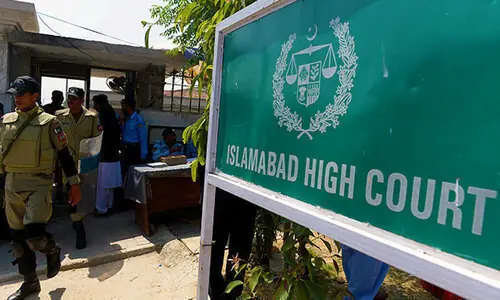
ISLAMABAD: The Islamabad High Court has ruled that the Council of Islamic Ideology (CII) does not have the constitutional authority to determine the criminal liability of any individual, declaring its 2025 opinion against Engineer Muhammad Ali Mirza unlawful.
In a detailed judgement authored by Justice Mohsin Akhtar Kayani before his transfer to the Lahore High Court, the court set aside the CII opinion that had described cleric-turned-YouTuber Engineer Muhammad Ali Mirza as a blasphemer. The order declared that opinion illegal, without lawful authority, and null and void.
The case arose after the National Cyber Crime Investigation Agency (NCCIA), while investigating a blasphemy case against Engineer Mirza, sought what it described as a scholarly opinion from the CII regarding a YouTube statement that formed part of the first information report. The case against him had been registered under Section 295-C of the Pakistan Penal Code and Section 11 of the Prevention of Electronic Crimes Act, 2016. The agency later placed the council’s opinion on record during the investigation.
The petition challenging the CII’s role was filed by Dr Aslam Khaki. During proceedings, Additional Attorney General Usman Ghuman represented the state, while Advocate Hafiz Muhammad Tahir Ayubi appeared for Dr Khaki.
Constitutional limits on CII
The judgement said the council had exceeded the scope of its constitutional role by taking up a reference sent by the NCCIA. According to the court, Articles 229 and 230 of the Constitution confine the CII’s advisory role to offering guidance to the president, governors, parliament and provincial assemblies, and not to courts or investigative bodies.
"The council is not a fact-finding or judicial forum, nor is it its role to determine the criminal liability of an individual, as this authority lies solely with the courts," the order stated.
Justice Kayani also held that by expressing an opinion on a matter linked to pending criminal proceedings, the CII had infringed the accused’s right to a fair trial under Article 10-A of the Constitution.
While the court acknowledged what it called the significant intellectual value of the council’s interpretations of the Qur’an and Sunnah, past practice could not supersede constitutional boundaries.
Court says only judiciary can determine culpability
The judgement further observed that investigative agencies may obtain independent scholarly views for their own understanding, but they cannot treat the CII as if it were a judicial body. Such opinions cannot be given legal effect in criminal proceedings.
"If deemed necessary, the federal government or the CII may approach parliament for appropriate amendments to expand the council’s jurisdiction. Until such amendments are made, any exercise beyond the existing constitutional mandate shall remain without lawful authority," the judgement said.
By allowing the writ petition, the Islamabad High Court effectively rejected the NCCIA’s reliance on the CII opinion in the case and reaffirmed that the courts alone have the authority to determine an individual’s criminal liability.
Comments
No comments yet. Be the first to join the discussion!


